Dogster is reader-supported. When you buy via links on our site, we may earn a commission at no cost to you. Learn more.

Ask the Vet

My Dog Got Stung by a Bee: Our Vet Explains What to Do

Dr. Joe Mallat
Written and fact-checked by Dr. Joe MallatVet Approved
Dr. Joe Mallat
Reviewed & Fact-Checked byDr. Joe MallatDVM (Veterinarian)
Joe is a veterinarian from Sydney, Australia. When he's not working, he enjoys cooking, exercising, and exploring the Australian wilderness. He has worked for 2 years at a mixed-species practice on the mid-north coast of New South Wales, treating animals of all sizes. His areas of particular interest include wound management, internal medicine, and oncology. Joe's love for the profession comes not only from helping dogs, but also from helping their parents and working with wonderful teams of people.View authorThe information is current and up-to-date in accordance with the latest veterinarian research. Learn more
Updated on July 1, 2026
Share
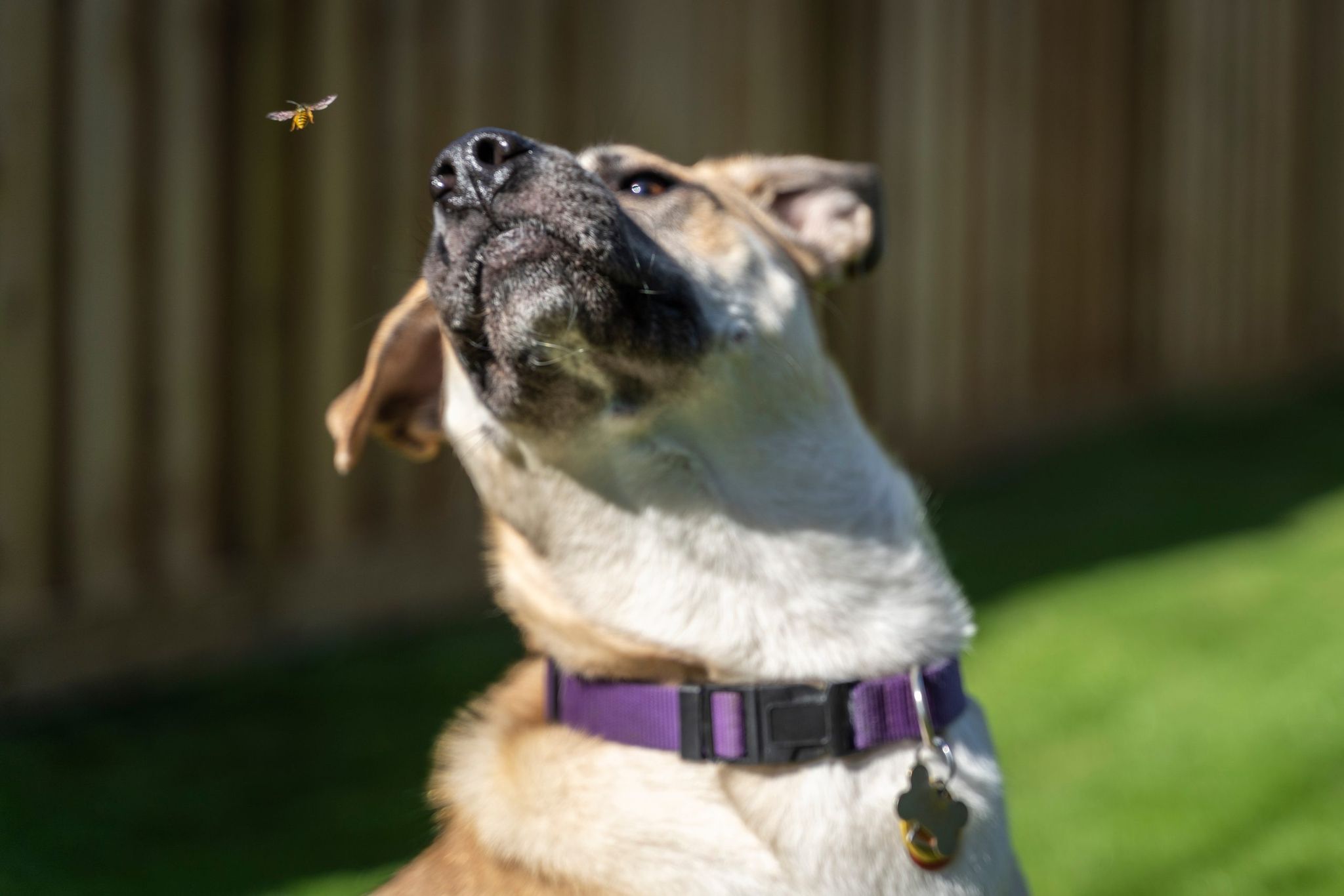
Dog with bee

Any vet who works in an emergency clinic can attest to the surprisingly high frequency at which dogs are stung by bees. Some dogs chase bees and get stung, some dogs tread on bees while walking, and some dogs lick or eat bees found on the ground. The range of reactions is wide—some dogs are completely fine, and other dogs experience life-threatening anaphylaxis.

If you’ve found a bee stinger in your dog or suspect that he or she has been stung by a bee, it’s best to get in touch with a veterinarian. Read on to find out what you should do in the meantime, and what you should be watching for!

divider single dog paw oct 2024

How Do I Know If My Dog Has Been Stung?

Rarely do dog owners actually see their dog get stung by a bee. Sometimes, if you look close enough and part the hair, you’ll locate the stinger, which is a small dark pointy “pin”. Other times, a diagnosis of a bee sting can be presumed based on signs of acute swelling and hives, or anaphylaxis.

Image Credit: Deer worawut, Shutterstock

Risks of Bee Stings in Dogs

As we mentioned, the possible outcomes for a dog stung by a bee are numerous:

  • No reaction or signs of ill-health
  • Localized mild reaction: Pain and swelling at the site of the sting (sometimes resulting in an obvious limp if stepped on)
  • Hypersensitivity: Swelling of the face and hives (“hypersensitivity”)
  • Anaphylaxis: Often resulting in collapse and shock
  • Swelling of the mouth and difficulty breathing (if eaten)

It is impossible to predict which one of these reactions your dog will have. It depends on their immune system, the potency of the bee sting, and possibly previous bee sting episodes. It is also important to note that while anaphylactic reactions may seem very scary, they are fairly rare. 

Here’s What to Do

Follow the below four-step plan to act quickly and get the best outcome for your dog:

  • Remove the stinger (if you can locate it). You will probably need to part the hair to visualize the stinger. It may help to have someone else gently hold or restrain your dog. The stinger can usually be removed with either your fingers or tweezers.
  • Check for any signs of ill-health. This might be vomiting, pain, swelling at the site, hives along their body, or swelling of the face (termed “edema”). Some dogs will appear lethargic, pale or even collapsed.
  • Watch and wait. If your dog seems completely fine, it may be reasonable to adopt a “watch and wait” approach while applying some cold compression to the area. If your dog is showing any of the above signs in (2), proceed to (4).
  • Contact a veterinarian. Arrange to have your dog seen by the vet, who can advise as to what treatment is necessary. Even if it’s just a check-up for your peace of mind, it’s probably worth it.
divider dog paws oct 2024

Frequently Asked Questions (FAQ)

How Are Bee Stings Treated by Vets?

This depends on how your dog presents to the vet clinic, what signs they are showing, and if they have a history of reactions to bees. All treatments will be discussed with you first.

Common treatments administered by vets include:

  • Removing the bee stinger
  • Painkillers and anti-inflammatories
  • Clipping and cleaning the sting site
  • Antihistamines (injections and tablets)
  • Antinausea medications (if vomiting is present)
  • Adrenaline and intravenous fluids (for anaphylaxis)
Image Credit: PRESSLAB, Shutterstock

How Long After a Bee Sting Will a Dog Have a Reaction?

Most bee-sting reactions occur within 30 minutes of the sting. Some dogs will have delayed reactions several hours after the sting. Very few dogs have reactions more than 24 hours after the sting occurs.

What Is the Prognosis for a Dog Stung by a Bee?

Thankfully, most dogs stung by a bee make a full recovery, especially with prompt veterinary intervention. The prognosis is worse with anaphylactic reactions. Severe hives and facial swelling can take several days to subside.

divider dog paws 3 oct 2024

Conclusion

Some dogs get stung by bees while minding their own business; other dogs unknowingly aggravate or eat the bee. If your dog seems completely fine, remove the stinger and monitor closely for signs of a reaction. If your dog seems unwell in any way, don’t hesitate to contact a veterinarian.

Sources

Featured Image Credit: Stefan Malloch, Shutterstock

The Dogster Newsletter

Expert dog care, straight to your inbox

News, insights, expert advice, and everything dog.

No spam — unsubscribe anytime.

By signing up, you agree to our Terms & Conditions and Privacy & Cookies Policy.

Click a star to rate. You can leave written feedback afterwards. (We read all feedback.)

Dr. Joe Mallat DVM (Veterinarian)
Authored by

Dr. Joe Mallat DVM (Veterinarian)

My Dog Ate a Bee & Got Stung: Our Vet Explains What to Do

My Dog Ate a Bee & Got Stung: Our Vet Explains What to Do

If your dog ate a bee or got stung by a bee in the mouth, it's important to remain calm. The odds of a dog dying after a bee sting are very low. However, aller…

Dr. Ashley Darby
By Dr. Ashley Darby · 3 weeks ago
My Dog Ate a Wasp: Our Vet Explains the Risks, Signs & Next Steps

My Dog Ate a Wasp: Our Vet Explains the Risks, Signs & Next Steps

All of us are likely aware of people who have serious allergies to bees and/or wasps and become worried that the same thing can happen to our dog. Oftentimes w…

Dr. Kim Podlecki
By Dr. Kim Podlecki · 3 weeks ago
Are There EpiPens for Dogs? Anaphylaxis Explained (Vet Answer)

Are There EpiPens for Dogs? Anaphylaxis Explained (Vet Answer)

Anaphylaxis is a rare but life-threatening allergic reaction that happens quickly after exposure to the inciting cause and affects various organs of the body.…

Dr. Rachel Ellison
By Dr. Rachel Ellison · 3 weeks ago
Allergy Bumps on Dogs: Our Vet Explains Hives & Urticaria

Allergy Bumps on Dogs: Our Vet Explains Hives & Urticaria

If bumpy red welts have erupted suddenly all over your dog, you may be wondering what they could be. These innocuous little bumps that can cause great discomfo…

Dr. Megan Barnes
By Dr. Megan Barnes · 3 weeks ago

Love Dogs? So Do We! Join the Dogster Community

Stay informed with expert pet care insights delivered straight to your inbox! Discover professional guidance on animal behavior, feeding tips, trusted product picks, and much more.

You may opt-out at any time. View our Privacy Policy for more information.

The Dogster app on a phone