
IV Fluids for Dogs: Our Vet Explains Types & Reasons Why They May Be Needed

In this article
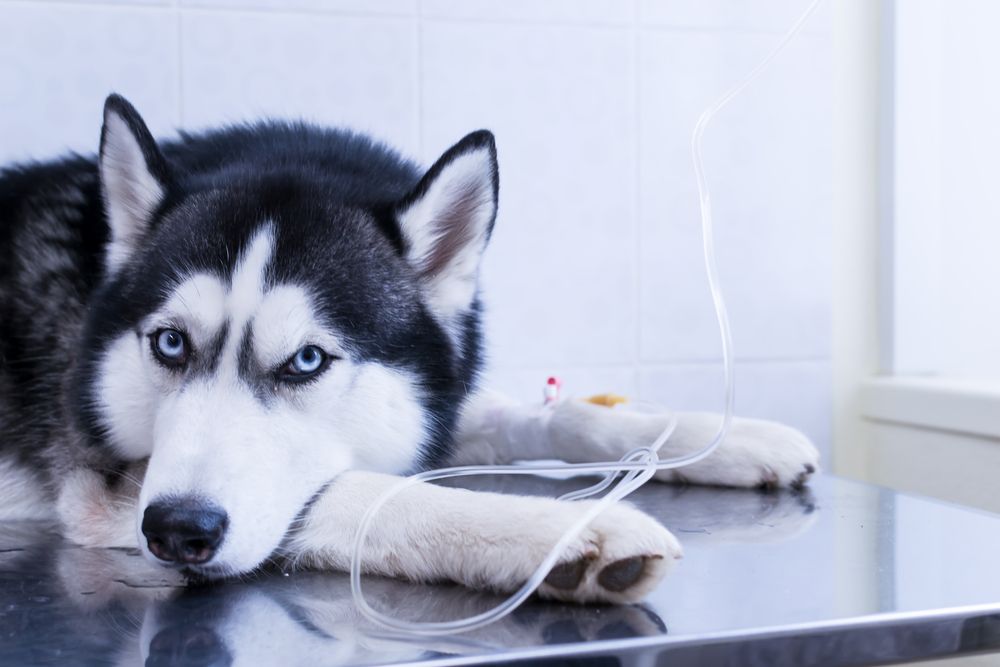
Intravenous (IV) fluids are commonly used in veterinary medicine for dogs who need fluid therapy quickly to either help prevent health problems or to treat disease. The products that are used and given are sterile (free from microorganisms) and administered through a catheter that is stabilized in their vein.
We’ll explore some of the reasons why IV fluids may be recommended, as well as different categories and numerous examples of types. Read on to learn more!

Why IV Fluids May Be Needed

There are numerous reasons your veterinarian may choose to give IV fluids to your dog at a veterinary clinic; some reasons are included below.
- Shock treatment. Shock is a medical emergency that occurs when the body does not have good circulation, which results in not enough oxygen getting to the organs and causes waste products to accumulate. There are a few different kinds of shock, and some can best be treated with a fast and aggressive administration of fluids.
- Rehydration. Dehydration is the body having below-normal fluid (water) levels which can lead the body to not function normally. This can vary in severity and can occur due to decreased intake (from lack of drinking) as well as due to excess fluid loss (such as with vomiting and diarrhea).
- Electrolytes. Some examples of electrolytes are sodium and potassium. These mineral particles carry a positive or negative charge and help the body complete key processes, while glucose is a sugar that serves as the body’s energy source. If the body does not have these substances in certain parameters, various negative health conditions can occur.
- Toxicity treatment. Some toxicities are fully or partially removed via the kidneys, so increasing fluids can help this process happen more quickly as well as decrease the likelihood of injury to the kidney.
- Renal (kidney) support. In cases of kidney failure, there is a loss in kidney function as time goes on and an inability for the kidneys to filter out waste products from the blood. Fluid therapy, which, depending on the situation, can be administered IV as well as other ways. It can be a mainstay in treatment for several reasons such as improving dehydration, replacing lost electrolytes, and helping flush out the kidneys and allow them to filter better.
- Treatment of low blood pressure (hypovolemia). While there are drugs that can be given, IV fluid therapy is often the first step in treatment for this medical condition, as it gives more fluid to help correct or even maintain normal blood pressure.
- Treatment of high body temperature. Also termed hyperthermia, or in cases of an illness that is causing a high temperature (such as a fever), fluid therapy is used as a component to aid in treatment.
- Aid in some types of medication delivery. While medications can come in many forms, some can be added to an IV fluid bag. This ensures not only that the animal is getting it quickly and directly into the vein, but also that it is given continuously at a specific amount and rate. A couple of examples include antibiotics for infections or dextrose to treat blood sugar, but there are numerous other options and uses.

Types Of Fluids in Veterinary Medicine
Fluids come in two broad categories, crystalloids, and colloids, which will be explored below.
Crystalloids
Crystalloids contain water-based solutions that have particles with a smaller molecular weight and can fluctuate throughout the compartments of the body. Within the category of crystalloids, three subcategories include isotonic, hypertonic, and hypotonic.
Isotonic solutions are the most commonly used fluid type used in veterinary medicine and have a similar concentration of dissolved particles as blood. As a result, isotonic fluid does not move into or out of the cells but rather is used to help correct fluid volume. Hypotonic solutions have a lower concentration of dissolved solutes than blood, and therefore ultimately cause water to enter cells.
In contrast, hypertonic solutions have a greater concentration of dissolved particles than the blood and lead to water leaving the cells.
Some examples of crystalloids are:

Colloids
Colloids are water-based solutions that have a large weight of particles that do not allow them to pass freely across the capillary membrane. This means that they can remain in the vasculature and hold or draw fluid with them. Within the category of colloids are two subcategories, natural and synthetic. Some examples are as follows:
Because the specifics of each fluid type selected will be determined by your dog’s veterinarian dependent on history, exam findings, and lab work, they are beyond the scope of this article. Do know that they will tailor what is best suited to your dog and their overall health condition with what is also available at the specific clinic.


Frequently Asked Questions
Can my dog have Liquid IV or Pedialyte?
If your dog is ill or in need of hydration, you should consult with your veterinarian before giving any product orally. Some human-balanced electrolyte solutions may be able to be used at home on a short-term basis if a dog drinks them.
The specific product will need to be evaluated to ensure the individualized ingredients are safe, such as making sure the product does not contain too much sugar, xylitol as a sugar substitute, or other harmful additives for dogs. There are also electrolyte solutions that are made specifically for pets that you may want to consider.
However, please note that if you need to give one of these products more often than on rare occasions, the dog should be seen by a veterinarian; long-term use would not be recommended.

Does it hurt my dog to get IV fluids?
A dog may indeed be confused or stressed to be in the hospital and to be restrained by strangers for catheter placement. There is also some minimal and short-lived discomfort when placing the catheter into the vein, which best case scenario may only last for a couple of seconds.
However, with that being said, the benefit of IV fluids when needed, far outweighs the minor stress and discomfort that accompanies them!
How long will my dog receive IV fluids?
This will depend on each individual case; some dogs may only need IV fluids during a short surgical procedure while others that are more ill may need it for hours to days while being hospitalized.
Your veterinary medical team will be monitoring your dog and looking for signs of when to adjust or discontinue fluids; they will be best acquainted with the specifics of how long they suspect your dog may need them.

Conclusion
Intravenous (or IV) fluid therapy is a common mainstay that is used in veterinary medicine for a myriad of reasons. With your veterinarian selecting the specifics needed for your dog’s situation, you can rest assured that it can be an integral part of either improving or maintaining your dog’s overall health.
Sources
https://www.dvm360.com/view/preventing-and-treating-hypotension-proceedings
https://www.cliniciansbrief.com/article/top-5-indications-fluid-therapy
https://www.amcny.org/blog/2016/02/10/five-reasons-veterinarians-love-fluid-therapy/
https://www.aaha.org/globalassets/02-guidelines/fluid-therapy/fluidtherapy_guidlines_toolkit.pdf
Featured Image Credit: Konstantin Zaykov, Shutterstock
Expert dog care, straight to your inbox
News, insights, expert advice, and everything dog.

No spam — unsubscribe anytime.
By signing up, you agree to our Terms & Conditions and Privacy & Cookies Policy.
How useful was this post?
Click a star to rate. You can leave written feedback afterwards. (We read all feedback.)
Dr. Rachel Ellison DVM (Veterinarian)
Dr. Rachel Ellison lives on a mountain in Utah with her husband, daughter, and son, as well as their animal menagerie— a Bernese Mountain Dog, a Bengal/Siamese mix, and an orange tabby cat, as well as numerous chickens. During her free time, she enjoys being with those she loves, cooking and baking, reading, hiking, sharing her knowledge about cats, and exploring nature and the world around her.


