Do Dogs Get Liver Spots? Our Vet Explains the Causes, Treatment & FAQ

In this article
Your dog has new spots developing, little pigmented areas you know weren't there last year. You think about your grandma's hands and wonder: do dogs get liver spots? If so, what exactly are they? Liver spots are also called age spots, and your dog can develop them like you.

What Are Liver Spots on Dogs?
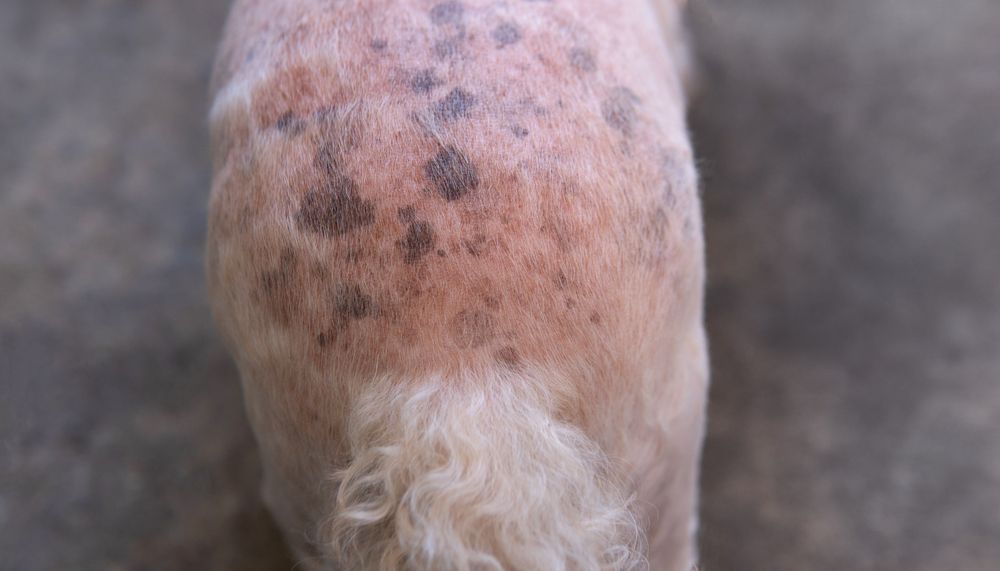
Because dogs have so much fur, liver spots are often not as noticeable. Still, you might see the spots, especially on the thinly-haired region of their belly.
Liver spots are not related to the liver. In people, they're more accurately referred to as solar lentigines. They develop secondary to exposure and subsequent damage from UV rays from the sun. The cells deposit more pigment in these areas, leading to darker spots.

Appearance of Liver Spots on Dogs
Liver or age spots on dogs are flat; they are not raised. They tend to be oval and can be slightly darker than your dog's normal skin tone, such as dark brown. Liver spots are small but may merge over time to become sizable. In dogs, they're more noticeable in areas with minimal hair or in dogs with light fur.
If you think your dog has liver spots, you should contact your vet directly for an assessment. They can provide you with more information and a care plan.
Other Causes of Hyperpigmentation
There are many other reasons your dog can develop discolored, darker skin, also known as hyperpigmentation. If the skin undergoes chronic rubbing, the friction can lead to hyperpigmentation. Allergies and skin infections can also lead to darker-colored skin.
Some other causes include:
- Hypothyroidism
- Demodex (a microscopic skin mite)
- Cushing's disease or pseudo-Cushing's disease

Do You Need to Treat Hyperpigmentation in Dogs?
You'll want to take your dog to the veterinarian if you've noticed new spots to make sure they're not anything to be concerned about. For instance, melanoma can sometimes look like a small, pigmented spot in its early stages.
Your veterinarian may recommend testing such as:
- Skin impression to look for evidence of a yeast or bacterial infection
- Skin scraping to check for microscopic mites
- Skin biopsy to rule out cancer or an autoimmune condition
If there's no evidence of an underlying health issue, your dog likely had an age spot. The good news is that you don't need to treat these. However, consider minimizing the time your dog spends in direct sunlight to reduce the development of age spots.
Some signs that your dog may have a skin issue that needs to be addressed include:
- Itching (pruritus)
- Red skin
- Hair loss (alopecia)
- Lumps or bumps forming
Possible Treatments
If your veterinarian finds evidence of a skin or parasitic infection, they will recommend treatment, such as antibiotics, antifungals, or topical therapy, such as shampoos and conditioners. Allergies can be more challenging to treat. Your dog might need a food trial on a specific diet, such as a hydrolyzed protein diet. Allergy medication, including Cytopoint, Apoquel, or Atopica, could be prescribed. Your dog might also need allergy testing, immunotherapy, or allergy shots.


Frequently Asked Questions (FAQ)
Is it normal for my dog to get spots?
It can be relatively normal for your dog to develop some spots. You'll want to check with your veterinarian to ensure there is no underlying cause, such as skin allergies or a skin infection that needs to be treated and controlled to minimize recurrence.
Are liver spots on dogs harmful?
Liver spots are not harmful to your dog. They are small areas of darker pigment on the skin. If there is an underlying cause for the hyperpigmentation, such as allergies, that can cause issues for your pup.
Conclusion
Liver spots are a relatively common part of the aging process, generally occurring secondary to sun exposure. If your dog is itching or has evidence of discomfort, the spots are likely caused by something else, and your veterinarian may need to investigate and develop a treatment plan.
Sources
Featured Image Credit: 9gifts, Shutterstock
Expert dog care, straight to your inbox
News, insights, expert advice, and everything dog.

No spam — unsubscribe anytime.
By signing up, you agree to our Terms & Conditions and Privacy & Cookies Policy.
How useful was this post?
Click a star to rate. You can leave written feedback afterwards. (We read all feedback.)
Dr. Samantha Devine DVM (Veterinarian)
Dr. Samantha Devine is a practicing veterinarian who enjoys caring for animals and sharing her knowledge with pet owners. Preventative care, ranging from nutrition to vaccination, is her specialty and passion!
With over 12 years of veterinary experience, Dr. Devine has extensive knowledge to share about small animal medicine, horses, aquatic species, and even zoo animals. She has also been writing for online pet sites for most of that time.