How Often Should I Deworm My Dog? Our Vet Explains When, Timings & Schedule

In this article
Worms are common parasites that can infest a dog’s digestive system and, in the case of heartworms, even their blood vessels. Parasite prevention is an important part of keeping your dog healthy. Fortunately, there is a vast number of medications that are safe and effective in protecting your dog from worms.
However, this variety of medication and information can sometimes be confusing for dog owners. Adult dogs can be dewormed every month to 3 months, depending on the schedule you choose. However, puppies need to be dewormed more frequently.
In this article, we will discuss worming schedules for dogs and puppies, different options for keeping your dog safe against worms, the types of products you can use, and a summary of the various worms that dogs can pick up. When thinking about parasite prevention, you should also consider prevention for external parasites such as fleas and ticks.

Puppy Deworming Schedule
Pups under 6 months old have a unique deworming schedule since they are more susceptible to the parasites. Over the age of 6 months, pups can be started on one of the adult deworming schedules. However, until then, you should deworm your puppy more frequently. Here is the recommended schedule for puppies, along with the timing of their vaccinations:
| Age | Treatment |
| 2 weeks | Dewormer |
| 4 weeks | Dewormer |
| 6 weeks | Dewormer |
| 8 weeks | Dewormer and first vaccination |
| 10 weeks | Dewormer |
| 3 months | Dewormer and second vaccination |
| 4 months | Dewormer and third vaccination |
| 5 months | Dewormer |
| 6 months | Dewormer |

Product Examples
Your veterinarian will likely prescribe parasite prevention for your puppy and may recommend different medications at different times. However, if you purchase it yourself, you should look for products that cover all the necessary parasites and are safe to administer at your pup’s age.
In general, puppies can start receiving heartworm, flea, and tick prevention at 8–12 weeks old. Read the product description carefully to ensure it’s right for your dog, but some good products to look at include:
- NexGard PLUS Chew for Dogs
- Simparica Trio Chewable Tablet for Dogs
- Drontal Plus Tablet for Small Dogs & Puppies
- Revolution Topical Solution for Kittens & Puppies
- PetArmor Sure Shot 2X Dewormer for Hookworms & Roundworms for Dogs
Adult Dog Deworming Schedules
While there are 101 combinations of medication you can use to kill all the parasites your dog needs protection from, there are two different schedules for deworming. It all depends on how you choose to prevent heartworms in your dog.

Yearly Heartworm Preventative Deworming Schedule
This worming schedule starts with an injection called Proheart, which is an injection of moxidectin that protects your dog against heartworm for a full year or 6 months, depending on which injection is given.
Your veterinarian will usually prescribe and administer this medication during routine checkups. Dogs with Proheart on board will still need medication to kill intestinal worms. It is typically given every 3 months unless your veterinarian instructs otherwise.
Here is an example of a deworming schedule for a dog that receives Proheart 12 in January:
| Date | Treatment |
| January | Proheart 12 and intestinal dewormer |
| February | No treatment |
| March | No treatment |
| April | Intestinal dewormer |
| May | No treatment |
| June | No treatment |
| July | Intestinal dewormer |
| August | No treatment |
| September | No treatment |
| October | Intestinal dewormer |
| November | No treatment |
| December | No treatment |
Product Examples
Every 3 months, you should administer a deworming medication to your dog. You should add flea and tick prevention to this schedule for complete parasite coverage. Some of the best deworming options for dogs on this schedule include:
- Elanco Quad Dewormer for Hookworms, Roundworms, Tapeworms & Whipworms for Large Breed Dogs, Medium Breed Dogs, or Small Breed Dogs
- Drontal Plus Chewable Tablet for Large Dogs, Medium Dogs, or Small Dogs & Puppies
- PetArmor 7 Way Dewormer for Hookworms, Roundworms & Tapeworms for Medium & Large Breed Dogs or Small Breed Dogs
- Virbantel Chewable Flavored Tablets for Medium & Large Dogs or Small Dogs

Monthly Heartworm Preventative Deworming Schedule
If you choose to administer heartworm prevention with a tablet, you must deworm your dog every month. You should ensure the product you use kills heartworms. For this schedule, you should be more accurate with the dates you give the tablets. Here is an example of a deworming schedule involving monthly treatments:
| Date | Treatment |
| 1st January | Monthly all-wormer |
| 1st February | Monthly all-wormer |
| 1st March | Monthly all-wormer |
| 1st April | Monthly all-wormer |
| 1st May | Monthly all-wormer |
| 1st June | Monthly all-wormer |
| 1st July | Monthly all-wormer |
| 1st August | Monthly all-wormer |
| 1st September | Monthly all-wormer |
| 1st October | Monthly all-wormer |
| 1st November | Monthly all-wormer |
| 1st December | Monthly all-wormer |
Product Examples
Regarding monthly dewormers that cover heartworm, you can get a product designed for this purpose only or convenient treatments that include external parasite prevention, too.
Keep in mind these products don’t always kill tapeworms, so depending on your dog’s exposure to tapeworms, you may need to use an additional product every 3 months. You could also purchase a separate product that covers external parasites. Some good products to look at include:
- Simparica Trio Chewable Tablet for Dogs
- NexGard PLUS Chew for Dogs
- Interceptor Plus Chew for Dogs
- Tri-Heart Plus Chewable Tablet for Dogs
- Advantage Multi Topical Solution for Dogs
- Sentinel Tablet for Dogs
- Sentinel Spectrum Chew for Dogs
- Trifexis Chewable Tablet for Dogs
- Iverhart Plus Chewable Tablet for Dogs
- Heartgard Plus Chew for Dogs

Types of Worms in Dogs
Since few products cover every type of worm, it’s helpful to understand these parasites. The five main worms are:
- Heartworm: Heartworms are unique parasitic worms that infect dogs through a mosquito bite. They live in the major blood vessels around the heart and lungs, as well as in the heart itself. Heartworm infection can be fatal, even with treatment, so prevention is essential.
- Hookworm: Hookworms are tiny worms that latch onto the intestinal wall, feeding on blood, which can lead to anemia, especially in puppies. A dog can pick up hookworms from another dog's poop, and puppies can be infected through their mother’s milk. While they don’t usually cause as severe problems in adult dogs, they can still lead to gastrointestinal upsets, weakness, and intestinal bleeding.
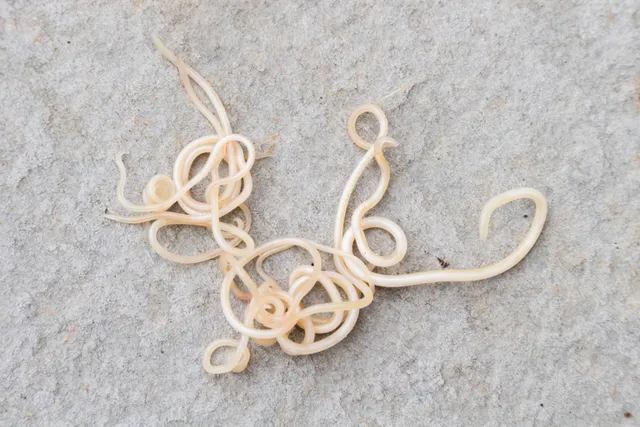
- Roundworm: Roundworms are very common, and dogs can be infected through poop or by their mother, similar to hookworms. The worms are several inches long and white. They can be seen in poop and vomit and cause diarrhea and abdominal swelling.
- Tapeworm: Tapeworms are transmitted to dogs by an intermediate host such as a flea, rodent, lizard, or farm animal. When the dog eats the body of an infected intermediate host, they become infected. Tapeworms release eggs in segments that look like grains of rice.
- Whipworm: Whipworms are tiny worms that live in the large intestine. They spread between dogs by laying eggs which come out in the poop to be ingested by another dog. In large numbers, whipworms can cause weight loss, digestive upsets, and malnutrition.
Final Thoughts
As you can see, the ideal deworming schedule varies from dog to dog. Some products kill external parasites such as fleas and ticks in addition to worms, which can be very convenient. Read the product label carefully to know which parasites it covers, how often you must treat your dog, and the safety information.
Since it can be complicated to ensure your dog has all the necessary coverage, and heartworm prevention requires a veterinary prescription, you should talk to your vet about parasite prevention. They can also make sure you aren’t unnecessarily doubling up on parasite prevention!
Sources
Featured Image Credit: Dmitriev Mikhail, Shutterstock
Expert dog care, straight to your inbox
News, insights, expert advice, and everything dog.

No spam — unsubscribe anytime.
By signing up, you agree to our Terms & Conditions and Privacy & Cookies Policy.
How useful was this post?
Click a star to rate. You can leave written feedback afterwards. (We read all feedback.)
Dr. Ashley Darby BVSc (Veterinarian)
Dr. Ashley has worked in mixed and small animal emergency clinics and general practice ever since 2017 after studying Sydney University. She grew up in South Africa and England before moving to Australia, and her passion for animals came from many childhood safaris in the Kruger National Park.
Ash lives with her husband, two happy Springer Spaniels, and one very patient black cat. She also competes in equestrian sports with her horse, Atlas.