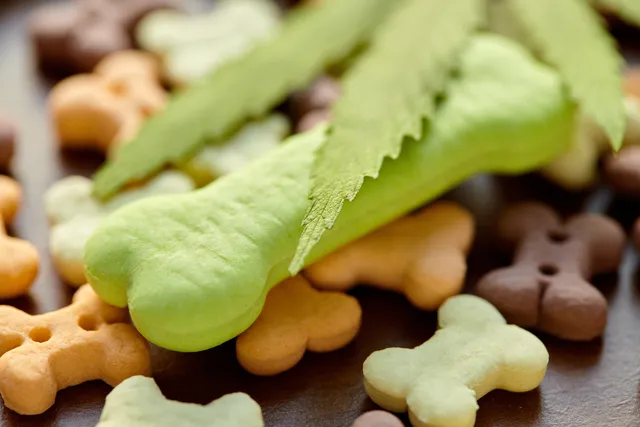
Debunking Myths About CBD Pet Chews (Vet Answer)

In this article
One of the great ironies of modern medicine is watching clinicians (me included) who have considered alternative and ancient therapies to be less advanced, and therefore inferior, discover that there may be some therapeutic benefits to some of the alternative treatments we have been dismissing for so long.
There are techniques that have been around for millennia that actually have a firm basis in physiology and embryology, even if those developing them didn’t specifically know this at the time. Therapies like acupuncture, aromatherapy, reflexology, and dietary manipulation and supplementation that have previously been dismissed as unproven, unscientific, and ineffective, are being slowly welcomed into mainstream medicine, along with a more holistic approach to treatment.
This “whole body” approach to treating, managing, and preventing disease is also being embraced in veterinary practice, but we still have a long way to go. For many of us, the primary concern about CBD pet chews is safety, but our research suggests that we ought to also be looking closely at whether or not they truly contain CBD.

How Can CBD Help My Dog?
The application of CBD products on dogs (and humans) targets receptors CB1 and CB2 in the endocannabinoid system (ECS), which is believed to play a role in a number of different pathways, including mood, inflammation, and pain. Just how significant a role the ECS plays is not yet fully known. From what is currently understood, there is reason to believe that CBD may have a positive effect on inflammatory conditions, arthritis, anxiety, seizures, and pain.

Myths and Realities of CBD for Pets
There is a phrase I always fall back on when I talk to clients about adding supplements to their pets’ diet: If it won’t hurt but it might help, it’s worth a try. At this stage, there are no major indications of CBD being harmful when used appropriately. However, there is still a lot we don’t know.
Let’s look at this overview of myths that are worth keeping in mind before you start your dog on CBD:
1. Myth: CBD Makes Your Pet Feel High
CBD will not make your dog “high.” The THC levels in over-the-counter CBD products are too low to have any psychoactive effects.
2. Myth: CBD Is Not Safe for Dogs
The safety of CBD is not guaranteed. There are yet to be extensive trials to address the long-term effects of CBD products on dogs and, in particular, its interaction with existing health conditions and medications.

3. Myth: Hemp Oil and CBD Oil Are the Same Thing
Many dog chews contain hemp oil as the main ingredient, not CBD oil, so you need to shop carefully.
4. Myth: The Dose Doesn’t Matter
Many CBD chews use doses that are significantly lower than those found to be safe and effective during scientific studies.
Holistic Opportunities
The benefits of acupuncture, food supplements, and low-allergen diets are fairly widely accepted within the veterinary community, with their results being relatively measurable. More recently, cannabidiol (CBD) has started to work its way onto the shelves alongside well-established players like glucosamine, chondroitin, omega-3, and L-tryptophan, but its illicit background has placed it under more intense scrutiny than the myriad other substances available on the market.
Compounds such as psilocybin, LSD, and even MDMA, are being intensely researched for their considerable benefits to human mental health, but their historical use (or more accurately, misuse) has made it incredibly difficult to cut through the red tape to reach the testing phase, let alone clinical trials and introduction to the pharmaceutical market.
One of the biggest stumbling blocks for vets has been the lack of scientific data about the applications, doses, and effects of cannabinoids on pets, but even that is changing. More researchers and clinicians are becoming open to the use of CBD in pets, with many even going as far as to say that there are clear benefits to using cannabinoids for the treatment of conditions such as osteoarthritis, atopic dermatitis, and seizure disorders.
One of the biggest challenges facing the use of these products in veterinary medicine is the lack of federal regulation and approval of these products. On top of that, there has been a lack of standardized dosing for CBD products, with most dog owners and vets applying a “trial and error” approach. However, several recent studies (1, 2) have established a safe and therapeutic dose of 4mg/kg (1.8mg/lb.) over a period of 6 months. But just like with humans, individual responses between individuals can be quite variable, and unlike humans, our canine patients cannot describe how these products make them feel, so we would be wise to start at lower doses and increase slowly.
While much ground has been gained in exploring the potential of CBD, it will likely be a very long time before we will see standardized doses in our veterinary formularies.

Hemp vs. Marijuana
If the idea of using cannabis in dogs conjures up images of super chilled pooches kicking back as they pass around a spliff, you might want to reserve those particular stereotypes for the dog with the double G, as they're neither accurate nor what we are aiming for. One only has to see the haunted looks in the eyes of a dog who has accidentally ingested someone's secret stash to know that recreational “weed” is not something in which our dogs enjoy partaking.
The most potent active component of the cannabis plant is delta-9-tetrahydrocannabinol (THC). Products containing more than 0.3% THC are classified as marijuana, which is classed as a controlled substance, with laws regarding its use differing between states and countries. Products with less than 0.3% THC are referred to as hemp, which has been deregulated for use in food and supplements. This is the form you will find in pet treats.
Hemp Seed Oil vs. CBD Oil
Most CBD pet treats contain hemp seed oil and or hemp seed powder, usually alongside a list of additional ingredients, depending on the purpose of the treat. For example, a calming treat may contain valerian, melatonin, tryptophan, and chamomile, while a treat formulated for joint support may also contain glucosamine, chondroitin, omega-3, and turmeric.
Hemp seed oil products are considered to be beneficial from a nutritional standpoint but are not recognized as being particularly powerful against arthritis, pain, or seizures. The rather wide and varied dosages listed on these types of products also suggest a lack of potency. Notably absent from the ingredients listed on these treats is CBD.
CBD oil in liquid or capsule form is not typically formulated for pets, meaning you need to be careful when working out dosages for your dogs. This is, however, the product that is most likely to provide your pet with any appreciable therapeutic effects.
Genuine CBD pet chews are still in their infancy, with the deregulation of the use of hemp products in pet foods only occurring in 2018. Pet chews that do contain CBD tend to use doses of around 0.1mg/lb., which is unlikely to have a significant therapeutic effect.
Final Thoughts
The potential applications for CBD oil in veterinary medicine are only now being explored, with recent studies finally providing us with a safe therapeutic dose. The majority of cannabinoid dog treats contain either the less potent hemp seed oil or an extremely low dose of CBD, calling into question the effectiveness of these products, but it does suggest that there is little chance of them being considered dangerous or harmful for our pets.
The inclusion of CBD is something worth considering for pets suffering from conditions such as anxiety, pain, allergic skin disease, seizure disorders, and arthritis, but only as an addition to current therapies, not in place of them, and not without first consulting your vet. Until we know more about the long-term effects of CBD on pets, I would advise proceeding with optimistic caution.
Sources
Featured Image Credit: New Africa, Shutterstock
Expert dog care, straight to your inbox
News, insights, expert advice, and everything dog.

No spam — unsubscribe anytime.
By signing up, you agree to our Terms & Conditions and Privacy & Cookies Policy.
How useful was this post?
Click a star to rate. You can leave written feedback afterwards. (We read all feedback.)
Dr. Karyn Kanowski, BVSc MRCVS (Vet)
Dr. Karyn is originally from Queensland, Australia, and has resided in the UK for the past 10 years. She graduated from The University of Queensland School of Veterinary Science in 2010, and also holds a Bachelor’s degree in Zoology. Karyn is passionate about using experience, evidence, and working with pet owners to provide the best solutions for pets. She also believes in making reliable information about animal health accessible to everyone. 5 cats and 4 dogs let her share their home with her and her husband, and when she is not practising as a veterinary surgeon, she spends her time writing, gardening, and cleaning up pet hair!