Syringomyelia in Cavalier King Charles Spaniels: Signs, Causes & Care (Vet Answer)


In this article
Syringomyelia (which we will abbreviate as SM) is a neurologic condition seen most commonly in Cavalier King Charles Spaniels. SM has been reported in other breeds (typically toy breed dogs), however, Cavaliers are over-represented.
This condition causes abnormal pockets of fluid to develop within the spinal cord, typically within the neck. Because this condition is common in Cavaliers, as an owner or potential owner of this breed, you should be aware of what it is, what to look for, and what treatments may be available.

What is Syringomyelia?
Syringomyelia¹ is the development of fluid-filled pockets, or cysts, within the spinal cord. One of these cysts is referred to as a syrinx. Syringomyelia is the presence of multiple syrinxes.
In Cavalier King Charles Spaniels, SM is typically caused by a congenital malformation of the skull called Chiari malformation. Normally, the bottom back part of the brain exits out of the skull through an opening called the foramen magnum. This is where the brainstem connects to the spinal cord. CSF, or cerebrospinal fluid, is the fluid that surrounds the brain, brainstem, and spinal cord, and aids in protection.
With Chiari malformation (CM), the foramen magnum is smaller than usual and the brain is often larger than usual (or the skull is smaller than usual). This will cause the brain to compress in the area of the foramen magnum and spinal cord. This compression then causes the CSF to build up abnormally. This build-up of fluid will then cause the fluid-filled pockets, or syrinxes, to develop.
If your Cavalier does not have Chiari malformation but your vet is suspicious of SM, he/she may have a tumor or other abnormality causing this condition. However, the most common reason we see SM is secondary to Chiari malformation.
What Are the Signs of Syringomyelia?
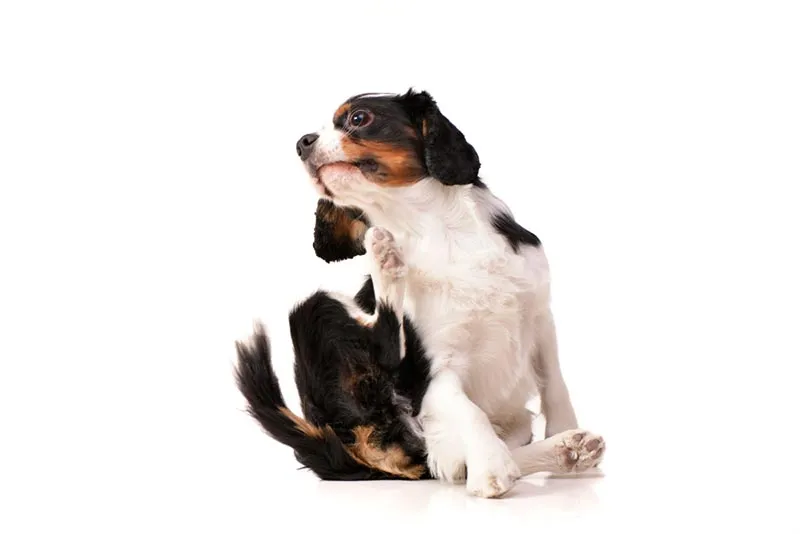
Most commonly, owners may notice their Cavalier trying to scratch at their neck or acting painful in the neck area. Oftentimes, owners assume that their dog has an ear infection because they notice them rubbing and scratching at the neck and head. The ears should be checked for infection by your regular veterinarian.
During the physical exam, your veterinarian may also notice pain on palpation, or moving the neck, neck tension and/or spasms, weakness of the limbs, and your dog holding their neck in what’s called a neutral position.
Sometimes, the neck pain will be severe enough that your dog may just randomly vocalize when they go to move, lie down, and/or stand up. Often, dogs with neck pain have difficulty looking up—therefore, you may notice that they won’t go up and down stairs, and/or get on and off furniture. Other times, it may be painful for your dog to bend down—for instance, they won’t want to bend down to get to their food and water bowl.
You may notice your dog standing there, staring straight ahead, holding their head straight out. Instead of turning their head to look at you, they may turn their entire body instead, so that they’re facing you.
If you are concerned about the health and well-being of your pet, seek veterinary advice for the best course of action.
What Are the Causes of Syringomyelia?
Unless the condition is caused by a tumor or other rare traumatic events, the vast majority of syringomyelia cases are thought to be an inherited, genetic disease. Studies are still pending on what exact genes may be involved, but results thus far strongly suggest a genetic correlation. Chiari malformation is also thought to have a genetic link.
The exact percentage of dogs with CM that will progress to having syringomyelia is unknown. Some studies do suggest upwards of 50% of CM-affected Cavaliers will develop syringomyelia. Currently, there are ongoing studies into the genetic links of CM, SM, and what dogs will have either or both conditions.
SM is not a condition caused by diet, lifestyle, and/or medications. Typically, the combination of Chiari malformation with a breed predilection is needed for SM to occur.

What Are the Treatment Options for Syringomyelia?
Treatment options for SM are aimed at keeping your Cavalier comfortable. Most dogs will be treated with pain medications—most commonly, a medication called Gabapentin which is great for nerve pain. Your veterinarian may want to try different anti-inflammatories and/or pain medication combinations to find what works best for your dog.
Unfortunately, SM can worsen and progress with time. Pain and anti-inflammatory medications that once worked may not work again in the future. It’s important that you routinely see your regular veterinarian and/or a veterinary neurologist to best control your dog’s pain.
If your dog is having difficulty and/or pain when they move their neck up and down, putting some steps or a ramp leading up to the furniture may help them. You can also raise their food and water bowls to a comfortable height, making bending down to eat and drink more comfortable for them.
Neck braces are not recommended. These can weigh your dog’s neck down, making it more difficult for them to get around. Putting a neck brace on may also add to the abnormal sensations, itching, and/or “pings” of pain that your Cavalier may already be feeling. Please do not purchase any braces online or use wraps in any way unless instructed otherwise by your veterinarian.
Some dogs who have SM secondary to Chiari malformation may be candidates for surgery. However, this is a very specialized surgery that your regular veterinarian would not be capable of performing. Only a specialty-trained and board-certified neurologist or surgeon would be able to screen your pup, decide if they are a candidate, and discuss risks, success rate, and cost.
How is Syringomyelia Diagnosed?
The only definitive test for Chiari malformation and syringomyelia is with an MRI. Laboratories and research institutes are working on potential blood testing for genetic or heritable markers. However, at this time, an MRI is the only diagnostic tool to rule the condition in/out.
In order to have an MRI performed on your dog, general anesthesia is required. This will increase the cost of the procedure. Many times, you will also need to take your Cavalier to a specialty hospital or a university to have an MRI performed. Your veterinarian can provide you with all of the referral information for locations and costs in your area.

Conclusion
Syringomyelia is a neurologic condition most commonly seen in Cavalier King Charles Spaniels, though other breeds have been represented as well. It is most commonly caused secondary to Chiari malformation. If your dog has CM, there is no guarantee they will or won’t develop SM. However, once they develop SM, there is no definitive cure.
Care is aimed at controlling pain and abnormal sensations. Surgery may be possible but difficult to find, and for many it is not an option financially. If you notice that your Cavalier has any neck pain, odd reactions to their neck being touched, and/or is itching or irritated around their neck and skull, please speak with your veterinarian.
See also:
Congestive Heart Failure In Dogs: Causes, Symptoms, Treatment
How to Help When Your Dog Has a Seizure: 9 Vet-Approved Crucial Steps
Featured Image Credit: Fotyma, Shutterstock
Expert dog care, straight to your inbox
News, insights, expert advice, and everything dog.

No spam — unsubscribe anytime.
By signing up, you agree to our Terms & Conditions and Privacy & Cookies Policy.
How useful was this post?
Click a star to rate. You can leave written feedback afterwards. (We read all feedback.)
Dr. Kim Podlecki DVM (Veterinarian)
A graduate of The Ohio State University College of Veterinary Medicine, Dr. Podlecki has more than 12 years of experience working with small animals in the US. Dr. Podlecki worked almost exclusively in specialty medicine and emergency for more than a decade before transitioning to relief in both general practice and ER. Dr. Podlecki also owns her own consulting company (renewvetconsulting.com) with the focus of helping veterinary hospitals prioritize their staff to promote a healthier internal culture.