Get

In Your Inbox

Dogster is reader-supported. When you buy via links on our site, we may earn an affiliate commission at no cost to you. Learn more.

Why Do Dogs Kick After They Poop? Vet-Reviewed Canine Behavior Guide

Share

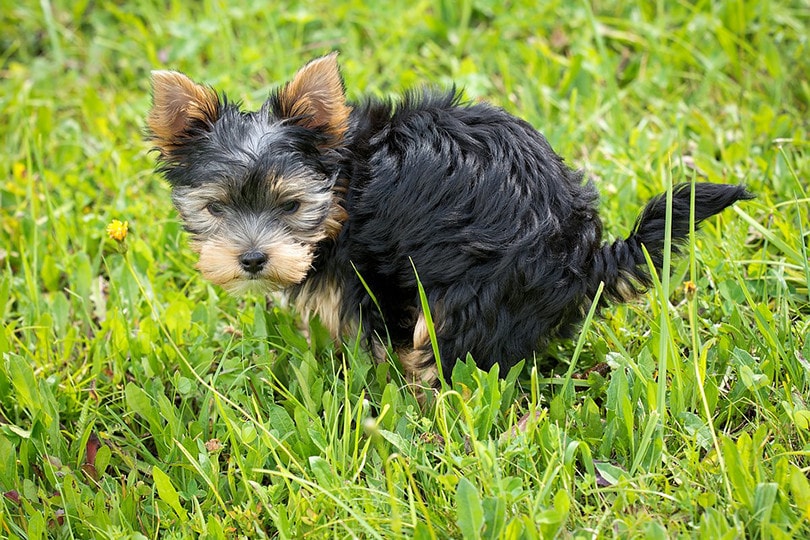
Dog Pooping

If you have ever noticed your dog kicking their back legs after going number two, you are not alone. Not all dogs exhibit this behavior but it is completely normal. It looks like they are trying to cover it as a cat would after doing their business in the litter box. The truth is, it’s an important way of communication and has nothing to do with cleanliness.

divider dog paws 3 oct 2024

Why Dogs Kick After Pooping

When you notice your dog forcefully kicking up the dirt and grass behind them after defecating, they are exhibiting the behavior known as “scrape behavior.” This is a unique and lesser-known way they mark their territory.

A dog’s paws are much more complex than our feet and serve more purpose than just cushioning their stride. There are glands within the paws that release pheromones that are left behind as travel. These pheromones are much stronger and stick around much longer than the feces they just dropped or even the urine that is used to mark territory. When your dog goes number two, the scents are combined for a stronger message.

The release of pheromones within the paws is a form of communication between dogs that goes completely unnoticed by us humans. It all comes down to their keen sense of smell. Other dogs that come across the territory will be aware this area has already been claimed by another canine.

This behavior can be a visual display for other dogs as well. In addition to the scent message, the disturbed area in the grass will let other dogs know that another has already been here. You may notice some dogs will only kick after defecating if another dog is present.

Jack,Russell,Dog,Guilty,For,The,Poop,
Image by: Kiadtisak-Khwanyu, Shutterstock

Why Do Dogs Mark Their Territory?

Our canine friends have evolved over thousands of years for species survival. As we know, dogs and wolves have a shared ancestor, and wild wolves and other species of wild dogs must claim their territory for the sake of obtaining prey, land area, and to keep competition away.

When your dog marks their territory, whether by spreading their pheromones with their paws by kicking up the area around them or by urine-marking, they are telling other dogs that they are present in this area, and it is already claimed.
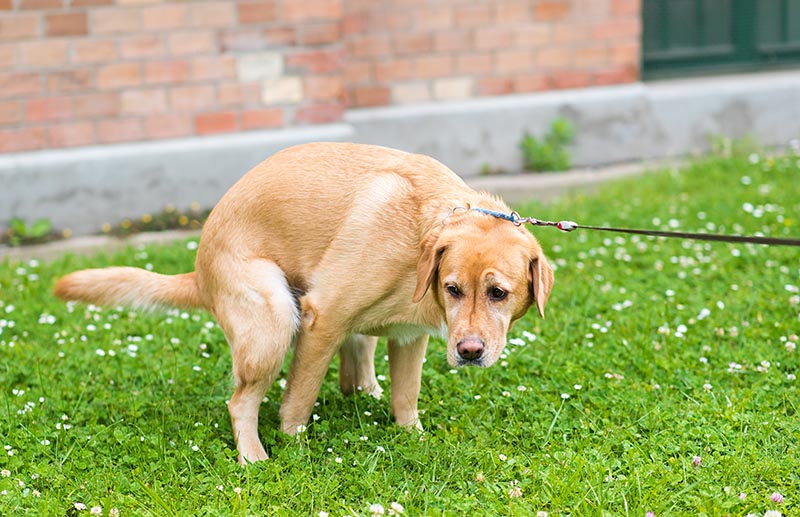
Labrador retriever dog poops in the green park
Image by: SasaStock, Shutterstock

Can This Behavior Be Stopped?

The good news is that this is a completely normal, healthy behavior your dog is displaying and there is no need to be concerned. The bad news is that this can cause damage to the lawn or area they choose to do this on. Some dogs will display this behavior on other surfaces within the household.

Typically, the behavior will not cause any harm to your dog unless they hurt their pads on rough surfaces or debris. It can, however, damage a well-maintained lawn or surfaces within your home. If it becomes too problematic, you can work to train your dog to stop the behavior.

If you plan on training your dog to stop this behavior, redirection and positive reinforcement are key. Refocusing their attention before they act is essential for redirection to work effectively. If your dog does this behavior regularly, you will be able to pick up on cues as to when they are about to start kicking.

The redirection needs to take place just before the kicking begins. This could be done by offering them their favorite chew toy or starting a game of fetch just after they’ve relieved themselves. Make sure to reward them when this is successful and keep consistent with this training.

You can always designate an area of your yard for your dog to use the bathroom and ensure they have already pooped before going on a walk through the neighborhood to avoid lawn damage. Keep in mind that this is a natural behavior and if they are not causing damage, there is no harm in letting dogs be dogs.

divider dog paws 3 oct 2024

Conclusion

It turns out that when your dog poops then begins to kick up dirt and grass afterward, they’re combining the scent of the feces with the pheromones coming from the glands in their paws to send a message that this territory is claimed. The rustled grass can also act as a visual cue for other dogs. This is a normal, natural behavior that has been passed down over thousands of years and is used in the wild by wolves, coyotes, and other wild dogs.

See also:


Featured Image Credit: Pezibear, Pixabay

Want content like this delivered to you?

Sign Up For Our Newsletter

News, insights, expert advice, and everything dog

* By submitting, you agree to our Terms & Conditions and Privacy & Cookies Policy.


How useful was this post?

Click on a star to rate (you can leave written feedback after clicking submit)

Help us improve Dogster for pet parents!

Your feedback really matters.

What did you like about this post? Also how can we improve it?

Join the conversation

Leave a Reply

You’re very welcome to leave a comment or question. Please know that all comments must meet our community guidelines, and your email address will NOT be published. Let’s have a positive and constructive conversation.


Talk With A Vet Online

Peace of mind,
anywhere, anytime

Affordable vet advice

Dogster’s Weekly Photo Contest Winners: Best Easter Photo (April 9, 2026)

Every week our team gets the privilege of sorting through our readers photos to choose what dogs will win this weeks contest! See...

We Didn’t Just Add a Dog to Our Life – We Built a Life With Him

“We didn’t just bring a dog home—we built a life together.” Most people are quietly taught a version of pet ownership that looks...

What Most Airlines Won’t Let You Do With Your Dog (Even If You Pay Extra)

Airline pet policies are notoriously hard to navigate. The information is scattered across different pages, buried in FAQ sections, and often contradicts what...

Designer Breeds: Best of Both? New Study Says No

“I’ll take a highly trainable, low-shedding lapdog, hold the heart disease and anxiety!” Something I always found amusing was when people would point...

More related

10 Best Dog Leashes for Puppies in 2026 – Reviews & Top Picks

When bringing home your new puppy, planning ahead of time is important for a smooth transition. One key essential item to have ready...

9 Best Harnesses for French Bulldogs in 2026 – Reviews & Top Picks

What’s not to love about the French Bulldog? They have consistently topped the list as one of the most popular breeds in the...

Why Does My Dog Keep Getting Ear Infections? Our Vet Explains Causes & Care

Ear infections are among the most common reasons dogs visit the vet clinic.1 While a normal dog could expect a couple of ear...

5 Dog-Safe Bouquets: Dog-Friendly Flower Arrangement Ideas

Bouquets and flower arrangements are vital in any celebration. However, many flowers in common arrangements can be dangerous to dogs. So, when you’re...

Keep reading

Semi-Moist, Dry & Canned Dog Food: Vet-Reviewed Pros & Cons

The world of dog food, diets, and what to feed your dog specifically has become an ever-changing topic. With so many brands, flavors, and types these days, it has almost become a complicated and mysterious affair to unravel. Yet it...

different kinds of dry and wet pet food

Can Dogs Eat Seaweed? Vet-Verified Facts & FAQ

Sharing some types of seaweed with your furry friend is okay in moderation. Seaweed is an excellent source of iodine, antioxidants, and vitamins, and it also provides a satisfying crunch and delicious natural flavor. However, it’s crucial to ensure that...

Can Dogs Eat Seaweed

Can Dogs With Pancreatitis Eat Eggs? Vet-Approved Facts & FAQ

Pancreatitis is one illness you want to take seriously, as mismanaging this disease can quickly become fatal. Pancreatitis is the inflammation of the pancreas, the part of your dog’s body that creates hormones such as insulin and digestive enzymes. The...

Can Dogs With Pancreatitis Eat Eggs

What to Feed a Dog With Arthritis: Comprehensive Guide

An estimated 20% of dogs over 1 year of age have osteoarthritis, or degenerative joint disease (DJD), which is a progressive and complicated disorder. It can profoundly impact an animal’s quality of life and, sadly, has no cure. Instead, pet...

Disabled Senior Dachshund Dog Eating Pet Food At Home

What Is Blood Meal in Dog Food? Health Facts & FAQ

You’re looking at the ingredients of your dog’s favorite dry food and come across this word: blood meal. What is it exactly? Will your beloved pooch benefit from it, or is it a potentially dangerous ingredient? The term “blood meal”...

dry dog food in a bowl on wooden table

10 Best Stainless-Steel Dog Bowls in 2026 – Reviews & Top Picks

There are many different dog food bowls, but stainless-steel bowls are some of the best options for many dogs. They’re more durable than other materials and can also be more hygienic. There isn’t much variety in stainless steel bowls, but...

two fluffy dogs eating from the triple stainless steel feeders

Does Canned Dog Food Need to Be Refrigerated? Vet Approved Health & Safety Tips

Sometimes, our dog doesn’t eat all their food, or we forget to put it away after we open the can. We’ve also seen great deals we can’t pass up and purchase in bulk. How do you store both closed and...

jack russell looking for food in the fridge

Can Dogs Eat Goat Cheese? Vet-Verified Nutrition Facts & FAQ

Goat cheese might not be among America’s top 15 most consumed cheeses, but it certainly has its fans. You probably won’t have any problem getting your dog to eat it, but does that mean you should? The answer raises more...

Can Dogs Eat Goat Cheese

Love Dogs? So Do We! Join the Dogster Community

Stay informed with expert pet care insights delivered straight to your inbox! Discover professional guidance on animal behavior, feeding tips, trusted product picks, and much more.


Sign up for the Dogster Email Newsletter