
How Fast Can Greyhounds Run? Facts & Animal Comparison


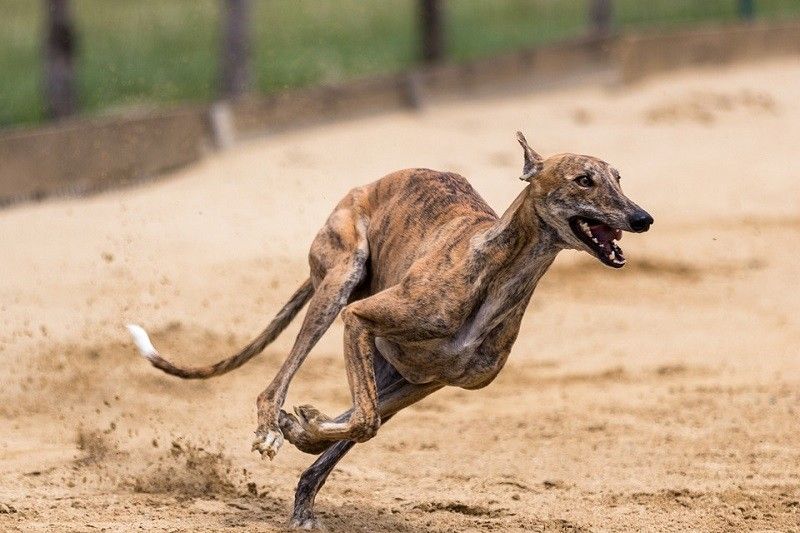
Greyhounds are well known for their speed, but seeing how fast they are can be surprising. As the world’s fastest canines, Greyhounds can reach speeds of up to 72 km/h, equivalent to 45 mph, making them much faster than mere humans. However, other animals can beat Greyhounds in a long-distance sprint.
In this post, we’ll explain why Greyhounds can run so fast and examine how they compare to humans and other animals in terms of speed.

Why Are Greyhounds So Fast?
Greyhounds are so fast because of their anatomy and what they were bred for. These graceful dogs are sighthounds that were initially bred to track down and outrun their prey, which accounts partially for why they’re so adept at running. In addition to their history as hunting dogs, Greyhounds are simply built for speed.
Their hearts are relatively large for their body size, which allows for efficient circulation and, therefore, well-oxygenated muscles to help them withstand running at such high speeds. The Greyhound also has long legs, a graceful yet athletic and muscular build, a high proportion of fast-twitch muscle fibers, a strong yet flexible spine, a short and fine coat, and a double suspension gait (also known as “double suspension rotary gallop”).

Greyhound Speed Comparison
Though Greyhounds are the world’s fastest dogs, they’re built to run short rather than long distances. For this reason, other endurance-adapted animals can beat the Greyhound in an endurance race, including Siberian Huskies, Alaskan Malamutes, and certain horse breeds. Though Greyhounds may initially run ahead of these animals due to their ability to reach high speeds incredibly quickly, Huskies, Malamutes, and endurance-trained horses are better suited to long-distance running than Greyhounds. If we compare Greyhounds with humans, Usain Bolt’s record time in a 100-meter race was 9.58 seconds, and his top speed was 22.9 miles per hour (36 km/h). It takes a Greyhound just 5.33 seconds to run 100 meters. Now, let’s look at how Greyhounds compare with other land animals regarding speed. The table below shows the approximate maximum speeds each animal can reach.
| Animal | Top speed |
| Greyhound | 72 km/h (44 mph) |
| Cheetah | 120 km/h (75 mph) |
| Springbok | 88 km/h (55 mph) |
| Lion | 81 km/h (50 mph) |
| Ostrich | 70 km/h (43 mph) |
| Domestic cat | 48 km/h (30 mph) |
| Grizzly bear | 56 km/h (35 mph) |

Is Greyhound Racing Cruel?
Yes. There are a host of animal welfare issues linked to the Greyhound racing industry. According to the RSPCA, Greyhound racing is dangerous because many Greyhounds suffer injuries caused by running at such high speeds around oval tracks. In some cases, the injuries result in the dog being euthanized.
As the RSPCA also notes, data from the Greyhound Board of Great Britain (GBGB) shows that hundreds of Greyhounds died in connection with racing activities between 2018 and 2022. Moreover, the data shows that over 22,000 injuries were recorded. These figures have raised significant welfare concerns among veterinary and animal welfare organizations.
In addition, the RSPCA draws attention to the fact that some racing dogs are kept in inadequate living conditions and fed nutritionally inadequate food.


Summing Up
To recap, Greyhounds are short-distance runners that can reach up to 72 km/h (45 mph). Because of their ability to reach their top speeds quickly, Greyhounds are the world’s fastest dogs, but they’re not the best endurance runners. Siberian Huskies and Alaskan Malamutes are better long-distance runners, so they come out on top in an endurance race.
See also:
Featured Image Credit: herbert2512, Pixabay
Expert dog care, straight to your inbox
News, insights, expert advice, and everything dog.

No spam — unsubscribe anytime.
By signing up, you agree to our Terms & Conditions and Privacy & Cookies Policy.
How useful was this post?
Click a star to rate. You can leave written feedback afterwards. (We read all feedback.)

Kit Copson is a freelance writer and lifelong animal lover with a strong interest in animal welfare. She has parented many furry beings over the years and is currently a proud cat mom of two—one very chilled (unless hungry) Siamese and a skittish but adorable Domestic Shorthair—and dog mom of one—an adopted Bichon Poodle cross. When not writing about or spending time with pets, Kit can be found drawing in her sketchpad, reading, or more often than not, drinking tea.