Get

In Your Inbox

Dogster is reader-supported. When you buy via links on our site, we may earn an affiliate commission at no cost to you. Learn more.

What Were Australian Shepherds Bred For? History & Origin

Share

australian shepherd enjoying the outdoors during autumn

The Australian Shepherd is a breed of herding dog that, despite its name, has an American origin story. It is likely that the breed originated from Collies that came over with livestock and herders from Australia, hence its name, but it was breeders in the western US that took existing Australian breeds and created what we now know as the Australian Shepherd.

Today, it is still used to herd livestock in countries throughout the world, but this active dog has also become a popular pet, although potential owners need to be aware that it will need considerable amounts of exercise and is unlikely to be happy with just an occasional walk.

divider dog faces oct 2024

The First Australian Shepherds

There are no documented records to show exactly where the first Australian Shepherds were bred, but it is believed that they originated from herding dogs that came over to the US from Australia and that were originally from the Basques region of Spain. Once in the US, breeders tried to breed even better herding attributes, ultimately making them more intelligent and hard-working.

Following World War II, the renewed interest in horseback riding and rodeos meant that the breed really took off in popularity. However, despite this renewed popularity, it wasn’t actually until 1993 that the dog was accepted into the American Kennel Club and breed standards were established.

Australian Shepherd
Image Credit: Jan Havlicek, Shutterstock

The Aussie of Today

The breed hasn’t changed much since WWII. It is still a highly energetic, very intelligent, hard-working breed that is happy on the ranch and in the fields, effectively working with ranchers to manage sheep and other livestock. The Aussie nips at the heels of larger animals and uses herding techniques to control its quarry. It also has what ranchers call an “eye” that stares at the livestock in such a manner to let them know it is in charge and that they need to do what the dog says.

While the Aussie is still a popular working dog and has all the attributes that make a good herder, it is also a very popular pet. It does need a lot of exercise as well as mental stimulation, and it will need training from a young age to discourage nipping and herding habits. Even with this training, you may find an Aussie attempting to round up smaller animals and even children.

Do Australian Shepherds Make Good Pets?

Australian Shepherds can make very good pets. They tend to be loyal, do not require too much fuss, and are very intelligent and eager to work, so they can be trained easily by an experienced handler. However, they do require constant training and exercise, or they can become bored. And be prepared for the fact that what you think of as a long walk will barely even be a warm-up for an Aussie. As working dogs, they will be in the field for hours every day and still be ready for a run at night.

A bored Aussie is more likely to show signs of destructive behavior, which tends to manifest as chewing and worrying. Be prepared to go on long walks, ideally runs, and enroll in canine sports classes to give your Australian Shepherd an outlet for its intelligence and physical demands.

happy young woman cuddling australian shepherd dog while sitting on couch
Image Credit: LightField Studios, Shutterstock

Do Australian Shepherds Bark a Lot?

Barking is one technique that an Australian Shepherd uses to help control its livestock, and it will use this same technique when trying to communicate with you and your family. This is one breed that will bark, so you will need to teach the speak command so that you have a means of encouraging and discouraging noise. Also, be aware that a bored Aussie is more likely to bark, and if yours is especially protective over you, your family, or your home, it will be more likely to make noise and bark.

Do Australian Shepherds Shed a Lot?

Australian Shepherds have beautiful medium-length coats. They are considered average shedders, and the coat will need some ongoing attention to help ensure that it is kept in good condition, especially if yours spends a lot of time outdoors laying in the grass or jumping around in mud. Weekly brushing will help prevent the coat from becoming matted and knotted, and you may need to give it an occasional trim to really keep your Aussie looking its best.
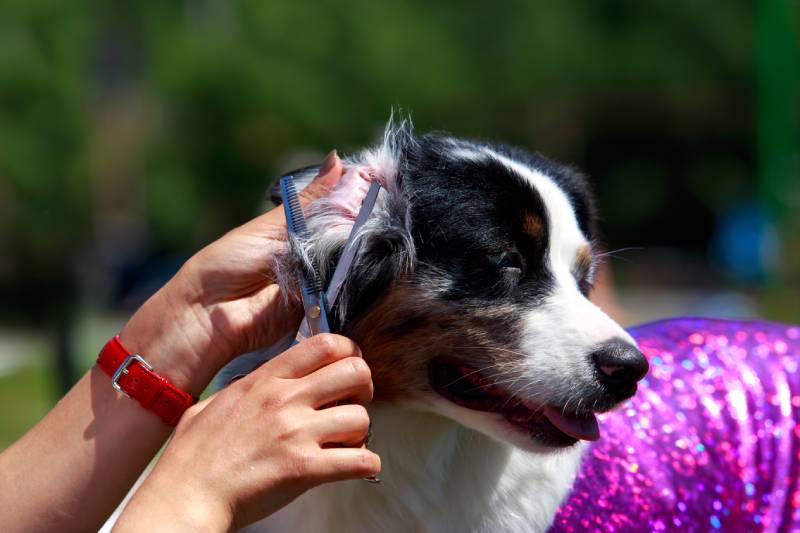
Image Credit: Olga Aniven, Shutterstock

divider dog faces oct 2024

In Conclusion

The Australian Shepherd is instantly recognizable thanks to its medium-length coat of many colors and its distinctive eye color that can range from amber to blue. It is a very hardworking dog that was originally bred in the US from Australian herding dogs, hence its name, and it retains many of the characteristics of a herding dog today. It is a popular pet, although it requires a lot of heavy exercise and some maintenance on its coat, while training is essential to prevent herding and barking.


Featured Image Credit: dodafoto, Shutterstock

Want content like this delivered to you?

Sign Up For Our Newsletter

News, insights, expert advice, and everything dog

* By submitting, you agree to our Terms & Conditions and Privacy & Cookies Policy.


How useful was this post?

Click on a star to rate (you can leave written feedback after clicking submit)

Help us improve Dogster for pet parents!

Your feedback really matters.

What did you like about this post? Also how can we improve it?

Join the conversation

Leave a Reply

You’re very welcome to leave a comment or question. Please know that all comments must meet our community guidelines, and your email address will NOT be published. Let’s have a positive and constructive conversation.


Talk With A Vet Online

Peace of mind,
anywhere, anytime

Affordable vet advice

Dogster’s Weekly Photo Contest Winners: My Favorite Toy (March 19, 2026)

Every week our team gets the privilege of sorting through our readers photos to choose what dogs will win this weeks contest! See...

Your Dog Thinks French Fries Are Fine. Your Dog Is Wrong.

Has your dog ever given you that look? The one where their eyes follow every movement of your hand from plate to mouth....

AKC Humane Fund to Provide Support When and Where It’s Needed Most

As more and more people are struggling to make ends meet, a new initiative has been launched to increase access to emergency veterinary...

Ask Dr. Paola- I Need Help With My Dogs Anxiety! (March 16, 2026)

Welcome to our “Ask Dr. Paola” series, where every Monday we bring expert advice straight from Dr. Paola Cuevas (MVZ) to help our...

More related

Brown Pomeranian: Info, Pictures, Origin & History

If you’ve ever seen a brown Pomeranian, chances are you fell madly in love with their small, charming, and delicate nature. While these...

Can Dogs Share Water Bowls? Vet-Verified Health Risks & Safety Tips

Cleanliness can be tricky when it comes to dogs. They’ll gladly eat off the ground, lick poop, and do all sorts of unsanitary...

Balls: The Right and Wrong Way to Play Fetch

Hi, I’m Dr. Karyn! Read my introduction to learn more about me and my five funny dogs, Poppy, Bailey, Kodah, Ned, and Fred....

12 Essential Great Dane Supplies to Get You Started: 2026 Guide

Preparing to adopt a Great Dane can feel exciting and overwhelming at the same time. In addition to puppy-proofing your home, you’ve got...

Keep reading

Why Do Dogs Bury Their Food? Reasons & What to Do

Have you ever seen your dog try to bury their food? Maybe they take a treat and run to the backyard or drag a food bowl over to somewhere where they can dig. This behavior might be baffling on the...

small dog digging

Dog Food Sensitivity: Vet-Reviewed Signs & Treatment

Just like humans, dogs can also develop sensitivities and allergies, especially when it comes to their food. However, identifying and addressing the signs of dog food sensitivity can be a challenge for many pet owners, particularly as some aren’t all...

sad golden retriever dog beside food bowl on the floor with no appetite

11 Best Dog Foods for Huskies in 2026 – Reviews & Top Picks

If you own a Siberian Husky, then you’re well aware of their high energy levels. But did you know that Huskies also have extremely high metabolisms? This does have something to do with their high energy levels, but it has...

Husky-puppy-eating-from-feeding-bowl-indoors

What Is Meat Meal in Dog Food? Vet-Approved Facts & FAQ

There are many misconceptions about meat meal out there. Since meat meal isn’t whole meat, many dog owners assume that it’s a derivative of meat, similar to by-products. However, this isn’t exactly true. Quality meat meal can actually be a...

dog eating

How to Calculate Pet Food Dry Matter Basis (With Calculator)

What is dry matter basis and why is it important for pet food? We’ve got the answers—and a calculator—to help you determine the ratio of nutrients to moisture content. When looking at the nutritional values of pet food, the guaranteed...

dry dog food in plastic bag and dog head

How Much Food Should My Havanese Eat Per Day? Vet Reviewed Guidance

A lot goes into feeding a dog, so if you’re stumped on how much to feed your Havanese, you’re not alone. The truth is, there is no set answer on how much to feed your Havanese. Each dog requires a...

Havanese dog eating

How to Soften Dog Food: 16 Easy Vet-Approved Tips

If you have a picky eater on your hands, or if your dog is simply having trouble chewing their food, you may need to soften their kibble. There are a few ways that you can do this by adding other...

Maltese dog eating from a bowl

8 Best Hydrolyzed Dog Foods in 2026 – Reviews & Top Picks

Owners are becoming more discerning about the ingredients and preparation of their pet’s food. Many times, there are products that we have never heard of and processes that we do not understand. One thing is for sure, however: When it...

miniature schnauzer dog eating on the sofa

Love Dogs? So Do We! Join the Dogster Community

Stay informed with expert pet care insights delivered straight to your inbox! Discover professional guidance on animal behavior, feeding tips, trusted product picks, and much more.


Sign up for the Dogster Email Newsletter