Every Papillon’s story is different. Still, when you look into those beautiful round eyes you might wonder how you were lucky enough to receive a dog that’s so cute and where they come from. The Papillon’s history is widely unknown, but we know that the French, Italians, and Spanish all had a part to play in the breed’s creation. Regardless of the accuracy, most of the credit goes to the French, who coined their name. Let’s look at 10 interesting facts about the Papillons to learn more about your adorable dog’s ancestors.

The 10 Interesting Papillon Facts
1. “Papillon” is the French word for “butterfly.”
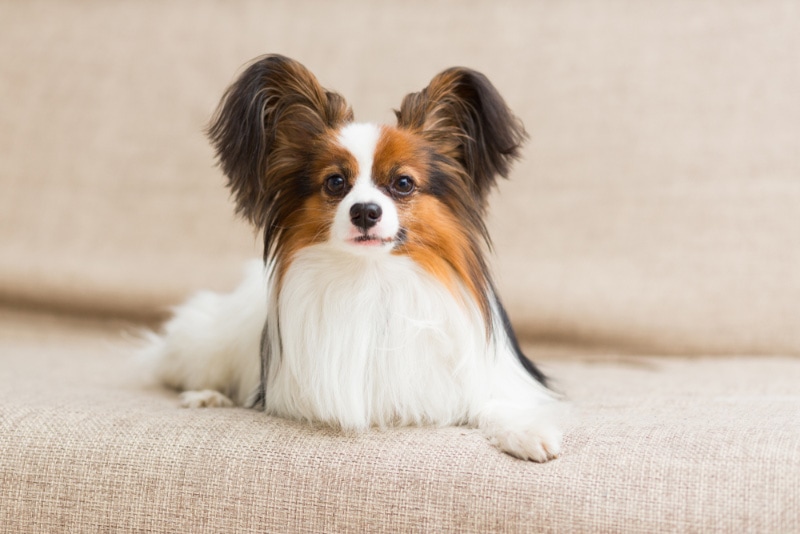
Their ears flutter out from the side of their head in such an iconic way that these features define the breed as a whole. While many dogs have upright ears, Papillon’s ears come out at a 45º angle, not straight up and down like a French Bulldog’s, for example, which is why they’re so unique.
2. Not every Papillon has the signature butterfly ears.
Even within the same litter of pups, some Papillons have folded ears. According to the breeding standard set by the American Kennel Club, a Papillon must have either the butterfly ears or completely folded ears. In Europe, Papillons with folded ears are actually called Phalene, which translates to “moth” in French. Ears that point straight upwards or ones that are only partially folded down are considered to be a fault.

3. They’re also known as Continental Toy Spaniels.
Papillons are also called interesting names such as Dwarf Spaniels or Squirrel Spaniels, which sounds cute but would actually be insulting to these dogs (if they understood what we’re saying) since they’re well known ratters. In the United States, all of these dogs are grouped under the single moniker Papillon.
4. Papillons have a low-shedding, single coat.
If you like a clean house, you’re in luck. While they aren’t considered hypoallergenic, the Papillon also won’t shed all over the place like a double-coated dog, such as the Siberian Husky. Even better news, since they still shed moderately, they also don’t have to have a haircut every couple of months like hypoallergenic breeds do.

5. White is always in their coat color, but never exclusively.
According to the AKC standard, all Papillons must have white in their coat, but all-white is considered a fault. Papillons are supposed to be parti or multi-colored dogs.
6. The AKC recognized the Papillon as a breed in 1915.
The Papillon is classified as a member of the Toy Group.

7. The Papillon is one of the most athletic members of the Toy Group.
While they were predominantly bred to be a lap dog, don’t be surprised if your energetic little dog would rather take a few laps around the block before they settle in for a snuggle. Despite their small size and aristocratic airs, the Papillon is surprisingly athletic and tends to score well in agility trials.
Famous Papillon owners include Christina Aguilera and Marie Antoinette. Marie Antoinette’s Papillon, Coco, surprisingly survived the French Revolution and lived to a ripe age of 22.

9. In 1999, Loteki Supernatural Being became the first Papillon to win Best in Show At Westminster.
As would naturally be expected of a supernatural phenomenon, the Papillon has only won best in show once.
10. The Papillon has a longer than average life expectancy.
The Papillon has a 14–16 year life expectancy. This is much longer than the average lifespan for dogs, which is around 10–12 years.

Other Things to Know About Papillons
Energetic, amiable, and eager to please, Papillons can thrive anywhere as long as they receive human companionship. They were bred to be with humans and can become anxious or even destructive if left to their own devices for most of the day. With early socialization training, they usually get along with other animals and children, making them a perfect choice for a family dog.
As a toy breed that’s generally healthy, the cost of caring for a Papillon should be considerably less than larger breeds or dogs with known genetic health conditions. Of course, feeding them a healthy diet coupled with at least 30 minutes of daily exercise, and following up with preventative annual vet exams determines their health status more than their breed.
Since they have a low-shedding single coat, Papillons require minimal grooming. You should use a comb or slicker brush to thoroughly groom their coat at least once a month to prevent matting. Aside from paws and sanitary trims, Papillons also don’t need haircuts. However, it won’t hurt their fur if you do decide to give them a little trim. Some Papillon parents actually prefer to do this during the summer months or if they spend a lot of time outside. You should never shave their coat though, since they need their fur for thermoregulation. Also, never use a deshedding tool or rake such as the Furminator on your Papillon. These tools are meant to remove a dog’s undercoat, which the Papillon doesn’t possess. Deshedding tools and rakes can severely damage their thin, silky single coat.

Conclusion
Thankfully, caring for a Papillon isn’t as mysterious as their origins. As long as they have human companionship for most of the day, as well as basic necessities such as food and safe housing, they’ll be happy to be your friend for life. Their cheerful attitude combined with their athletic prowess partly explains how they’ve survived some of the most brutal social revolutions in history. While history doesn’t exactly explain the full story, we’re grateful it preserved the special little butterfly in your lap.
See also:
- How Big Does a Papillon Get? Average Growth & Weight Chart
- 18 Papillon Mixes: History, Pictures & Info
Featured Image Credit: Fayzulin Serg, Shutterstock
 The 10 Interesting Papillon Facts