Do Dogs Have a Hierarchy? Vet-Verified Social Structures Explained


In this article
If you’ve been around dogs for a while and trained your fair share of canines, you’ve probably heard that while training, you need to ensure your dog understands that you are the “alpha” of the family “pack.” This means making sure your dog defers to you rather than trying to do their own thing. The idea of this came about from the social hierarchy between canines, a hierarchy that came from wolves. But is this idea of hierarchy accurate?
As it turns out, it is not. Not only do wolves not have a dominance hierarchy, but neither do canines. In fact, our furry pals don’t really have a hierarchy at all. So, how do dogs interact then?

How Does It Work?
The old way of thinking was that wolves have an alpha who is the dominant one and whom all the other wolves fall in line with. Because canines are descendants of wolves, it was believed they interacted in the same way. However, these beliefs were incorrect about both groups of animals.
Wolves have a social structure that is much more akin to a family unit than a dominance hierarchy. They have a hierarchical structure regarding a breeding pair, which are usually the parents of other pack members. Wolf leaders act more as parents in that they teach, guide, and care for the rest of the members of their packs. Wolf leaders will do things, such as letting their young eat first in times of scarcity rather than eating the food themselves or running at the back of the pack instead of the front. Biologists who have spent their lives studying wolves have also had a lack of reports of alpha wolves displaying dominant behavior. The stable structure is maintained by a complex communication system involving appeasing gestures to avoid conflict.

You would think that would mean that dogs also have a hierarchy that works more like a family unit, but that is incorrect. Dogs don’t have a hierarchy because how dogs interact with each other differs due to available resources, knowledge, and a desire to keep the peace. What that means is the desire for a resource, plus a dog’s previous knowledge, determines how that dog interacts with another dog for that specific encounter. Essentially, our canine pals want stability, and that isn’t found through aggressive behavior. Like wolves, they prefer to avoid conflicts involving other dogs and humans.
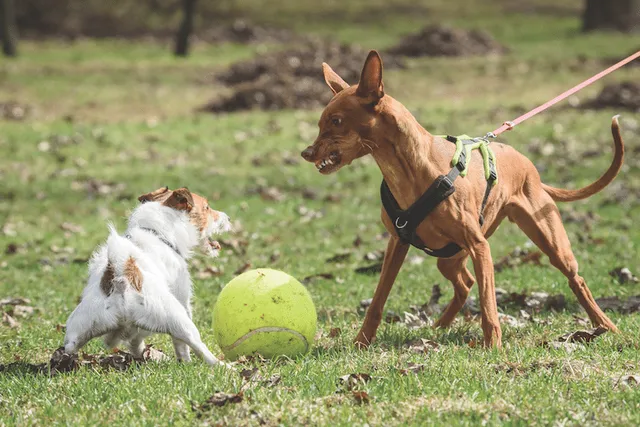
Why does aggressive behavior sometimes occur between dogs, then? It is often that the dogs both want a resource (food, a toy, a certain window to look out of) and are showing displays of aggression to each other to not only get the other to back off but also to avoid a fight. Again, they may want that resource, but they also want to maintain stability when possible.
What Are the Different Types of Hierarchies?
When it comes to the animal kingdom, hierarchies abound, and in most cases, they are dominance-based ones. What does that mean? A dominance hierarchy involves animals in a pack or herd operating off a pecking order, where some individuals in the group are higher-ranked than others. The higher-ranked individuals may be known as alphas, while the more subordinate individuals may be known as betas.
How does one become a more dominant member of the pack or herd? It varies by animal. For example, some animals may win their place in the pack or herd by excelling at competitions, while other animals are found to be more dominant due to certain traits.1 Still other kinds of animals may have a separate sex hierarchy, where one sex is more dominant than the other.
Some of the animal groups that use the dominance hierarchy include Moon wrasse fish, seals, gorillas, Capuchin monkeys, and Montezuma oropendolas.

What About Dogs?
To understand canine social structures we must look at research on dogs. Studies on feral dogs haven’t shown any consistent social structure. Some live on their own out of breeding season, while others form packs of up to 12 individuals.
A study on village dogs in West Bengal showed dogs living in family groups of 5-10 and defending shared territory from neighboring groups. However, when these dogs encountered a neighbor, they would usually defer to each other and return to their own core area. Wolf groups try to avoid each other, but if they meet, they have been shown to almost always fight. This suggests that the highly competitive nature of unrelated wolves has been removed from dogs during the domestication process.
How Does a Lack of Hierarchy Affect Training a Dog?
Now that you know the whole “alpha dog who wants to be dominant” thing is a myth, you might be wondering how the lack of hierarchy affects training a dog. After all, many methods of training are based on dominance hierarchy and letting a dog know who the “alpha” is. However, your pup isn’t trying to challenge human members of the family or battle it out for supremacy.
What that means for training is that the old rules, such as walking through a door first or eating before you feed your dog, don’t apply. In reality, some of the training methods based on dominance hierarchy can be rather cruel. These training methods also don’t consider that a dog’s interactions with their human family are vastly different from interactions with other canines, as they are driven by motivations other than resources in these relationships.
So, ditch training methods that work off the dominance hierarchy and incorporate methods like positive reinforcement and classical conditioning.

Canine and Human Interactions
If dogs don’t have a social structure or hierarchy among themselves or with humans, how do canines determine how to interact with humans? As we’ve said, canine and human relationships aren’t determined by dominant or subordinate social signaling but are rather affected by a wide variety of factors. How a dog interacts with a person depends on genetics, early socialization, what they’ve learned about people thus far, fear, resources, behavioral pathology, and more. Interestingly, our canine companions have developed the readiness and ability to respond well to humans, even though a wolf raised by people would not have this same readiness.
Canine and human relationships aren’t entirely dependent on the dog, though. People, too, need to learn to better understand and communicate with their pups. Dog parents should learn how to read their dog’s body language and visual signaling to determine when a pup wants to engage and when they’d rather not.

Frequently Asked Questions
If a dog isn’t trying to be the “alpha” or “take over the pack,” why do they sometimes act the way they do?
Just like children, dogs will test boundaries to learn how to interact with their people. By figuring out what works and what doesn’t in an interaction, your furry pal will learn how interactions with you and other family members should go.
What are some of the myths of dominance hierarchy-based training methods?
Just a couple of the most common myths are that you shouldn’t allow your pup to be on furniture because it elevates their status and lowers yours, and if you and your dog make eye contact, your pup should always look away first. Neither of these things is true.
Do all dogs engage in social signaling in the same ways?
They do not! Because of breeding and domestication, there is extensive variation in social signaling among dogs. Some breeds, such as Huskies, engage in social signaling that is more reminiscent of wolves, while other breeds will have retained little instinctual social signaling from their wolf ancestors. That means it is sometimes difficult for different breeds to read one another at first.
Conclusion
The idea that dogs work off a dominance hierarchy is now known not to be true. Our canine companions don’t actually have a social hierarchy at all! Instead, how one dog interacts with another is mostly determined by what resources are available at the time and who wants them. Our pups prefer not to fight over things; they use appeasing and conflict-avoiding signals and prefer having stability. This also makes the training methods based on the dominance hierarchy outdated, so find a different training method to use with your dog.
Featured Image Credit: Tara Lynn and Co, Shutterstock
Expert dog care, straight to your inbox
News, insights, expert advice, and everything dog.

No spam — unsubscribe anytime.
By signing up, you agree to our Terms & Conditions and Privacy & Cookies Policy.
How useful was this post?
Click a star to rate. You can leave written feedback afterwards. (We read all feedback.)
Misty Layne lives out in the woods in small-town Alabama with her two Siamese - Serafina & Jasper. She also has an array of stray cats, raccoons, and opossums who like to call her front porch home. When she’s not writing about animals, you’ll find her writing poetry, stories, and film reviews (the animals are, by far, her favorite writing topic, though!). In her free time, Misty enjoys chilling with her cats, playing piano, watching indie and foreign films, photographing abandoned places, and catching up on her never-ending TBR list.