Get

In Your Inbox

Dogster is reader-supported. When you buy via links on our site, we may earn an affiliate commission at no cost to you. Learn more.

Can a Dog Smell Human Pheromones? Vet-Reviewed Facts & FAQ

Share

dog sniffing owner's hands

Dogs can be embarrassing. It never seems to fail that when people stop by to visit, our best friends and furry family members will greet guests by sniffing their crotches and acting as if it’s the most natural thing in the world. Oddly enough, for your dog, it is. This is how a dog learns about the people around them. They use their powerful noses. Knowing this may lead you to ask, can a dog smell human pheromones? The answer to that question is yes. Dogs can use their powerful snouts to smell way more than you can imagine. Let’s learn more about dogs and their ability to smell human pheromones. This may make things less awkward the next time a neighbor stops by and your dog is a bit intrusive.

divider dog faces oct 2024

A Dog’s Amazing Nose

A dog’s sense of smell leads them throughout the world. Dogs can smell 1,000 times better than we humans can and dogs have around 300 million olfactory receptors. If you are curious as to whether this is a lot, we humans only have 6 million of these receptors. When a dog smells something with these receptors, the part of their brains that analyzes these smells is activated. That part of your dog’s brain is 40 times larger than your own.

Dogs use these smells to tell them information about what’s happening around them. They can learn things about the area, people they are around, and other canines they may encounter. This happens due to dogs continuously smelling. Dogs have additional slits on their nostrils. Instead of exhaling through their nostrils as we do, they exhale through those slits. This is what allows them to sniff continuously. Exhaled air is separated from the new scents they are taking in. A dog’s nose also separates the air they need for breathing from the scents they are taking in.

You are free to use this image but we do require you to link back to Dogster.com for credit

The Jacobson’s Organ

The vomeronasal organ, or Jacobson’s organ, is found in the area of your dog’s nasal cavity and the roof of its mouth. This organ is typically used by your dog to detect pheromones, allowing sexual and social assessment of other dogs. This is how male dogs learn that females are in heat. They use this organ when they smell a female’s urine. At times, it can also be used to alert dogs to danger that may be around them.
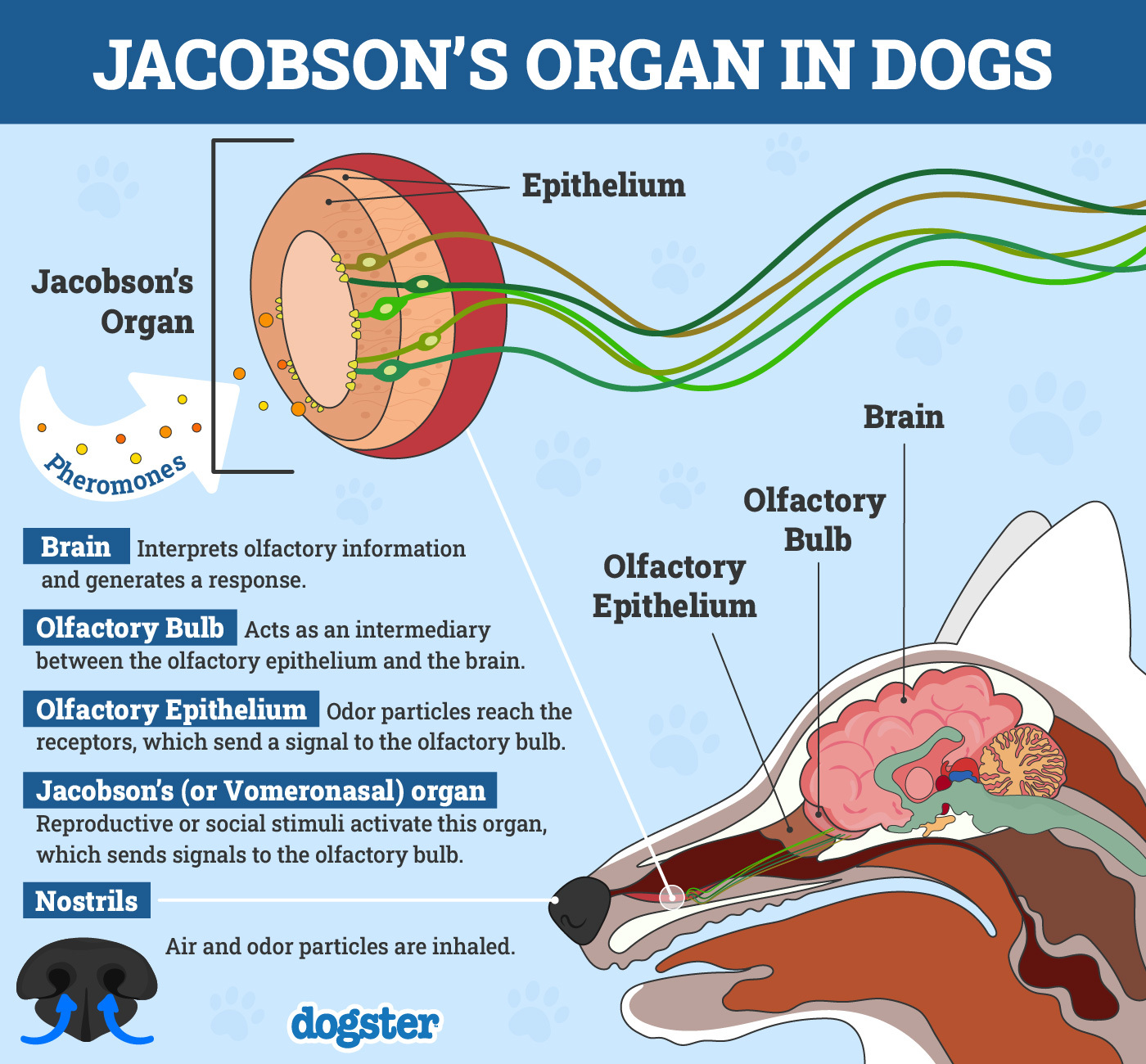
Jacobson's Organ in Dogs
You’re welcome to use our images, but we require you link directly to this site for credit (ex. Image from Dogster)

Dogs and Pheromones

Pheromones are a chemical that animals release that can affect the physiology or behavior of other animals of the same species. Dogs secrete many different pheromones from different areas of their body, with the most concentrated amount of glands being around their genitals and anus. This is why they sniff the rear end of another dog when they meet. Different canine pheromones provide different messages.

In people, pheromones are mostly produced in the armpits and genitals. When we release pheromones, our dog’s intense sense of smell can pick this up. This is why so many dogs rush toward our no-no zones when they meet us, when we come home from work, or when they notice a change in us. It’s how they learn what’s going on. For example, dogs may be able to detect ovulation, although this is not definitively proven.

While many dog owners may feel that this sniffing isn’t behavior they want from their dog, it’s simply an important part of how they interpret the world and the people and animals in it. All the time they are sniffing, they are processing important information.

dog on a woman's lap
Image by: Tamara Bellis, Unsplash

What Can Dogs Smell on Us?

We all know our dogs can smell other animals on us when we come home. We’ve all received those looks of jealousy when we realize we’ve been playing with another dog. There’s a lot more to it, however. With dogs smelling our pheromones, it only makes sense that they can smell other things.

Dogs can smell adrenaline when we’re worked up or scared. They can also sense tiny changes in odors produced by the human body associated with disease. Medical Detection Dogs have been trained to diagnose cancer, Parkinson’s disease and sniff out bacterial infections. They can also act as alert assistance dogs for example to alert diabetic patients when their blood sugar is low. What dogs can smell on us is truly amazing.

divider dog faces oct 2024

Summary

If you’ve wondered about dogs and their ability to smell our pheromones, now you know that they can. While the act of them getting a sniff of these pheromones is a bit off-putting, it’s important for bond forming and your dog feeling like they’re part of the family. Of course, you can always work with your dog to teach them better manners so that this private area sniffing doesn’t get out of hand.

See also:


Featured Image Credit: Prostock-studio, Shutterstock

Want content like this delivered to you?

Sign Up For Our Newsletter

News, insights, expert advice, and everything dog

* By submitting, you agree to our Terms & Conditions and Privacy & Cookies Policy.


How useful was this post?

Click on a star to rate (you can leave written feedback after clicking submit)

Help us improve Dogster for pet parents!

Your feedback really matters.

What did you like about this post? Also how can we improve it?

Join the conversation

Leave a Reply

You’re very welcome to leave a comment or question. Please know that all comments must meet our community guidelines, and your email address will NOT be published. Let’s have a positive and constructive conversation.


Talk With A Vet Online

Peace of mind,
anywhere, anytime

Affordable vet advice

Dogster’s Weekly Photo Contest Winners: The Cutest Puppy (April 2, 2026)

Every week our team gets the privilege of sorting through our readers photos to choose what dogs will win this weeks contest! See...

The Hidden Risk in Tall Grass That Most Dog Owners Ignore

Finding a tick on your dog can look like a lot of things, depending on when you catch it. Some are engorged and...

Ask Dr. Paola- Help! My Dog Keeps Barking at the TV! (March 30, 2026)

Welcome to our “Ask Dr. Paola” series, where every Monday we bring expert advice straight from Dr. Paola Cuevas (MVZ) to help our...

Dogster’s Weekly Photo Contest Winners: I’m a Messy Eater (March 26, 2026)

Every week our team gets the privilege of sorting through our readers photos to choose what dogs will win this weeks contest! See...

More related

Can Dogs Have Molasses? Vet-Verified Nutrition Facts, Dangers & Benefits

Molasses is a thick syrup by-product of the sugar-making process. It’s commonly used in baking and can even be found in some dog...

7 Best Dog Foods for Ear Infections in 2026 – Reviews & Top Picks

Did you know that food allergies may cause itchy ears? Dogs who develop chronic ear infections may be experiencing an allergic reaction to...

What to Do When an Off-Leash Dog Approaches Your Leashed Dog: Vet-Approved Tips

Regardless of the situation, having a strange and unleashed dog approach you and your dog can be quite frightening. Not knowing their temperament...

How to Celebrate DOGust 1st 2026 (the Universal Birthday for Shelter Dogs)

When you adopt a dog from a shelter, details of their past life often tend to be somewhat murky. Due to this, it’s...

Keep reading

How to Cook Chicken Liver for Dogs: Vet-Approved Recipes & FAQ

Chicken liver is commonly used in many dog treats and dog food formulas. This delicious organ meat is a great way to add some nutritional value to your dog’s diet 1, so whether you are looking to serve it plain,...

Raw chicken liver in bowl on white table

Puppy Feeding Guide: Quantity, Schedule & FAQ

It is essential to feed your puppy correctly. Puppies are constantly growing and need different nutrition than an adult dog. Feeding your puppy correctly now can prevent problems later on. For instance, many large and giant dogs will develop hip...

Cocker Spaniel puppy eating

Can Dogs Eat Garlic Bread? Vet Approved Facts, Safety Guide & FAQ

Maybe you had some yummy garlic bread for supper and your dog stole a bite, or you’re just wondering if you can feed them some. Can dogs eat garlic bread? The short and simple answer is no. Garlic bread is...

Can Dogs Eat Garlic Bread

Can Dogs Eat Kiwis? Vet-Approved Facts & Info

Kiwis are unique and tasty fruits. They have as much vitamin C as an orange or lemon and the same amount of potassium as a chunk of banana. They are extremely safe for dogs and can make an excellent snack...

Can Dogs Eat Kiwis

Pros & Cons of Grain-Free Dog Food: Benefits, Risks, & More

Grain-free dog food has been gaining in popularity over the past few years. And while grain-free diets may have some benefits, there are also some potential risks associated with them as well. In this article, we’ll take a look at...

a dog eating from metal bowl

8 Best Dog Foods for Hair Loss in 2026: Reviews & Top Picks

Shedding is common with some dog breeds, but if you experience more shedding than usual or hair coming out in clumps, leaving behind bald patches, that’s a sign that something is amiss. Whether your dog is suffering from a skin...

a shetland sheepdog shedding a lot

Blue Buffalo Dog Food Review 2026: Pros, Cons & Verdict

Review Summary Blue Buffalo is one of the largest dog food manufacturers in the United States, and its surge to the top is because it creates high-quality and nutritious food for dogs. It makes all its food in the United...

Dogster_Blue Buffalo Dog Food Review

Can Dogs Eat Walnuts? Vet-Verified Facts & Safety Tips

Dogs can eat many foods that humans eat, and you can enjoy sharing a variety of snacks with your dog. However, in most cases, dogs should refrain from eating nuts and seeds, including walnuts. While walnuts in themselves aren’t toxic...

Can Dogs Eat Walnuts

Love Dogs? So Do We! Join the Dogster Community

Stay informed with expert pet care insights delivered straight to your inbox! Discover professional guidance on animal behavior, feeding tips, trusted product picks, and much more.


Sign up for the Dogster Email Newsletter