In this article
View 6 More +The Dalmatian is a white dog with black or brown spots and is the unofficial mascot for firefighters in the US.1 However, it’s rare to spot (no pun intended) a Dalmatian these days because the breed is simply not as popular as other breeds. What’s even rarer is spotting a Long-Haired Dalmatian. Wait—there’s a Dalmatian with long hair? Why, yes, there is!
If you’ve never heard of one or are simply curious, read on to learn more about the Long-Haired Dalmatian and their characteristics.
Breed Overview
Height:
20–24 inches
Weight:
35–60 pounds
Lifespan:
10–15 years
Colors:
White with black or brown spots
Suitable for:
Active families, those who don’t mind shedding, and those looking for a high-energy dog
Temperament:
Gentle, intelligent, loving, loyal, easy to train but stubborn, friendly, gets along with other pets
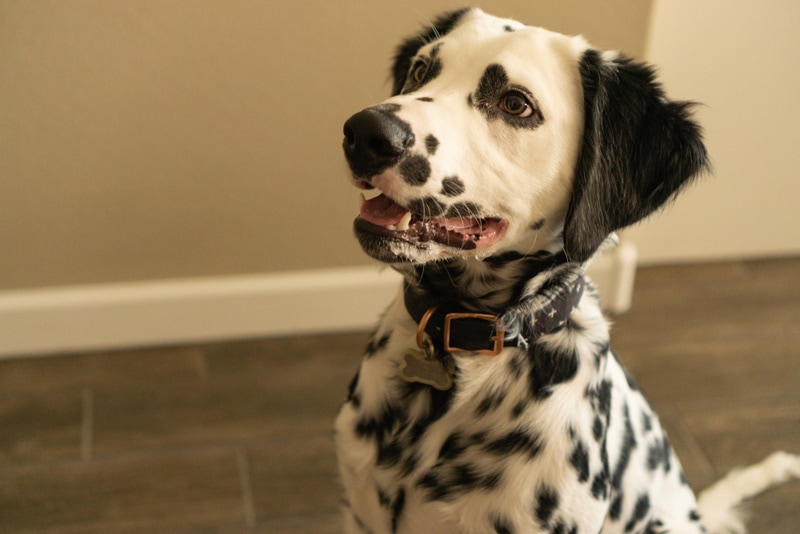
The Long Hair Dalmatian resembles any other Dalmatian with one difference—they have a long, feathery coat. The long coat comes from a naturally occurring recessive gene called the “long coat” or “LC” gene. They are considered purebred; however, they are not recognized by the American Kennel Club (AKC) as a standard breed like the short-haired version.
Dalmatians shed excessively, and the Long-Haired Dalmatian is no different. Their coat requires weekly brushing to keep tangles and mats down, but the cleanup is easier since the hair isn’t short and stiff and won’t get embedded in everything. The coat is silky and soft, and the thickness makes the dog better equipped for colder climates than a short-coat Dalmatian.
Long-Haired Dalmatian Breed Characteristics

The Earliest Records of the Dalmatian in History
Most everyone knows the breed from the hit movie 101 Dalmatians. However, the Dalmatian was a beloved working dog before they stole the hearts of millions upon the release of the 1961 movie. Researchers have worked to gather information regarding the origins, and it’s highly debated. So far, the origins have been pinned down to Europe, Britain, North Africa, and Asia.
Some believe their history began in Croatia. A Croatian bishop wrote about a white hunting dog with black spots from Dalmatia (a region in Croatia) in 1374, giving an indication that the bishop was referring to what we now know as the Dalmatian, but that hasn’t been verified.
Dalmatians became more common in the 1700s but gained popularity when some were shipped to England and the United States in the 1800s. They became well-known for their athletic build, intelligence, and unusual but beautiful spotted markings. The Long-Haired Dalmatian was more common during this time period; however, the public preferred the shorter coat, prompting breeders to comply with the demand, which is why the Long-Haired Dalmatian is rare today.

How the Dalmatian Gained Popularity
The Dalmatian gained popularity in the 1800s when people realized they could run alongside carriages during travels to protect the horses from other dogs and predators. Given their ability to be coach dogs, they soon became the mascot for firehouses in New York City in 1870. They aided firefighters by barking to alert the public of the imminent danger and rode along on calls to protect the firehouse carriage.
Dalmatians became popular after the hit film 101 Dalmatians was released in 1961. The movie sparked a craze for the dogs, but their popularity dwindled when some Dalmatian owners claimed the breed could be stubborn. Unfortunately, they were labeled as having a difficult temperament, and the demand declined. They are smart enough to be trained, but an owner must dedicate at least an hour of vigorous exercise daily to keep behavioral problems to a minimum.
Formal Recognition of the Dalmatian
The American Kennel Club (AKC) recognized the breed in 1888, but only Dalmatians with short coats conform to the breed standard. The Long-Haired Dalmatian is not recognized, but the hope is that one day, the AKC will recognize the longer coat as simply a breed variation. The Long-Haired Dalmatian is considered purebred, but they are disqualified from competing in shows because of the coat.
The Dalmatian Club of America is a 501c 3 organization established in 1995 to support rescue organizations, educate about the breed, and fund health research to benefit the Dalmatian.
Top 5 Unique Facts About the Dalmatian
1. They Are Born Solid White
Believe it or not, Dalmatians are not born with polka-dot fur; they are born solid white and remain spot-free until roughly 2 weeks of age. The spots continue to pop up and develop until the dog is over a year old.

2. They Have an Increased Risk of Deafness
Dalmatians can inherit a gene that causes deafness in one or both ears. It’s estimated that roughly 15% to 30% suffer some degree of deafness, with 5% being deaf in both ears. Deafness is caused by a lack of mature melanin-producing cells in the inner ear.
3. George Washington Was a Fan of the Breed
Our county’s first president had a Dalmatian named Madame Moose, whom he took along on duck-hunting outings. George Washington had many dogs over his lifetime, and it’s believed he paid 12 shillings for the dog in 1786.
4. They Have Many Purposes
Dalmatians are known to be hunting, herding, and ratting dogs, but they are also the only breed bred for “coaching,” which meant they could run alongside a horse carriage and clear crowds away so that the horses could pass through.
5. They Are an Old Breed
Even though their origins are not fully known, the Dalmatian is thought to have been around during Egyptian times. Paintings of spotted dogs running along carriages have been found on Egyptian tombs.

Does the Long-Haired Dalmatian Make a Good Pet?

The Long-Haired Dalmatian is an active dog that is gentle in nature and loyal to their owners. They have an even temperament and make excellent companion dogs. They shed frequently, just like any Dalmatian, and they are identical to shorthair Dalmatians in terms of personality and other traits. The only difference is the coat.
Dalmatians require a moderate amount of exercise. They love to swim, play fetch, and go on walks or runs with their humans. They are perfect for active families and make terrific watchdogs. They can be aloof with strangers, but they are gentle dogs that do well with children and other pets. They require daily mental stimulation to prevent boredom and form strong bonds with their human families.
Early socialization is recommended with Dalmatians for the best outcome for a well-behaved dog. Dalmatians are easy to train but can be stubborn, requiring patience. Stay the course with training; in the end, you’ll have a loyal, loving, gentle, and fun dog to add to your family.
Conclusion
The Long-Haired Dalmatian is no different from a shorthaired one regarding temperament and intelligence. The only difference between the two is the coat. While the Long-Haired Dalmatian is rare, finding one from a breeder is not impossible. If you find a breeder, ensure the breeder is reputable, has all necessary AKC paperwork, has performed a BAER test for deafness, and provides a genetic health guarantee.
Dalmatians can be stubborn regarding training, but with persistence and early socialization, they make excellent family companions. If you’re thinking of adopting one, ensure you have the time to devote to exercising your Dalmatian for at least an hour daily.
Related Read:
- Pug vs Bulldog: Differences Explained (With Pictures)
- How Big Does a Pug Get (With Weight & Growth Chart)
Featured Image Credit: SCEDIT, Shutterstock