Cane Corso vs Kangal: The Differences (With Pictures)

In this article
Lovers of giant, muscular, strong dog breeds have a good variety of breeds to choose from, ranging from almost any Mastiff breed to the giant Great Dane. Two other breeds that certainly qualify as giants are the Cane Corso and the Kangal. However, while these are both large breeds, and the two do share some similarities, there are plenty of ways that the two differ.
They originate from different countries and were bred for different reasons, and they have different physical appearances and characteristics, too. Also, while they are both giant breeds, the Kangal typically weighs noticeably more than the more muscular Cane Corso.
Read on for more details on these two breeds and to see some of the differences between the two breeds.

Visual Differences

At a Glance

Cane Corso Overview

The Cane Corse is an Italian Mastiff breed that was originally bred to hunt large game and to guard humans and their property, having been bred from Roman war dog stock. They would be used to herd some cattle, too, and this range of activities meant that the Cane Corso became an excellent all-rounder working dog. As machinery took over the roles of farm dogs, the Cane Corso fell out of favor somewhat, but efforts were made in the latter part of the 20th Century to reinvigorate the breed.
It wasn’t until 1988 that the Cane Corso was introduced to the U.S. and the breed gained formal recognition from the American Kennel Club in 2010.
Personality/Character
The Cane Corso originates from war dog lineage and was favored as a working dog because of its relentless and tireless attitude. The breed is very intelligent and can attempt to boss its humans around if it doesn’t get consistent and masterful training from its handler. The Cane Corso can become aggressive if it doesn’t receive appropriate training, and it has been outlawed in several countries around the world.
Potential owners should always check local laws to ensure that the breed is not banned or restricted.
Training 🎾
The Cane Corso is a very intelligent breed and is often described as being the most intelligent of the Mastiff breeds. While this intelligence is a good thing for an experienced handler who is willing to put in the time and provide consistent training, it also means that without good training, the breed can make up its own rules and may expect people to follow.
When this happens, the dog can use its size and power to command its humans. Start training early, ensure good socialization from a young age, and never let Cane Corso be the “boss” of the house.

Health & Care
Giant breeds are prone to dysplasia and the Cane Corso is no exception. The breed is also prone to entropion and ectropion, which are malformations of the eyelids and may also suffer from bloat. To try and avoid these problems, buyers should always ensure that a breeder has health screening checks for dysplasia and good eye health from the parents.
The most demanding aspect of Cane Corso care is exercise. These are giant breeds but they do require a lot of exercise: typically at least two hours a day, including walks as well as more intense exercise.
The breed can benefit from being enrolled in any of a wide range of canine sports and activities.
Suitable For:
Experienced dog owners who are looking for a companion or working dog that can dedicate a lot of time to training, socialization, and regular exercise.

Kangal Overview

The Kangal, which is more properly known as the Kangal Shepherd Dog, is of Turkish origin and was originally bred to watch over livestock in the field. According to some reports, the dogs were first used to ward off bears, which would explain their giant size.
The breed was introduced to the U.S. in 1985 and while the breed is still used as a working dog, it is also seen as a family pet, although it is not a common breed.
Personality/Character
The Kangal Shepherd Dog is often described as being a gentle giant. It has a huge frame and can be very protective over family and possessions but it forms a close and loving bond with humans. It is also said to be gentle with children, seemingly having an understanding of its relative size and potential for causing harm. Like the Cane Corso, the Kangal does require training and socialization from an early age.
Training 🎾
The Kangal is a working dog and it needs a physical and mental outlet. Provide 2 hours of exercise a day, including walks on a leash as well as more strenuous exercise. You should start training and socializing the Kangal as soon as possible, too, to ensure that it doesn’t recognize every person or animal as being a potential threat to you and your family.
The size and strength of the dog mean that it is especially skilled in physical canine sports, such as pulling events.

Health & Care
While the Cane Corso has a short coat, the Kangal has a thicker and slightly longer coat. Although it is still relatively easy to maintain, it will require some more maintenance than the Corso. Dysplasia is common in this breed, too, along with tumors and entropion. Enrol with a vet as soon as you get your Kangal and ensure you visit for any potential problems.
Suitable For:
An experienced dog owner who is willing to exercise their pup at least 2 hours a day and that will provide regular socializing and training from a young age.
Physical Differences
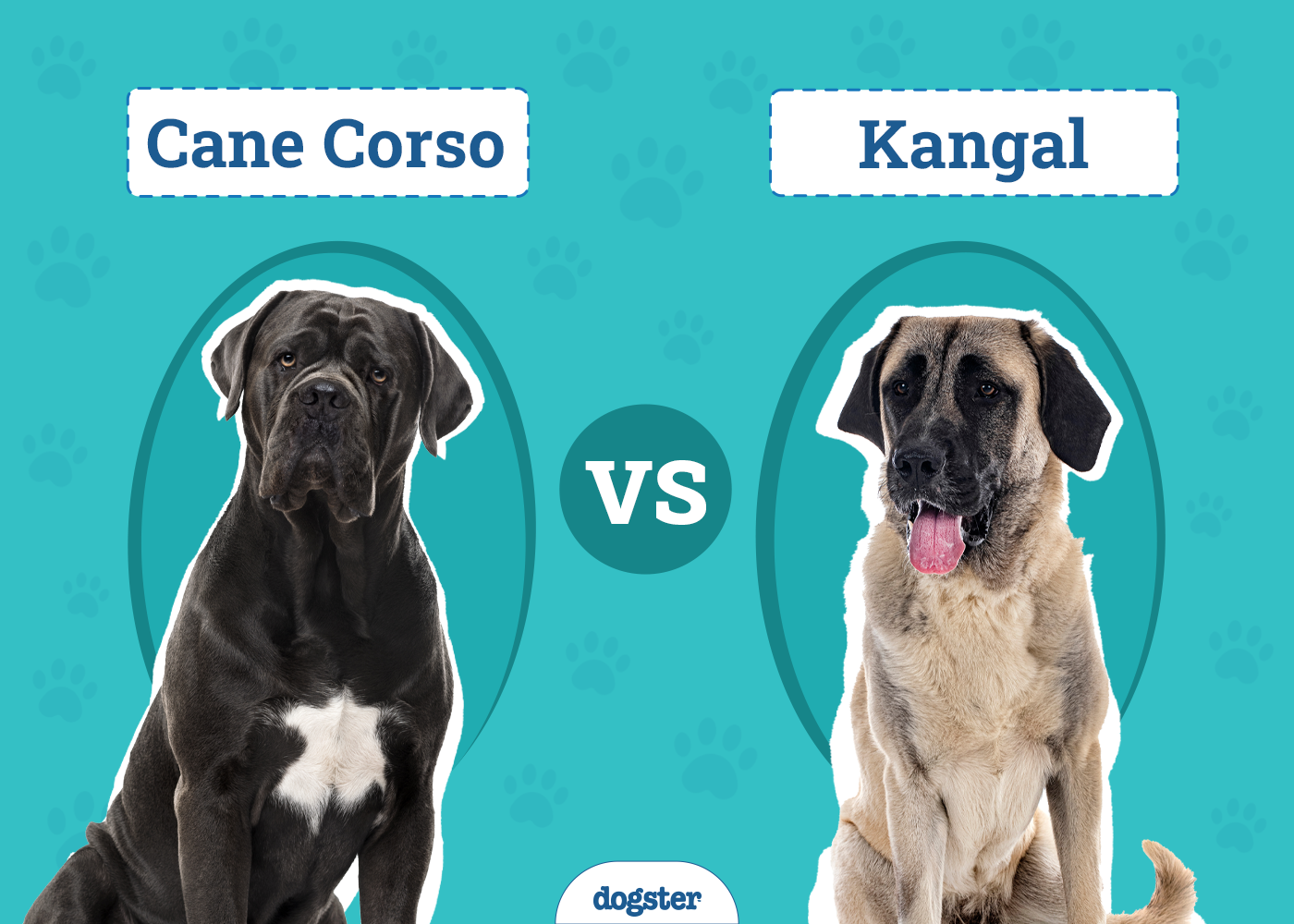
Although both breeds are considered giant, and the Cane Corso is certainly not a small dog, it is the Kangal that is the larger of the two breeds, potentially weighing up to 30 pounds more. There are other physical differences, too.
While the Cane Corso has short hair, the Kangal has a thicker and slightly longer coat. The Kangal is typically a tan color while the Cane Corso can come in a range of different colors including tan but also black, brown, and gray.
The Cane Corso has a square-looking head with pointy ears and is more jowly. It also has droopy eyes, whereas the Kangal has a more rounded head, floppy ears, and does not tend to have the same dropping eyes.
Care & Health Differences
There are a few care and health differences between the two breeds. Both require around 2 hours of exercise a day and both require consistent training and early socializing. But the droopy eyes of the Cane Corso mean that it is more prone to eye conditions than the Kangal. Both breeds, because of their size, are somewhat prone to dysplasia of the joints and may suffer from bloat.
Banned Breeds
Both the Cane Corso and the Kangal have been banned in at least one country. Potential owners should check their national and local laws to determine whether either of these breeds are prohibited, because in most cases if the authorities find a banned breed, it will be removed and destroyed, and the owner can be faced with financial penalties and potentially even a prison sentence.
Which Breed Is Right for You?

Both of these breeds are giant breeds, weighing in at 100 pounds, in the case of the Cane Corso, and up to 140 pounds for the Kangal. Both have been used to protect livestock, and both have the potential to be difficult and possibly even aggressive if they don’t get the appropriate training and socialization.
There are differences between the breeds, as well. The Cane Corso has pointy ears while the Kangal has floppy ears. The Cane Corso has drooping eyes, while the Kangal does not. Although both breeds can be good with children, the Kangal has something of a reputation for being a gentle giant with the children in its family, but with dogs of this size, there is always a danger of accidental injuries at the very least.
See also:
Expert dog care, straight to your inbox
News, insights, expert advice, and everything dog.

No spam — unsubscribe anytime.
By signing up, you agree to our Terms & Conditions and Privacy & Cookies Policy.
How useful was this post?
Click a star to rate. You can leave written feedback afterwards. (We read all feedback.)
Nicole has loved animals of all sizes her whole life so it's no wonder she has dedicated her career to helping them through what she loves best: learning, writing, and sharing knowledge with others. She’s the proud mom of two dogs, a cat, and a human. With a degree in Education and 15+ years of writing experience, Nicole wants to help pet parents and pets around the planet to live happy, safe, and healthy lives.