My Dog Ate Cardboard: Should I Be Worried? Our Vet Answers

In this article
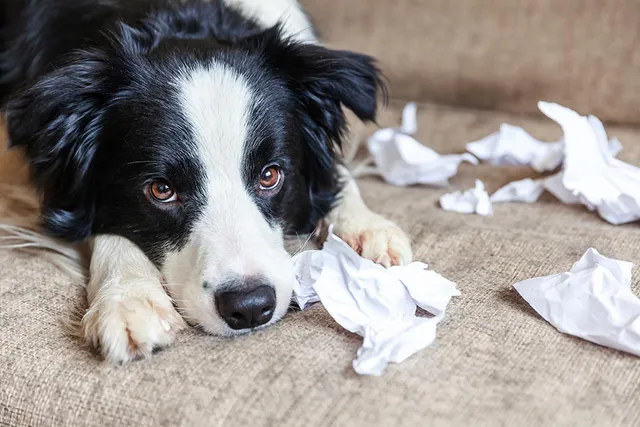
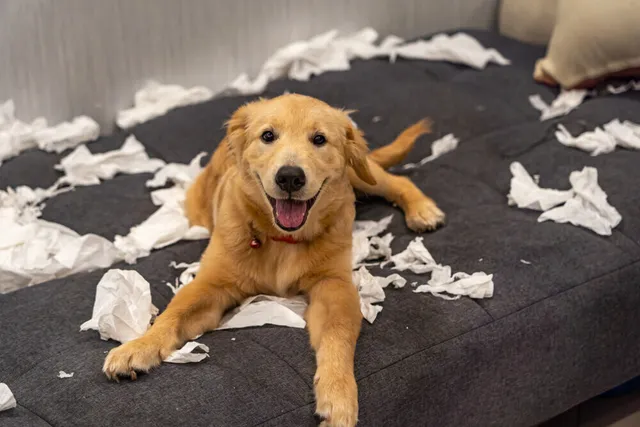
Most dogs enjoy chewing on cardboard, but what makes it so special? When a dog decides to eat the cardboard they’re chewing on, is it hazardous? Most of the time, if a dog eats some cardboard, it’s no big deal. If they eat a lot or they have really bad luck, though, this material is an obstruction risk to worry about, so here’s what you need to know about the situation.

Why Do Dogs Eat Cardboard?
Of all the items in your house, why would a dog choose to eat cardboard? It isn’t made of anything nutritious, it doesn’t smell like an animal, and in theory, it doesn’t taste good, so why do many dogs love to rip it up and swallow it?
Cardboard is popular for a few reasons. In terms of chewing, it essentially has a good mouth feel, like rawhide. It also makes pleasing sounds when it's chewed. Cardboard is used in the packaging for many dog toys. A dog may already be associating it with a toy, which they would normally put in their mouth and are also at risk of ingesting.
Cardboard boxes, in particular, have interesting smells after going through the mail system. They may even have something on them that a dog likes, which significantly increases the chances that the dog decides to eat the cardboard instead of just chewing on it.
Anxious dogs will do what they can to self-soothe. Bored, anxious, scared, stressed dogs left to their own devices may start chewing on cardboard simply because it’s available and satisfying to chew. With nothing else to do, deciding to eat things around the house, including cardboard, isn’t abnormal.
Lastly, some dogs are mentally inclined to eat things that aren’t food. This condition is called pica.

What Is Pica?
For dogs that don’t seem to know not to eat non-food items, their disorder is known as pica. Dogs with pica may simply have an interest in eating things they shouldn’t, but sometimes this can be due to nutritional deficiencies. To decide to eat the cardboard rather than just chew on it, a dog usually needs to be bored or have pica unless the cardboard, like a pizza box, has an appealing smell.
Dogs with pica can cause themselves a lot of harm, including breaking teeth, ingesting toxins, breaking out of areas, and eating obstructive materials that require surgery to remove. If you have a dog with pica, it is important to carefully regulate their environment for their safety and work with your veterinary team and a trainer or behaviorist to get to the bottom of their reason for having pica so you can help them if possible.
Is Cardboard Toxic to Dogs?
The good news is if your dog eats cardboard, you don’t automatically have a problem because cardboard isn’t toxic to dogs. While cardboard can have something on it that is toxic to dogs, usually, it wouldn’t be in a quantity large enough to hurt them.

What to Worry About When Your Dog Eats Cardboard
The risk of a dog eating cardboard is that it can get stuck in their stomach or intestines. Cardboard isn’t food, and they can’t digest it. Eating small amounts or small pieces is usually fine. It isn’t a sharp object and will usually pass through their GI tract unnoticed or, at worst, cause some mild GI upset.
If a dog is swallowing large pieces of cardboard or eats a lot of it, the cardboard can get lodged somewhere in the GI tract, usually the bottom of the stomach or the small intestines, which can be an emergency. In a normal GI tract, rhythmic contractions throughout the GI tract and strategically placed sphincters keep food, which becomes digested, moving onward through the GI tract until it is expelled as poop.
A GI obstruction occurs when something is stuck in the GI tract and stops being moved forward by those contractions. A GI obstruction can be partial or complete. In most cases, the GI tract continues to contract even though something is stuck. In a partial obstruction, some fluid can still make it past the obstruction, just slowly, with a lot of painful inflammation and gas build-up, or the obstructed object does continue to move but much more slowly, again causing pain, inflammation, and bloating.
Complete obstructions occur when something is stuck and not moving, and nothing else can get around it.
What Are the Signs My Dog Is Ill Because They Ate Cardboard?
Whenever a dog eats anything outside their regular diet, they are at risk for mild signs of GI upset, such as diarrhea, vomiting, mild lethargy, or inappetence. This may develop within a day or so if your dog eats cardboard. If a dog is experiencing a GI obstruction after ingesting cardboard, they will likely stop defecating and vomiting.
If a dog can’t keep anything down and is vomiting anything you give them, even water, that is a bad sign. If a dog is also given anti-nausea medication and still can’t keep anything down after eating some cardboard, it indicates that they have an obstruction. These dogs will also usually be lethargic and have tense, painful abdomens. You may see them trying to stretch their bellies to relieve pressure (unsuccessfully), vocalizing, or collapsing entirely.
If a cardboard ingestion obstruction goes untreated for too long, the wall of the area of the GI tract can die from the pressure and inflammation around the cardboard and cause a leak. Leaking ingesta, stomach acid, or feces into the abdomen will often cause extreme pain in the belly and lethargy, and they need to go to the ER immediately.

How Is Cardboard Ingestion Treated?
For mild cases with minor GI upset, a bland diet is usually enough to help these dogs recover. A veterinarian can help with GI protectants, anti-diarrheal or anti-nausea medication, and sometimes even appetite stimulants for dogs feeling under the weather.
If a dog has a GI obstruction after eating cardboard, it must be removed one of two ways, both under general anesthesia. An endoscopy can be performed if the cardboard is in the esophagus or stomach, in which a camera is passed through the upper GI tract to the object and is grabbed with the scope to pull it back out of the dog’s mouth with no incision needed.
Otherwise, in cases where this cannot work or when endoscopy is unavailable, the dog will need surgery to remove the cardboard and potentially remove any dead GI tract tissue.
How Do I Keep My Dog From Eating Cardboard?
While in most cases, nothing bad happens when a dog eats cardboard, if that description of GI obstructions has you worried, you may want to know if there’s a way to train your dog not to eat cardboard. While it can be tricky to teach a dog not to eat cardboard, there are some ways to intervene.
By working with a trainer or behaviorist, you can identify possible triggers, like boredom or separation anxiety, that may be responsible for the behavior. A veterinarian can also screen for potential nutritional deficiencies. These changes may help your dog learn not to eat cardboard going forward.
For many dogs, it’s impossible to train them never to eat cardboard when unsupervised within the limits of the average family home and training schedule. Keeping the cardboard in an inaccessible area, securing cabinets, using recycling containers with lids and locks, and keeping it out of your yard can prevent your dog from eating it.
If you are home and would like to unpack impulse purchases in peace, training a “leave it” command for your dog can be very helpful. If your dog can be consistently relied upon not to eat something when you ask, it can make your home a lot safer for your pup.

Frequently Asked Questions
How Long Does It Take to Know if My Dog Has an Obstruction After Eating Cardboard?
Usually, dogs will start to show signs within 12 hours, but it can take a couple of days, especially if initial signs are subtle or they start with a partial obstruction.
Can I Give My Dog Something to Help Them Pass the Cardboard They Ate?
While there are some examples of things you can give a dog to help them pass foreign objects like cardboard, it is best to have them checked by a veterinarian first since doing this isn’t always recommended depending on what they ate, when, and how sick they may be. If a veterinarian thinks it’s a good idea, they can recommend their favorite home treatment after checking the dog first.
How Much Does It Cost to Remove a Blockage From a Dog?
Cost can vary widely as different procedures may need to be done, the hospitalization duration variese, and the cost depends on your location. Generally speaking, these procedures or surgeries cost at least $1,000 but can climb even higher than $10,000 after that in some cases.
Summing Up
Most of the time, when a dog eats cardboard, it’s no big deal, and they never show signs of a problem. If the cardboard doesn’t sit right with their stomach, they may experience some mild diarrhea, vomiting, or inappetence. In severe cases, the cardboard can get stuck in their GI tract, causing a GI obstruction, which can be an expensive and potentially fatal medical emergency.
If you know your dog ate cardboard, it is best to decide how much they ate if you can tell. Unless a dog is already acting sick or you know they ingested a significant amount, it is usually okay to not do anything unless a problem arises. Be sure to watch your dog carefully over the next few days. It's vital to check their stools for confirmation they’re passing the cardboard and watch for the first signs of a problem.
Related Reads:
Expert dog care, straight to your inbox
Vet-reviewed advice, training tips, and the best of Dogster. Free, and you can unsubscribe anytime.
By signing up, you agree to our Terms & Conditions and Privacy & Cookies Policy.
Dr. Maria Zayas DVM (Veterinarian)
Dr. Zayas is based in Colorado with her animal friends - her dogs, cat, and fish. Maria has a strong passion for sharing her extensive knowledge about dogs to as many people as possible. With global travel experience, she prioritizes delivering accurate, informative responses to her clients' inquiries. Specializing in house-call veterinary care, she focuses on allergies, pain management, and tailored solutions for dog health care, stemming from a diverse background in shelter medicine and home health. Dr. Zayas holds a Bachelor's degree from Bryn Mawr College and a Doctor of Veterinary Medicine degree from Ross University School of Veterinary Medicine.
Join the conversation
Ask a question, share your story, or send private feedback.