Lyme Disease in Dogs: Causes, Signs & Treatment (Vet Answer)


In this article
When you think of Lyme disease, you probably automatically think of ticks, but did you know ticks aren’t the cause of Lyme disease? Ticks are a “vector” for the disease, meaning they carry and spread it. But not every tick will carry Lyme disease. So, what is the actual cause of Lyme disease? How can you protect your dog? And what do you do when you think your dog has Lyme disease? In this article, we’ll provide the answers and much more.

What Is Lyme Disease?
Lyme disease is a tick-borne illness. Dogs, people, and other animals can contract it, but the illness cannot spread directly between mammals. It is prevalent in the Northeast, Mid-Atlantic, and northern Mid-West US states, but it has been seen in every state.
Lyme disease is considered a zoonotic disease, meaning it is spread from animals to people. Unlike many zoonotic diseases, Lyme disease requires a vector to spread. This means you won’t get Lyme disease directly from your dog, but you can get it if bitten by the same ticks that infect your dog and other mammals.

What Are the Signs of Lyme Disease?
Forget what you probably know about Lyme disease in people, as dogs usually react differently. Only around 5% of infected dogs will show any signs of illness, as opposed to 90% of humans. Therefore, most dogs become asymptomatic carriers of Lyme disease.
While people show serious signs of Lyme disease within weeks, most dogs only show signs two to five months after initial infection.
Signs of Lyme disease in dogs include:
An uncommon but severe complication of Lyme disease is kidney damage. Lyme disease can cause inflammation of the nephrons in the kidney (nephritis). Young to middle-aged Retrievers appear to be more susceptible to Lyme nephritis.
It may lead to signs like:
What Causes Lyme Disease?
Lyme disease is caused by the bacteria Borrelia burgdorferi, which is part of a family of coiled bacteria known as “Spirochetes.” The deer tick or black-legged tick (Ixodes spp) is most notorious for spreading the Lyme disease bacteria. The bacteria use the lifecycle of the tick to move between hosts.
When larvae hatch, they must immediately feed. They usually attach to a small animal like a mouse. If the mouse is carrying Borrelia burgdorferi, the tick will become infected upon feeding on its blood. Ticks don’t suffer any adverse effects from the spirochete bacteria but will harbor it throughout life.
About a year later, the larval tick becomes a nymph or juvenile tick. The nymph can feed on small or larger mammals, including humans and dogs, transmitting Lyme disease to them. After a few months, the nymph molts into an adult tick, which continues to feed on large mammals like deer, humans, and dogs, spreading the disease.
Thankfully, transmitting Borrelia burgdorferi from tick to mammal takes around 48 hours, meaning that Lyme disease can be prevented with timely tick removal. Once the bacteria enter the dog’s blood, they are carried throughout the body, especially to the joints or kidneys.
If you are concerned about the health and well-being of your pet, seek veterinary advice for the best course of action.
How Do I Care for a Dog With Lyme Disease?
If you suspect your dog has Lyme disease, you must work with your vet to help your dog. There are a couple of ways you can help your dog.
Prevention
This won’t help you if your dog already has Lyme disease, but an ounce of prevention is worth a pound of cure. If you have other dogs or your dog hasn’t contracted Lyme disease yet, you should carefully prevent their exposure to ticks.
You can also have your dog vaccinated against Lyme disease, especially if you live in a prevalent area and your dog is regularly exposed to ticks. You should ask your veterinarian whether this vaccination is suitable for your dog.

Seek Veterinary Treatment
If your dog is unwell, you should take them to the vet. The vet will take a thorough history and examine your dog to determine if a blood test for Lyme disease should be performed. Your vet can also order blood and urine tests to rule out Lyme nephritis.
Sometimes, blood testing is done annually in endemic areas or 4–6 weeks after a known tick bite to detect dogs exposed to Lyme disease. Knowing if your dog has been exposed helps you monitor them closely for signs of illness.
If your dog has Lyme disease, they will be prescribed antibiotics. Doxycycline is the most common antibiotic used. A 4-week course is usually needed to clear the infection, but sometimes a second round of antibiotics is required. Other than that, the treatment may be focused on relieving joint pain or other symptomatic treatment.
Dogs with kidney damage will need hospitalization for fluids, monitoring, and other supportive treatments. For example, immunosuppressive medication can reduce kidney inflammation, benazepril reduces protein loss from the kidneys, and anti-nausea medication makes your dog feel better.


Frequently Asked Questions (FAQ)
Can a Dog Survive Lyme Disease?
Yes, most dogs survive Lyme disease. Asymptomatic and mildly affected dogs usually have a good prognosis and recovery. Some dogs will have ongoing joint pain that needs to be managed.
Those who do not survive usually develop a complication known as Lyme nephritis, which causes kidney damage. While this only occurs in around 1%–5% of infected dogs, if your dog develops this complication, the prognosis is poor.
Where are Ticks Most Commonly Found on Dogs?
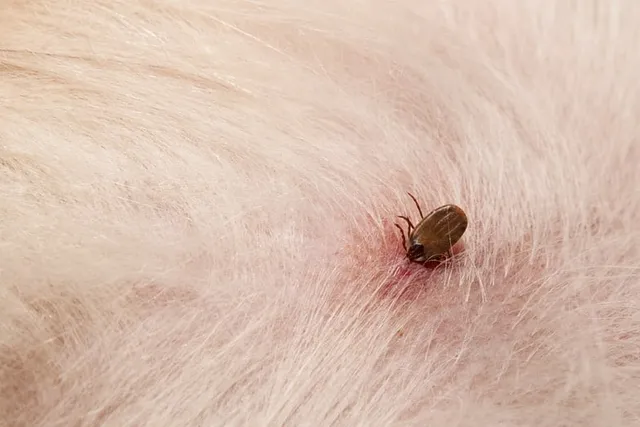
Most ticks are found on the head and neck. You can search your dog by running your fingertips all over their skin, under the hair. If you feel a lump, it could be a tick. Ticks can be very small, especially nymphs, which are about the size of a poppy seed. You should inspect your dog’s whole body for ticks.
Make sure you look:
What Should You Do After Finding a Tick on Your Dog?
If you find a tick, you can use tweezers, or even better, a tick remover, to get it off your dog. If you get the tick off within 2 days of it attaching, you can prevent your dog from getting Lyme disease.
Wear gloves, use tweezers to grasp the tick as close to the skin as possible, and pull slowly outwards. If using a tick remover, place the tick into the notch on the tool and twist it to remove the tick, as shown in the video below. Dispose of it somewhere it cannot bite another animal or human.
Then, disinfect the site of the tick bite with a dog-safe antiseptic, such as chlorhexidine solution. Monitor the site and contact your vet if you notice any redness, swelling, or discharge.
Conclusion
Lyme disease is caused by bacteria that is spread by ticks. Not every tick bite will transmit Lyme disease, and not every dog with Lyme disease will become ill, but since there is a risk of severe complications of Lyme disease, you should never be complacent about it.
Tick control is the best way to protect your dog against Lyme disease, followed by veterinary treatment as soon as possible if your dog becomes unwell. You must be vigilant about Lyme disease, especially if you live in a prevalent area.
See Also:
Tick Paralysis In Dogs: Our Vet Explains The Signs, Causes, and Treatments
Anaplasmosis In Dogs: Our Vet Explains the Signs, Causes & Treatment
Featured Image Credit: Zontica, Shutterstock
Expert dog care, straight to your inbox
News, insights, expert advice, and everything dog.

No spam — unsubscribe anytime.
By signing up, you agree to our Terms & Conditions and Privacy & Cookies Policy.
How useful was this post?
Click a star to rate. You can leave written feedback afterwards. (We read all feedback.)
Dr. Ashley Darby BVSc (Veterinarian)
Dr. Ashley has worked in mixed and small animal emergency clinics and general practice ever since 2017 after studying Sydney University. She grew up in South Africa and England before moving to Australia, and her passion for animals came from many childhood safaris in the Kruger National Park.
Ash lives with her husband, two happy Springer Spaniels, and one very patient black cat. She also competes in equestrian sports with her horse, Atlas.