What Does Pet Culture Look Like in France? How They Fit In


If a move or visit to France with your furry friends is on the cards or something you’re thinking about, and you want to know what pet culture looks like in Europe’s third-largest country, you’ve come to the right place.
First of all, you can relax—France is a largely pet-friendly country, especially for dogs and cats. In this post, we’ll explore various aspects of pet culture in France to give you a clearer picture of what to expect. We’ll discuss pet ownership stats, vet care, banned breeds, transport regulations, and more.

Pet Ownership in France: Statistics
Cats are the most common and popular pets in France, closely followed by dogs. The 2022 FEDIAF report revealed that, in 2021, there were 15,100,000 cats and 7,500,000 dogs in France.
Compared to the rest of Europe, France had the third-highest number of cats after Russia and Germany, and the sixth-highest number of dogs after Russia, the UK, Germany, Spain, and Italy.
The report also showed that there were 5,300,000 ornamental birds, 2,291,000 aquarium animals (fish, etc.), 3,600,000 small mammals, and 3,300,000 terrarium animals (tortoises, etc.). In terms of households in France owning at least one cat or dog, the report estimated that 33% own a cat and 20% own a dog (FEDIAF).

Pet-Friendly Establishments
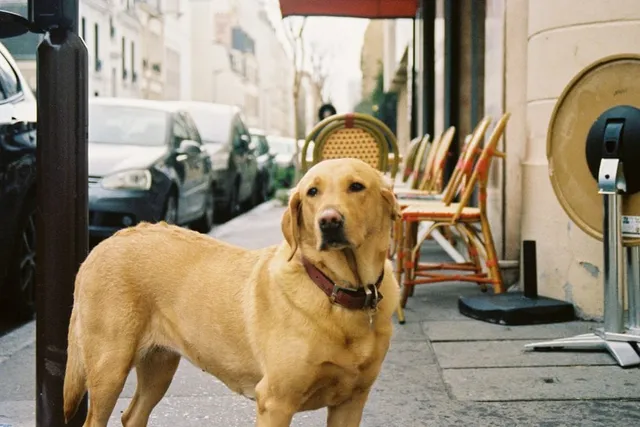
Many bars, cafés, and restaurants in France welcome well-mannered dogs, often on the terraces outside, but sometimes inside, too. In my experience, I’ve sometimes seen owners even popping into bakeries and shops with their dogs.
Dogs are also typically welcome in parks (though not all), and some parks have dog-dedicated free-roaming areas. Owners are, of course, expected to pick up after their dogs and can be fined if they fail to do so.
If you plan to head to a restaurant, bar, or café with your pooch, it’s best to call ahead first to make sure they’ll be welcome. If you’re popping into an establishment spontaneously, look for signs on the door that read “chiens interdits” (dogs forbidden) and/or ask the staff before entering with your dog.
Transport
Trains in France are quite pet-friendly, as long as you follow certain rules. Pets must either be inside a pet carrier or leashed and muzzled if they cannot fit inside a pet carrier. Leashed and muzzled dogs have to sit at your feet throughout the journey. You must carry your pet’s ID papers and purchase a ticket for your pet, but guide dogs go free and do not need to be muzzled.
Small dogs that can fit into a carrier (i.e. dog bag or basket) are allowed on buses, the metro, the RER, and trams, as long as (according to the official guidelines) they don’t bother other passengers.
If your dog cannot fit into a carrier, again, the rules state that they must be muzzled and leashed to go on the metro or RER, but they are not allowed on buses or trams. There is no extra charge for taking dogs on the bus, metro, RER, or tram.
Guide dogs are, of course, also welcome as long as they’re either harnessed or wearing a training jacket depending on the situation. You must also carry forms of identification for your dog (i.e. ID card, trainer’s card, and/or orange-colored disability cards). These also differ depending on the situation—you can find the full list of requirements on RATP’s website.

Restricted Dog Breeds in France
Unfortunately, some breeds of dogs are restricted in France, and it’s important to know which breeds fall into this category beforehand. Restricted breeds fall into two categories—category one and category two.
Dogs in the first category are heavily restricted. It is illegal to own a category one dog without a license of aptitude, and these dogs cannot be imported into France.
Dogs in category two are permitted only if the owner has a license and follows certain rules, but they are less restricted than category one dogs. For example, category two dogs can be imported into France if they meet certain requirements, whereas category one dogs cannot.
Category two dogs can also enter public spaces and transport as long as they’re leashed and muzzled. Below are the breeds in categories one and two.
Category One
- American Staffordshire Terrier-types
- Mastiff-types
- Tosa-types
Category Two
- Purebred American Staffordshire Terrier
- Purebred Rottweiler
- Rottweiler-types
- Purebred Tosa

Microchip and ID Laws
Dogs, cats, and ferrets are legally required to be registered in the national pet identification system, which is managed by I-cad. Identification can be in the form of an ear tattoo or microchip. If you change your address or phone number, it’s important to update your details with I-cad.
Veterinary Care
It isn’t hard to find a great vet in France. My own experience of vet care in France has been positive so far—I’ve found vets and staff at both of the clinics we’ve chosen for our pets to be caring, friendly, thorough, and professional. There is also the option to see an emergency 24/7 vet should you ever need one.
A vet consultation typically costs between 30 and 50 Euros, and vaccinations typically cost between 50 and 80 Euros. Microchipping tends to fall between 50 and 70 Euros and spaying and neutering are between 100 and 300 Euros, with spaying being the most expensive of the two procedures.

Petsitters
If you ever need someone to take care of your pet while you’re away, it’s a good idea to check out petsitting and boarding sites and apps. On these, you can read reviews of petsitters operating near you and choose the most ideal sitter for your pet’s needs.
Nutrition
Food for dogs, cats, and small mammals is commonly sold in supermarkets, pet stores, garden centers, and sometimes hardware stores in France. It isn’t hard to find popular brands like Royal Canin and Purina Pro Plan, and there are typically multiple options available. If you prefer feeding a raw diet, your best bet is to order from a French raw pet food website.
It may be a bit harder to find food and supplies for reptiles, but this shouldn’t be too much of a challenge. We’d recommend checking out garden centers, larger pet stores (animeralies), and online stores.

Pets for Adoption
If you’re thinking of adopting a pet in France, you have plenty of options. La Société Protectrice des Animaux (SPA) has thousands of cats, dogs, small mammals, and more waiting for loving homes, some of which urgently need to be adopted. Sadly, around 60,000 pets are abandoned by their owners in France each year in the lead-up to summer.
Conclusion
In conclusion, France is a largely pet-loving nation with around one-third of the population owning a cat, and around one-fifth of the population owning a dog. Dogs are often welcome in public places, though this shouldn’t be taken for granted—always check ahead of time to avoid disappointment—and there is a wide pool of veterinary professionals to choose from.
On the downside, if you own a restricted breed of dog, like an American Staffordshire Terrier-type or Tosa-type, you won’t be allowed to enter France with your dog. If you own a category two breed, you will face restrictions while in France.
We strongly recommend checking out France’s laws on restricted breeds in full if you’re thinking about traveling with your dog. Also, speak to your vet well in advance about preparing your pet for travel to France—the earlier, the better, as, in some countries, this process can take several months.
Sources
Statistics
Other
https://www.sncf.com/en/passenger-offer/travel-for-everyone/pets
https://agriculture.gouv.fr/les-chiens-de-categorie-1-et-2-dits-chiens-dangereux
https://www.sncf.com/en/passenger-offer/travel-for-everyone/pets
https://www.eurotunnel.com/uk/holiday-ideas/doggy-dining-in-france
https://www.petrelocation.com/blog/post/dogs-and-cats-in-france
https://www.la-spa.fr/adoption/?search=1&page=1&full=1&seed=822112676638463
https://fr.statista.com/themes/3183/les-francais-et-les-animaux-de-compagnie/#topicOverview
Featured Image Credit; MHFotografie, Shutterstock
Expert dog care, straight to your inbox
Vet-reviewed advice, training tips, and the best of Dogster. Free, and you can unsubscribe anytime.
By signing up, you agree to our Terms & Conditions and Privacy & Cookies Policy.
Kit Copson is a freelance writer and lifelong animal lover with a strong interest in animal welfare. She has parented many furry beings over the years and is currently a proud cat mom of two—one very chilled (unless hungry) Siamese and a skittish but adorable Domestic Shorthair—and dog mom of one—an adopted Bichon Poodle cross. When not writing about or spending time with pets, Kit can be found drawing in her sketchpad, reading, or more often than not, drinking tea.
Join the conversation
Ask a question, share your story, or send private feedback.