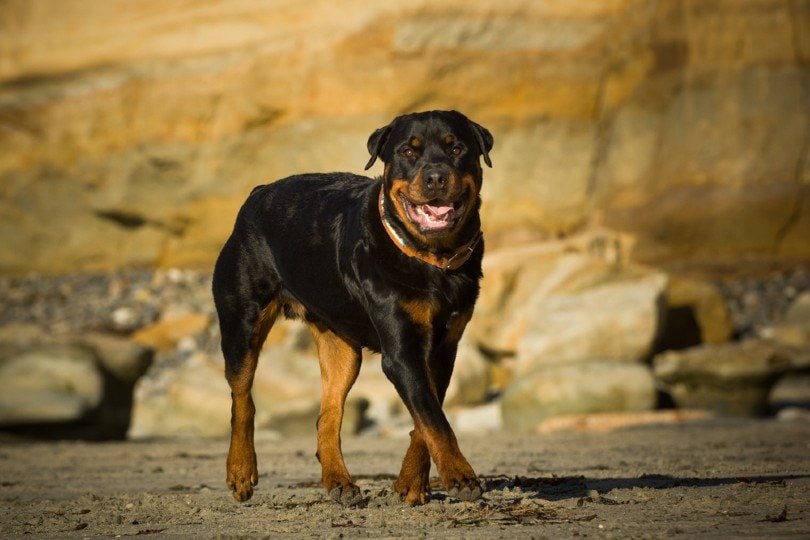
The Rottweiler is one of the most recognizable breeds today. Even people who prefer small dogs often can identify a Rottweiler with just one glance. While many people can recognize the Rottweiler, their history and origins are long and varied, which means only true Rottweiler fans know the full background of this unique dog.
For example, the Rottweiler has one of the longest histories, dating back to the time of the Roman Empire. Also, these dogs are highly intelligent and can learn tough skills in no time. To learn the history, origins, facts, and more of the Rottweiler, read on!

Where Are Rottweilers From?
The formal history of the Rottweiler began in 1901 when the International Club for Leonbergers and Rottweiler Dogs created the first standard for the breed. This recognition occurred in the country of Germany, which means Germany is the formal country of origin for the Rottweiler, but the history of the Rottweiler is much messier than that answer implies.

The Rottweilers’ Ancient Roots
The reason we used the word “formal” is that Rottweilers have a long history that predates the modern countries we are familiar with. The Rottweiler is considered one of the oldest breeds because it is descended from drover dogs used by the Roman legions.
Whenever the Roman Empire reigned over Europe, they used drover dogs as their cattle-driving dogs. It wasn’t until the 2nd century that the Romans abandoned most of their locations in Europe, leaving what would become the Rottweiler in Rottweil, Germany, after which the dog was named.
Of course, the Rottweiler of the 2nd century was very different from the Rottweiler today. Nevertheless, the Rottweiler is one of the few breeds that we can trace back this early in history.
Butcher Dog in the Middle Ages
After the Roman Empire left Germany, the Rottweiler became a working dog, especially for local butchers. When on buying expeditions, the Rottweiler would accompany butchers by carrying money, acting as a guard dog, and driving cattle.
Because of this butcher dog background, the Rottweiler was constantly around people, which is largely responsible for their compassionate, bubbly, and sociable nature today. More so, they had to defend the butcher in case of robbery, allowing the dog to learn crucial guarding skills and loyalty.
From the Middle Ages to around 1900, the Rottweiler was primarily used for these purposes. They acted as a working dog that was still a part of the family, especially in continental Europe.

Near Extinction During Industrialization
During the middle of the 1800s, the Rottweiler almost became extinct. Because of industrialization, the need for Rottweilers decreased dramatically. Butchers didn’t need them for herding cattle, and they didn’t need as much protection on the road.
Luckily, there were a few Rottweiler lovers who continued to breed the species. It is from these people that the Rottweiler avoided extinction during the 1800s.
The Rottweiler Today
Today, Rottweilers are known as “gentle giants” because of their bulky stature and calm personality. Although people don’t use working dogs as formally as they did in the past, Rottweilers are still loved for their working background.
Many people introduce Rottweilers into their homes to act as guard dogs, protect children, or keep up with active families. Even though these dogs descended from cattle-driving dogs, most people prefer sheep dogs and other working dogs for that purpose today.


Rottweilers Are One of the Most Intelligent Dogs
Because of the Rottweiler’s long and varied history, this breed is considered one of the most intelligent today. Nearly all experts rate the Rottweiler as being the ninth most intelligent breed. This placement is based on three qualifications: obedience, instinct, and adaptive intelligence. The Rottweiler scores highly in all areas.
Obedience and Training
As you would expect from any intelligent dog, Rottweilers are obedient and easy to train. Many Rottweilers can learn new commands and tricks in under five repetitions. Some Rottweilers can learn in only one.
Moreover, Rottweilers are good at what they were bred for. In other words, most Rottweilers have a strong instinct about how to be a working dog and perform various tasks at hand.
Adaptive Intelligence
Arguably, the most impressive aspect of the Rottweiler’s intelligence is their adaptive intelligence. This refers to a dog’s ability to learn by watching other people or from their own past. The majority of dogs have very low adaptive intelligence and must be trained as a result.
Rottweilers are so intelligent that they can easily watch you or other dogs to pick up on commands or situations. Likewise, they can problem-solve and learn from their own past to solve difficult problems at hand. This adaptive intelligence is what really allows Rottweilers to stand out.

Gentle Giants
One of the most interesting characteristics of the Rottweiler is their gentle demeanor. Unlike most other working and guard dogs, Rottweilers love people and are quite sociable. They are unlikely to be outright aggressive unless abused or outright taunted.
Rottweilers are often ranked as being some of the most compassionate, cuddly, and affectionate dogs. Even around newcomers and children, Rottweilers warm up very quickly and beg for more attention and playtime.
Their gentle demeanor extends beyond just people. Rottweilers have surprisingly low prey drive, which means they aren’t known to chase or hunt as much as other big dogs. Because of this fact, Rottweilers often get along with cats and other animals as though they were their own species.
Still, the Rottweiler can turn into a bit of a beast if needed, especially when their family is in danger. The Rottweiler is known to act quickly and efficiently to keep everyone safe. This applies to the adults, children, and other pets of the household.
Final Thoughts
Next time you see a Rottweiler, you will know that you are looking at a dog with a centuries-long history. You can better understand the Rottweilers you encounter since you now know how they were bred and what their ancestors have faced.
Thanks to the Rottweilers’ long history, these dogs are gentle giants with an incredibly high IQ. Whether you are simply looking for a compassionate companion dog or a working dog that can figure out some hard puzzles, the Rottweiler may be the perfect choice for you.
You may also want to read:
Featured Image Credit: everydoghasastory, Shutterstock
 Where Are Rottweilers From?