How to Build Confidence in a Puppy: 10 Vet-Approved Tips


In this article
Bringing home a new puppy is a time full of excitement and happiness—and a slight measure of trepidation. After all, when you consider housetraining, the chewing of everything, and trying to establish a routine, it’s quite exhausting being a puppy owner.
But a considerable part of raising a puppy is ensuring that they grow into a happy and confident dog. That is all your responsibility.
Fortunately, we have 10 tips here to help. Some are simple and others are a bit more complex, but all should help you ensure that your puppy has confidence in spades!

The 10 Tips to Build Confidence in a Puppy
1. Socialize Them
The most critical thing that you can do for a puppy is to socialize them, starting as early as possible. If you’re getting your puppy from a breeder, they should have already started socializing the puppies in the litter. When you bring home your puppy, they’ll be 8 to 10 weeks old, and you'll need to start introducing them to new people, environments, animals, and situations.
Socialization tends to start at 3 weeks of age, through interactions with the puppy’s mother, littermates, objects in the puppy pen, people and other animals in the house. The ability to notice and accept things as non-threatening continues until they are 15 weeks old. Older dogs can also be socialized, but the best window is between 3-15 weeks old.

2. Allow Them to Make Decisions
It’s essential to respect the puppy’s feelings. If you’re taking a short walk and someone is approaching and your puppy seems nervous and wants to avoid them, let them. Forcing your puppy to do something that they are not comfortable doing will only scare them, and it might erode their trust in you.
Giving them the choice to approach someone on their own terms or to avoid them will build their confidence.
3. Have Plenty of Patience
Raising a puppy requires plenty of patience! Some puppies will take more time and more patience than others because they are all unique. Take things slowly. As much as you want them to hurry up and be a good dog, rushing things won’t give your puppy the right amount of time to learn and grow.

4. Give Them Reassurance and Comfort
Sometimes, your puppy just needs reassurance from you that everything is okay when they seem nervous. Give them pets, treats, or whatever will comfort them.
5. Teach Them to Be Comfortable While Being Restrained
Dogs need to be restrained at times, such as at the veterinary office, at the groomer’s, and even at home. Dogs that don’t like being restrained can react out of fear, so it is best to get your puppy used to being handled at an early stage.
You can start by using gentle pats and giving your puppy a treat after each touch. Slowly increase your touch, and gradually build up to handling their paws, ears, and mouth while holding them still. Use positive reinforcement and don’t punish your dog if its not cooperating.

6. Teach Them How to Be Alone
Your puppy will need to learn how to handle being left alone. Even if you’ve taken time off work to spend with your new puppy or if you work from home, they will eventually need to learn to be by themselves. Just like everything else with your puppy, you need to do short periods of time away and then gradually work up to longer periods.
Place your puppy in a playpen or crate, and leave them alone briefly with a toy or food-stuffed chew. This builds a positive association with your absence, and you can gradually increase the time away from your puppy until they are calm while you’re out of sight.
7. Read Your Puppy’s Body Language
Learning how to “read” your puppy will make it easier for you to understand them and know how they are feeling at any particular moment. It’s quite easy for us to misinterpret how a dog is feeling; for example, a dog pants when they are hot but also when they are stressed or in pain. You can tell the difference by deciphering the other signs that go along with the panting or whatever else is going on with your puppy. Learn their body language!

8. Gradually Acclimatize Them to Something Scary in the Environment
Here’s a slow-and-steady-wins-the-race scenario. This can be done at home using something like YouTube, but look for tracks that play every-day sounds like traffic, construction, thunder, doorbells, etc. on a loop.
Start at a low volume, slowly turning it up throughout the week, and allow it to play in the background. If your puppy shows stress when the volume is at a certain level, turn it down a bit and start over, slowing the increase in volume.
You can also give your puppy something to do during these times, such as training or providing them with a chew treat. The more you distract them, the less they will notice the sounds.
9. Try Confidence-Boosting Games
There are several confidence-building games that you can try with your puppy. A nice simple one is “Over-Under-Through.” This involves a homemade obstacle course using items that you likely already have:
Signs of dehydration may include:
You can also use anything that will provide a different texture or something to go under. Lay these items on the floor, making it into a kind of obstacle course. Lead your puppy over, under, and through the items. You can use treats to help lure them through and gently encourage them when they seem unsure.
They will step on surfaces like bubble wrap and slippery plastic storage lids. The whole thing is designed to be new textures and sounds for your puppy. They will learn to associate you (whom they love) with navigating challenging obstacles successfully.

10. Train Them
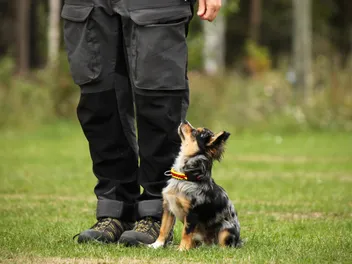
Training your puppy will definitely increase their confidence. Start with basic commands, such as “sit,” “come,” and “watch me.” Training builds a stronger bond between you and your puppy and gives them confidence, particularly when they successfully learn a command or trick.
You can also try obedience classes, which will have the bonus of extra socialization.

Conclusion
Socialization is crucial to a puppy’s confidence! The more exposure they have to different sights, sounds, smells, people, and places, the more relaxed they will be in different scenarios.
Just remember to go slowly with most things. Your puppy should be given the choice as to whether they are comfortable going into a loud building or being petted by a stranger. You should also avoid dog parks until your puppy is more mature and confident, especially if they are off-leash.
But the liberal use of praise, pets, and treats will go a long way and will teach your puppy that good things can happen outside the house, even when things seem scary.
Featured Image Credit: otsphoto, Shutterstock
Expert dog care, straight to your inbox
News, insights, expert advice, and everything dog.

No spam — unsubscribe anytime.
By signing up, you agree to our Terms & Conditions and Privacy & Cookies Policy.
How useful was this post?
Click a star to rate. You can leave written feedback afterwards. (We read all feedback.)
Kathryn was a librarian in a previous lifetime and is currently a writer about all things pets. When she was a kid, she hoped to work in a zoo or with wildlife in some way, thanks to her love for animals. Unfortunately, she's not strong in the sciences, so she fills her days with researching and writing about all kinds of animals and spends time playing with her adorable but terribly naughty tabby cat, Bella. Kathryn is hoping to add to her family in the near future – maybe another cat or two and a dog.