Anal Gland Removal in Dogs: When to Consider It (Vet Answer)

In this article
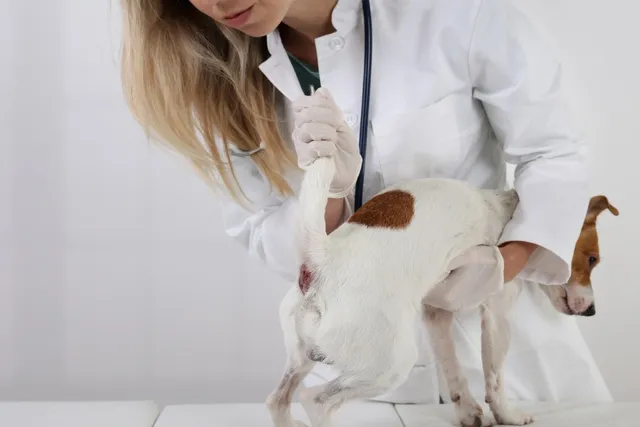
Anal glands are not something you want to talk about while eating dinner, let alone can you remove a dog's anal glands. These two scent glands, sitting adjacent to a dog’s anus, are invisible and unnoticeable in most dogs. In some dogs, however, these glands can be a real nuisance. In severe cases, the best way to resolve ongoing anal gland issues is to remove the anal glands altogether.
But when is this the best option for your dog? And what does the surgery involve? Read on to learn more about anal glands and when they should be removed.

What Are Anal Glands?
The anal glands, sometimes referred to as the anal sacs, are two pouches located next to the anus at roughly the 4 o’clock and 8 o’clock positions. They are present in all dogs. The lining of the anal glands produces a fluid that acts as a scent marker for dogs. In a normal situation, the contents of the anal glands are released with the muscular contraction used to pass a stool.
This explains why dogs are so interested in smelling one another’s feces. The anal glands serve no purpose beyond their scent gland function, and dogs can live completely normally without them.

What Are the Signs of Anal Gland Disease?
The most common signs of anal gland disease are scooting (dragging the back end along the ground) and repeated efforts to bite or chew at the back end. Some dogs will vocalize due to discomfort. If an abscess has formed, a swelling may be visible adjacent to the anus. If the abscess has burst out at the skin, a hole will be present with bloody fluid oozing from it.
Anal gland tumors can take a number of appearances, but a lump protruding from the surface is usually noticeable.
If your dog is showing any of these signs, we recommend speaking with a vet.
What Are the Causes of Anal Gland Diseases?
There are three main diseases that can occur in the anal glands:
- Impaction. This refers to a blockage of the anal gland duct, meaning that the fluid within the gland cannot be emptied during defecation. This causes the fluid to accumulate, often forming a firm and painful impaction.
- Infection. The anal glands can become infected, usually by bacteria. In veterinary circles, this is referred to as anal sacculitis. Infected anal glands can form an abscess—a hot, painful pocket of pus—that then ruptures out at the skin below the anus.
- Tumors. Lumps can occur on or in the anal glands. These can be benign (harmless) or malignant (cancerous). The most common malignant anal gland tumor is the anal gland adenocarcioma.

Frequently Asked Questions
When Should Anal Gland Removal Surgery Be Considered?
As a veterinarian, there are three main instances in which I recommend surgical anal gland removal for dogs (anal sacculectomy):
- It’s affecting your dog’s quality of life. If anal glands have been bothering your dog persistently or on and off for more than 6 months despite non-invasive veterinary treatments, it could be a good idea to remove them surgically.
- It’s bothering you. If you’re having a hard time with the frequent vet visits, the foul anal gland smell, or the distress it’s causing your dog, surgery is a good option. While the up-front expense for surgery is significant, it could save years of discomfort, vet visits, and treatments.
- There’s a lump there. Anal gland tumors can be nasty. Discuss surgical removal with your vet, though sometimes a biopsy (sample) of the lump is necessary to guide the surgical technique. For cancerous anal gland adenocarcinomas, chemotherapy may be warranted too.
What Does Anal Gland Removal Surgery Involve?
At most veterinary clinics, anal sacculectomy is a day procedure. This means your dog will be admitted to the hospital in the morning and discharged from the hospital in the same afternoon or evening. It can be performed by specialist surgeons or experienced general practitioners. Patients always undergo a general anesthetic.
In simple terms, the anal glands are surgically removed, and the deficit is stitched close. Complications such as infection, bleeding, fistulas, and fecal incontinence should be discussed with your vet prior to surgery.
Conclusion
Anal glands go unnoticed in most dogs. However, once you whiff the rotten-fish smell of the anal gland fluid, you’ll never forget it. In some dogs, anal glands are a cause of ongoing discomfort. When conservative medical treatments fail to resolve the problem, surgery for your dog's anal gland removal is a good idea.
If the anal glands have developed a tumor, work closely with your vet to ensure prompt diagnosis and intervention.
See also:
Sources
Featured Image Credit: Yekatseryna Netuk, Shutterstock
Expert dog care, straight to your inbox
News, insights, expert advice, and everything dog.

No spam — unsubscribe anytime.
By signing up, you agree to our Terms & Conditions and Privacy & Cookies Policy.
How useful was this post?
Click a star to rate. You can leave written feedback afterwards. (We read all feedback.)
Dr. Joe Mallat DVM (Veterinarian)
Joe is a veterinarian from Sydney, Australia. When he's not working, he enjoys cooking, exercising, and exploring the Australian wilderness. He has worked for 2 years at a mixed-species practice on the mid-north coast of New South Wales, treating animals of all sizes. His areas of particular interest include wound management, internal medicine, and oncology. Joe's love for the profession comes not only from helping dogs, but also from helping their parents and working with wonderful teams of people.
Joe completed his Bachelor of Veterinary Biology and Doctor of Veterinary Medicine at the University of Sydney in 2020.