
Australian Shepherd Herding: A Complete Guide

In this article
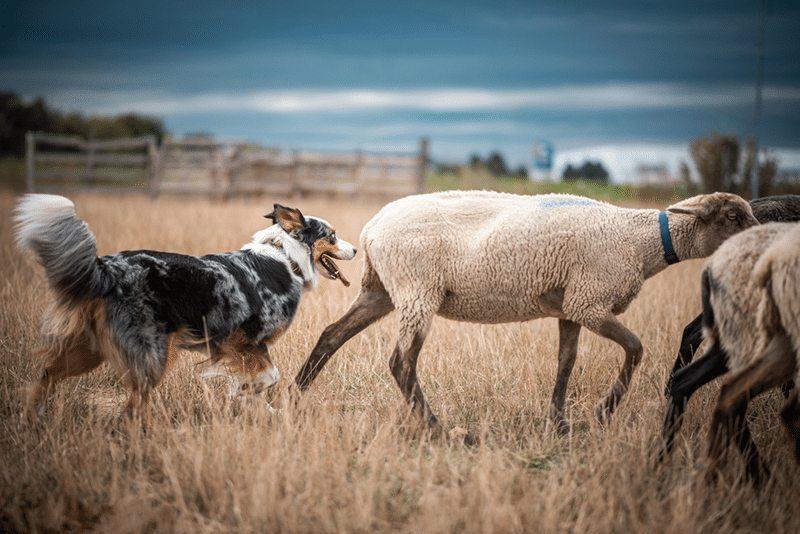
View 3 More +The Australian Shepherd’s name is misleading because the breed didn’t originate in Australia. Instead, they were created as herding dogs in the United States during the late 1800s. The breed was derived from British herding dogs that came to America earlier. While the breed is more popular as a household pet nowadays, these dogs still have what it takes to be superstars when it comes to livestock herding.
Are you wondering what Australian Shepherd herding is all about, how it works, and how you may be able to train your own herding dog? Read on!

How Does It Work?
Farmers and ranchers implement herding to help ensure the health and well-being of livestock animals that roam on large areas of land. The practice was developed about 10,000 years ago to control animals that humans domesticated to secure and maintain an ongoing source of food and hides for housing and clothing. Most livestock animals naturally roam around in groups that we humans call “herds.”
As a natural-born herder, the Australian Shepherd responds to commands from the human herder, which are designed to help keep cattle, sheep, and other livestock together. The idea is to keep the herd moving in the same direction together. Herding makes it possible to get livestock to move through gates and other obstacles to specified areas where the herders want them to roam. Sometimes, herding is used to take livestock out to transition areas where the land is not suitable for human farming but where animals can graze.
Australian Shepherds have amazing herding abilities due in part to the physical attributes that had been bred into them. These include plenty of stamina, an agile build, a weather-resistant double coat, and a thick “mane” that helps protect them from rowdy livestock animals. They have deeply ingrained herding instincts, which can drive them to nip and push against other animals and children even when not in a farming atmosphere.
Like most other herding breeds, this dog can be trained to respond to specific commands and perform specific actions based on those commands. For example, the command, “come by,” is meant to result in the Australian Shepherd herding the livestock clockwise. The command “away to me” means to herd the animals in counterclockwise movements. Commands like “steady” and “stand” are used to control the way that a dog approaches the livestock during a herding session.


What Are the Different Types of Australian Shepherd Herding?
There aren’t different types of herding for Australian Shepherds to take part in, per se, but there are different aspects of the overall herding practice.
Protection
Herding dogs have an instinct and drive to protect the livestock that they are herding. If predators approach, the herding dog will get between them and the livestock in an attempt to create a barrier. If necessary, they will fight with the predators to keep them from killing any livestock. Every animal in the herd that is killed by a predator means less food and resources for the farmers who are raising the livestock, so this task is vital.
Grazing Movement
Australian Shepherds might help move livestock from one grazing site to another when necessary. This can take place when a pasture has been thoroughly grazed and needs to grow back, so the animals must move to a new plot of land and graze there while the original plot replenishes. Grazing movement might take place between two or more plots of grazing land throughout the year, depending on the location and situation.

Terrain Guidance
When livestock must travel through rough terrain for any reason, a herding dog like the Australian Shepherd will guide the animals through the terrain safely and help them avoid dangerous things like high cliffs, large boulders, and predator territory. Of course, they rely on the direction of their human herding partners to let them know where to guide the livestock animals during the journey.
Where Is Herding Used?
The practice of herding is utilized in a variety of different locations and terrains throughout the world. Herding is done in Africa, Asia, Europe, Patagonia, Thailand, the United States, and anywhere else where livestock animals are raised on open pastures for food and other resources.

How Are Australian Shepherds Trained to Herd?
Training an Australian Shepherd to herd is much different than obedience training. Special skills and in-depth experience are necessary to ensure proper training and effective results. Most Australian Shepherds are trained by professionals in the industry before their owners attempt to partner with them for livestock herding. This breed is intelligent and can quickly learn, but like many herding dogs, they can be quite stubborn, so herd training can even be difficult for experts, let alone novices.
Training typically involves a “classroom” setting, where basic commands are taught and practiced with the help of equipment like faux livestock animals and different obstacles. Obedience training is a necessity before herding training is even considered. If an Australian Shepherd does not reliably sit, stay, and come at a minimum, they won’t have the knowledge, structure, or discipline to succeed with herding training. If they are not properly trained to herd, they can end up hurting or even killing the livestock, and they won’t be very effective when it comes to driving the animals where they are supposed to go.
Frequently Asked Questions
Do Herding Australian Shepherds Require Special Care?
An Australian Shepherd that works as a herder does not require any specialty care that a typical pet would, though certain aspects of care may be a bit different. For example, a herding dog does not require daily walks to stay happy and healthy because they get all the exercise that they need while they are working. Also, an Australian Shepherd that herds “for a living” may require more daily food than the average pet does.
How Long Does It Take to Train an Australian Shepherd for Herding?
Australian Shepherds are smart and have instincts that make them excellent herders, and many do learn how to herd quickly. However, the length of time that it takes to train a dog to herd depends on their personal temperament, surroundings, health, age, and many other factors. Therefore, it can take anywhere from just a couple of months to more than a year before an Australian Shepherd might be fully ready to take on the job of herding.
Are Herding Australian Shepherds More Dangerous Than Pets?
No! Australian Shepherds are friendly and can get along well in social situations even if they spend most of their time herding livestock animals. However, they can develop the habit of trying to “herd” children and other animals out of instinct. Therefore, they should understand when they should and shouldn’t practice their herding skills.

Conclusion
The Australian Shepherd is an impressive, beautiful breed that can happily live as a pet in a family household environment. Since they were born to herd livestock, they also thrive on living in farm and ranch environments. Hopefully, the information laid out here offers insight into what Australian Shepherd herding is all about, how it works, and what the practice entails.
See also:
Featured Image Credit: Ellis Berankova, Shutterstock
Expert dog care, straight to your inbox
News, insights, expert advice, and everything dog.

No spam — unsubscribe anytime.
By signing up, you agree to our Terms & Conditions and Privacy & Cookies Policy.
How useful was this post?
Click a star to rate. You can leave written feedback afterwards. (We read all feedback.)

Rachael has been a freelance writer since 2000. In this time she has had an opportunity to research and write about many different topics while working to master the art of fusing high-quality content with effective content marketing strategies. She is an artist at heart and loves to read, paint, and make jewelry. As a vegan, Rachael is obsessed with helping animals in need, both in her community and anywhere in the world where she feels she can make a difference. Animals also happen to be her favorite topic to write about! She lives off the grid in Hawaii with her husband, her garden, and her rescue animals including 5 dogs, a cat, a goat, and flock of chickens.