Do Dogs Understand Pointing? Scientific Discoveries & Training Tips (Vet Approved)


In this article
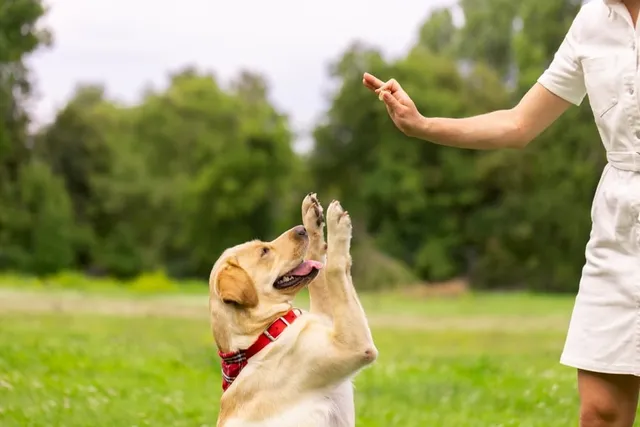
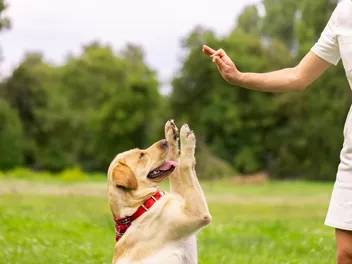
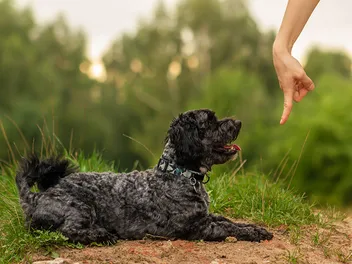
Pointing is an essential means of non-verbal communication. We use it between ourselves to reinforce something that we’re saying, and we also point to teach young children the names of objects or people around them. But can dogs understand this simple gesture too?
It’s one thing to talk about highly trained dogs, as it takes time and effort to create those associations. The question is whether our pups understand what it means. Research shows that dogs may recognize the gesture of pointing and what you’re trying to convey. Let’s get more into the specifics here.

The Role of Domestication
Domestication is something to consider when discussing the recognition of pointing. Research has found that 4-month-old wolves don’t grasp pointing as well as dogs do, even if they are hand-reared.1 The scientists dismissed domestication as a prerequisite for generalizing this context. Nevertheless, it suggests that domestic dogs have an advantage in their sensitivity to human gestural cues from early in their development.
Humans' first selective breeding with wild dogs gave them functional roles, which segued seamlessly from their niches in the food web.2 It’s not a stretch to surmise that these social avengers could quickly learn the significance of pointing, particularly if the object being pointed at was food. Canines also routinely use problem-solving skills to hunt. Pointing simply may have been a variation on these skills for them.
The takeaway is that dogs and their relationship with humans set the stage for the correct interpretation of pointing, especially if it benefits them. The next question is whether it’s simply an innate response, or do our pets truly understand what we’re trying to say with a mere gesture?

Supporting Evidence That Dogs Understand Pointing
Scientists have examined this question thoroughly, coming up with various insights into canine behavior. One study considered the role of the human versus the gesture in dictating behavior.3 The dogs responded correctly to pointing if done by a real-life figure. The results did not translate with a point-light or a two-dimensional representation of a human (a pointing silhouette) alone. The researchers concluded that the canines needed more clues than simply the gesture represented in two dimensions. In other words, dogs can perfectly understand the pointing cue when given by a human but not from a drawing or representation of a human.
How the point is delivered also influences the canine response. Another study found that dogs were more likely to comprehend pointing if objects were placed farther apart or the pointing was done close to the item.4 The researchers interpreted these findings as indications of dogs using different strategies in various scenarios to interpret this non-verbal communication.
Adding Verbal Cues to the Mix
Often, people use the same technique for teaching their pets the names of objects as they do with children: They point at something and say what it is.
One team of researchers investigated whether canines link the two for identification, using word-trained dogs. They concluded that when a person spoke of an object and pointed, they would fetch that specific object.
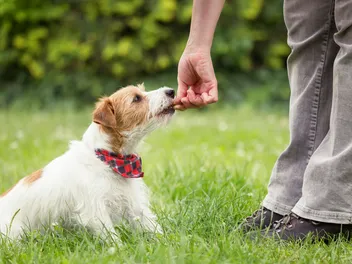
Pointing is a common way pet owners teach their pups this dual communication. How often does one say, “Get your ball!” while pointing at the requested object? The dog learns through positive reinforcement that these stimuli mean playtime and interaction with their human companions, and the behavior sticks. A stimulus and an immediate reward make it easy for them to learn and reinforce this behavior.

Do Dogs View Pointing as a Command?
Scientists equate the emotional capacity of canines with that of a 2.5-year-old child. Our pets can feel excitement, fear, and love, but are they capable of more complex emotions? One study looked at the pointing response, yielding some unexpected results. The researchers instructed the participants to point at empty or food-containing bowls in front of the dogs. They made several interesting observations, one of which was that the animals responded equally well to children. The authority of the individual giving the command wasn’t significant. However, if the participants pointed at an empty bowl, the dogs ignored it. Another study yielded similar results, suggesting that canines can distinguish between lying and misinformation. The researchers interpreted these data as compelling evidence that dogs have a rudimentary theory of mind and can interpret human behavior.
Using This Science When Training Our Pets
Using the information we’ve gathered from several studies, it’s safe to say that dogs do, in fact, understand what pointing means—quite impressively too. So, how can we incorporate this into our training? We can start by implementing hand signals into our training for every command we give!
- Sit: Hold your hand in front of you with your palm facing up, then raise your hand in an upward motion toward your shoulders when giving the “sit” command.
- Lie down: This is the opposite of the “sit” gesture. Have your hand up by your shoulder, and flick your wrist so your hand lowers to the ground while giving the “lie down” command.
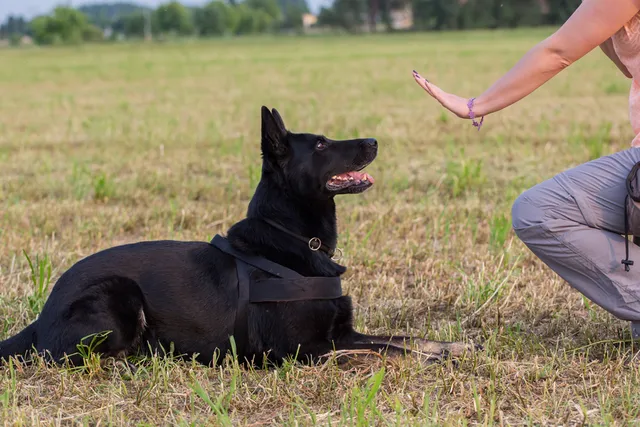
- Wait: Hold your hand in front of you at around waist height with your palm facing forward while giving the “wait” command.
- Come: This is one of the most important commands you can teach, also called recall. Start by putting your hand at your side with your palm facing up, and then bring your hand up to your opposite shoulder while giving the “come” command.
- Spin: Hold your hand in front of you, and make a circular motion with a pointed finger while giving the “spin” command.
- Roll over: Have an outstretched arm and hand in front of you, and then move your arm in an arc movement while giving the “roll over” command.
- Up: Have your hand outstretched in front of you at your waist, and lift it to shoulder height while giving the “up” command.
- Fetch: Similar to pointing, point your finger with your hand at your side, and then raise it while pointing at the item they need to fetch, all while giving the “fetch” command.
- Stay: Hold your hand out with your palm facing your dog, and give the “stay” command, then keep it there until you’re ready for them to move.

All in all, understand that hand signals used on top of verbal cues are the easiest way to train your dog, but you can incorporate other dog training tips to make it go even smoother.
- Use high-value treats only when training your dog so they're extra motivated.
- Incorporate praise as another method of positive reinforcement.
- Keep training sessions short so you have their full attention.
- Exercise your pup before a session so they don’t have pent-up energy.
- Keep a positive attitude.
Final Thoughts
So, now we know that dogs do understand pointing, particularly when food is involved. However, evidence suggests that they’re aware of the circumstances and recognize when they’re being deceived. Without the reward, they don’t seem to respond. What this all means is that our pets may be more intelligent than we give them credit for, and these findings can definitely be used when training any new dog that we welcome into our home.
See also:
Featured Image Credit: Dragon Images, Shutterstock
Expert dog care, straight to your inbox
News, insights, expert advice, and everything dog.

No spam — unsubscribe anytime.
By signing up, you agree to our Terms & Conditions and Privacy & Cookies Policy.
How useful was this post?
Click a star to rate. You can leave written feedback afterwards. (We read all feedback.)
Since 2009, Chris has written on a variety of topics. Her motto with all of her writing is “science-based writing nurtured by education and critical thinking.” She specializes in scientific topics, with a special love for health and environmental topics, and of course, pets of all shapes and sizes.
Chris lives happily with her husband and three cats in the land of 10,000 lakes, writing, wining, and boating as much as she can. She and her husband, Norm, were awarded the State of Kentucky Colonel Honor for their restoration work at Mammoth Cave National Park.