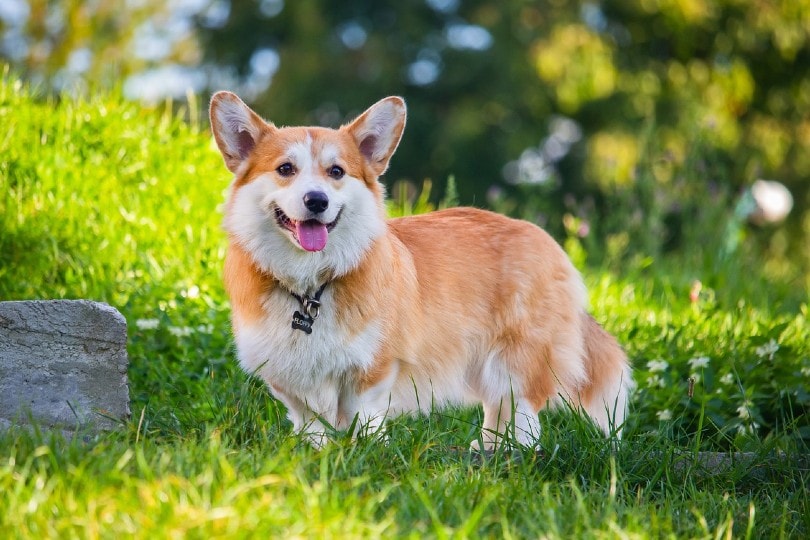
The Corgi is an intelligent, keen, and tenacious breed that’s recognizable almost as soon as its unique silhouette is seen. There are two distinct types of Corgi: the Cardigan and the Pembroke Welsh; both Corgi dogs make excellent service animals.
Important information: Although certain breeds may be more commonly represented in service work, breed alone does not determine suitability. Genetics, environment, individual personality, and professional training are the most important factors. Each dog must be assessed as an individual rather than judged solely by breed characteristics.

What Are Service Dogs?
The Americans with Disabilities Act (ADA) defines a service dog in the US as “a dog that is individually trained to do work or perform tasks for a person with a disability.”
These tasks have a wide range and include everything from opening doors and helping their owner to navigate to alerting a person when they can sense they’re going to have an anxiety attack.
Usually, these are specially trained animals paired with people they’d suit the most. This is commonly done through organizations set up specifically for this purpose. Still, as long as there are certain behaviors the dog can carry out and adhere to, any dog can qualify as a service dog.
This includes the Corgi variants. While they aren’t as popular as other breeds for service tasks, they still make amazingly useful companions.

What Makes Corgis Good Service Dogs?
Corgis are known to not only be intelligent as a breed, but both variants tend to be good with children and, according to the AKC, have what’s known as a “big dog bark”. This big bark comes from their herding ancestry and might be useful in certain alert-based tasks when properly trained.
Despite their small stature, Corgis are sturdy and energetic dogs. However, their physical structure, particularly their long backs, means they are not suitable for heavy mobility or weight-bearing tasks. As with any service prospect, temperament, health, and individual suitability are more important than breed alone.
Service Dog Suitability Between Pembroke & Cardigan Corgis
Despite being very similar, there are some subtle differences in the two Corgi breeds that may influence suitability for certain types of service work. Variations in size, energy levels, and temperament can matter to someone who relies on their dog for specific physical or task-based support.

Pembroke vs. Cardigan: Physical Traits
The Pembroke Corgi is a slightly smaller breed with no tail (or a closely docked one), while the Cardigan Corgi has a heavier structure and a long, foxy tail. While this difference is small, a service user who uses a wheelchair may not want to work with a Cardigan for fear of hurting their tail accidentally.
Both types have the same double coat, which doesn’t require much grooming, making them equally suitable in that respect.
Pembroke vs. Cardigan: Personality
Both these dogs are friendly, generous, and intelligent. Still, there are subtle differences in how they tend to interact with strangers or situations, which can have an impact on specific service dog jobs.
The Pembroke is known for their love of a good time. They’re light-hearted and will adapt readily to nearly all situations, making them particularly suitable for children or service users in different situations. They have high energy, however, so they may not do well with service users who are restricted to being mostly at home.
The Cardigan is just as friendly and is a loyal and dutiful companion, but instead of leaping head-first into new situations, the Cardigan is more pensive. They will likely stand back and consider new people or situations before committing to them, which can hold them back if they work with a social butterfly.

What Can a Corgi Be Trained to Do?
Corgis can be trained to do everything a service user needs as long as it’s within their physical capabilities. A corgi won’t be able to lift an adult, for example, whereas a Great Dane could, but they can perform several other tasks.
- Navigating around hazards (such as bollards or lamp posts for seeing-eye dogs)
- Avoiding moving objects
- Finding entrances and exits
- Opening and closing doors
- Finding and retrieving lost items
- Alerting to specific sounds such as babies crying, doorbells ringing, etc.
- Carrying a basket of items
- Putting trash or items into the bin or a bag
- Helping owners dress or undress
- Calling out in an emergency on a K-9 rescue phone
- Alerting to medical emergencies such as diabetic crashes or imminent seizures
There are specific tasks, such as heavy-duty lifting or bracing service users, that Corgis won’t be able to do. This is due to their physical strength and the fact that they’re so short in stature.
Conclusion
The Corgi makes a great service dog, whether they’re a Pembroke Welsh with their bat-like ears and grinning faces or a Cardigan type with their sturdy frame and fox-like tail. The intelligence and friendliness of the Corgi make them ideal as a service dog in many situations; the only case in which the Corgi might not excel is if heavy lifting is involved. Despite this, the Corgi is a dog of poise and joy, and each will make a great addition as a service dog.
See also:
Featured Image Credit: MolnarSzabolcsErdely, Pixabay
 What Are Service Dogs?