Four Quadrants of Operant Conditioning for Dog Training: Vet-Approved Facts


In this article
Training is a critical part of pet ownership. Experts recommend starting the process right after your new animal companion has adapted to the transition to your home. In the past, many may have practiced physical punishment with their dogs, which was cruel and unnecessary, while others didn’t train their dogs at all. However, operant conditioning offers a better approach that is more likely to achieve long-term success, and the process involves voluntary behavioral modification and learning.
The four quadrants of operant conditioning are positive reinforcement, positive punishment, negative reinforcement, and negative punishment. Operant conditioning differs from classical conditioning, which develops an involuntary response and stimulus as opposed to a voluntary behavior and consequence. Let’s learn a bit more about operant conditioning and its four quadrants.

How Does Operant Conditioning Work?
To put it simply, operant conditioning uses rewards and punishment to adjust behavior. Behavior that is rewarded is likely to be repeated, while behavior that is punished is likely to happen less. For example, you give your dog a treat if they don’t bark when the doorbell rings. You get what you want (your dog to not bark), and your pet gets what they want (a tasty treat).
Operant conditioning dog training is adopted from human studies. This theory was first described by B.F. Skinner, who based it on two assumptions. The first assumption was that the cause of human behavior is something in a person’s environment, and the second is that the consequences of a behavior will determine the possibility of it being repeated.
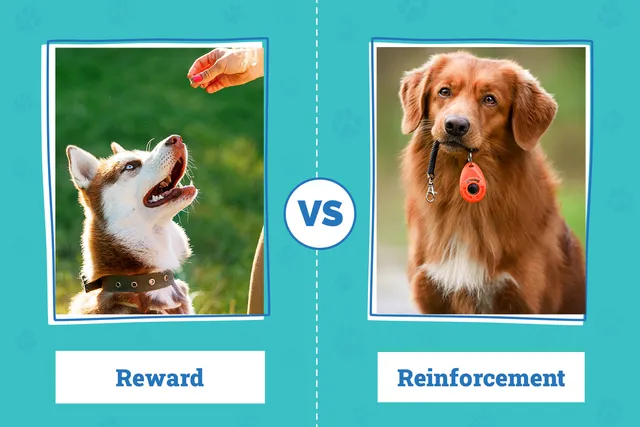
Keep in mind that “positive” and “negative” don’t mean “good” and “bad.” Positive refers to the addition of a stimulus, and negative refers to the removal of a stimulus. Meanwhile, “reinforcement” means to “increase or maintain” while “punishment” means to “decrease the likelihood” and not to harm a dog. This is where most confusion comes into play.

How Positive Punishment and Reinforcement Work in Dog Training
Positive reinforcement (R+) is the means to increase a behavior. A positive or appetitive stimulus is the reward for doing what you want. Treats are an excellent motivator, although many dogs are eager to please and will respond to praise. Your goal is for your dog to make the connection and voluntary choice to do what’s required to get the reward. Positive reinforcement is the first quadrant.
Positive punishment (P+) is what you add to a situation to get the result you want. It might be you saying “No!” in a low-pitched, low-volume voice that signals your displeasure. The desired effect is that your pup won’t do whatever they did to anger you. However, it’s not only about words; it can be any action you add that affects your pet’s behavior, such as making a loud noise. Positive punishment is the second quadrant of operant conditioning.
How Negative Punishment and Reinforcement Work in Dog Training
Negative reinforcement (R-) modifies your dog’s behavior by taking away something they don’t like to change their response. For example, you stop pulling on your dog’s collar while on a walk when they listen to a command to heel. Negative reinforcement is the third quadrant.
Negative punishment (P-) involves the removal of something your dog wants to change their behavior. Not offering a treat when your dog doesn’t listen to a command is a good example. Negative punishment is the fourth and final quadrant.

How Is It Used?
Positive reinforcement is often the best approach to dog training. Remember that your pet only has the emotional capability of a 2.5-year-old child.1 Scientists haven’t uncovered evidence to suggest canines are capable of higher, more complex emotions, such as guilt or shame. Besides, it often works better than punishment for long-term modification. As they say, you attract more bees with honey than a stick.
It is best to use operant conditioning once you have a good understanding of the four quadrants and how they work together. When used in the right way, it creates clear communication between you and your dog that you can both understand.
With operant conditioning, the four quadrants should be used interchangeably. Basically, the argument is that every dog is different, and how you respond to different situations should change based on how they respond as well. Which of the four quadrants you use in the moment depends on the dog, the situation, and the environment. Sometimes it can be difficult to determine what would be the right approach at given moment, so if you would ever be unsure, it is always best to ask a veterinarian for an advice.
Advantages of Operant Conditioning
It’s hard to overestimate the advantages of operant conditioning. Not only can it be effective, but it creates a healthy training environment. It also provides valuable mental stimulation. Dogs are highly intelligent and need enrichment for a good quality of life, and operant conditioning can offer it.
Disadvantages of Operant Conditioning
While dogs learn equally through all four quadrants, you shouldn’t use them all equally. Most experts would agree that the use of positive reinforcement is the most valuable, and creating any negative associations with behavior can discourage a dog from wanting to learn.

Frequently Asked Questions (FAQ)
What if My Dog Is Still Misbehaving if I Apply Punishment?
Perhaps the choice of punishment isn’t potent enough to sway your pet’s behavior. You might try a different sequence to see if you can find something more effective.
Should I Use All the Quadrants Equally?
We suggest leaning heavily on positive reinforcement with some negative punishment, as needed. Your goal is to create favorable associations with training. Most dogs are so food-motivated that you’ll make better strides sticking with this plan, just make sure you aren’t overfeeding treats.
Can I Use This Method for Clicker Training?
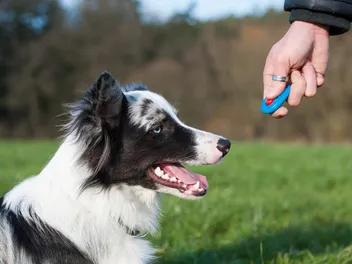
Absolutely! Operant conditioning provides an excellent platform for making it a part of your pup’s lessons. Your dog can learn positive reinforcement when you combine the clicking with a treat.

Conclusion
Operant conditioning is an excellent way to use your dog’s instincts to shape wanted behaviors. Its premise is simple: positive actions get rewards. Once your pup makes this association, you can use it to teach them various tricks and commands. With enough practice, your pooch will likely figure it out eventually!
Sources
Featured Image Credit: lara-sh, Shutterstock
Expert dog care, straight to your inbox
News, insights, expert advice, and everything dog.

No spam — unsubscribe anytime.
By signing up, you agree to our Terms & Conditions and Privacy & Cookies Policy.
How useful was this post?
Click a star to rate. You can leave written feedback afterwards. (We read all feedback.)
Since 2009, Chris has written on a variety of topics. Her motto with all of her writing is “science-based writing nurtured by education and critical thinking.” She specializes in scientific topics, with a special love for health and environmental topics, and of course, pets of all shapes and sizes.
Chris lives happily with her husband and three cats in the land of 10,000 lakes, writing, wining, and boating as much as she can. She and her husband, Norm, were awarded the State of Kentucky Colonel Honor for their restoration work at Mammoth Cave National Park.