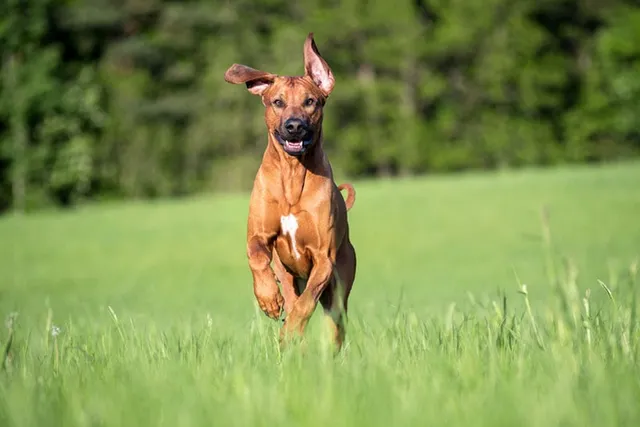
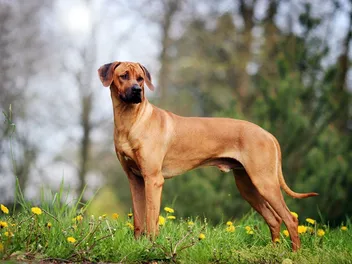
What Were Rhodesian Ridgebacks Bred For? Facts & History


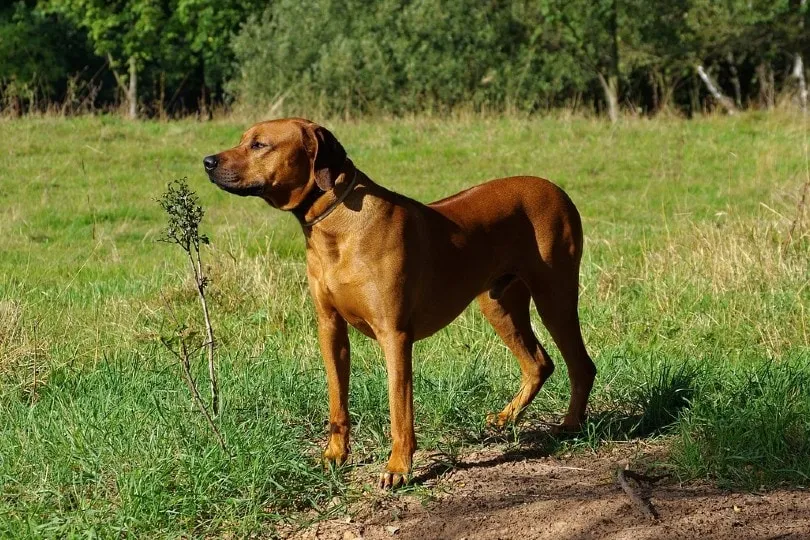
The Rhodesian Ridgeback is a hound originating in South Africa that is distinctive due to the stripe of hair (or “ridge”) growing backward on its back. These dignified and affectionate dogs are athletes with a high prey drive. They are also intensely loyal to their families, making them wonderful family dogs.
This dog breed has a fascinating history, including why they were originally bred. It turns out this breed started as a hunter and protector in Africa, though they’ve gone through many changes and crossbreeding to get where they are today.

Rhodesian Ridgebacks Through the Times
1600s
The Rhodesian Ridgeback dates to the 1600s and originated in Rhodesia (now known as Zimbabwe). Also called the African Lion Hound, this breed’s roots are in semi-wild dogs with the “ridge” down the back, pricked ears, and a jackal-like appearance.
The Dutch East India Company brought settlers to the Cape of Good Hope to work and live during this century. These Dutch settlers took note of these semi-wild dogs that the native people, the Khoikhoi, had. As farmers, these Europeans sought the ideal dog to guard their farms against wild animals and catch game, large or small. This perfect dog would also need the ability to withstand the temperatures of Africa, have a coat that could avoid ticks, and be able to go an entire day without water.
Eventually, these farmers decided to breed dogs they had brought with them with the semi-wild dogs. Some breeds included in this cross-breeding were Great Danes, Terriers, Mastiffs, Greyhounds, Bulldogs, and Bloodhounds. The “ridge”, as a dominant trait, persisted in the new dog breed.

1800s
Fast forward around 200 years, and the Rhodesian Ridgeback breed faces changes again. A professional hunter named Cornelius van Rooyen was known for arranging hunting expeditions in Africa for wealthy Europeans and for capturing wild animals to sell to zoos in Europe. He needed fearless dogs capable of hunting lions to help on these expeditions.
Cornelius van Rooyen had a friend, Reverend Helms, who would leave his dogs with him whenever he traveled: two female dogs with “ridges” on their backs. These two dogs ended up breeding with van Rooyen’s own, which are thought to have included Collies, Bulldogs, Irish Terriers, Greyhounds, and Airedale Terriers. The resulting new Rhodesian Ridgebacks became known as van Rooyen’s Lion Dogs and ended up with quite the reputation. They were featured in hunter and explorer Frederick Courteney Selous’s 1893 book Travel and Adventure in South East Africa.
1900s
How did we get the Rhodesian Ridgeback we have today? In 1922, a large group of Lion Dog owners met in Zimbabwe to set up a standard for the breed. Their Rhodesian Ridgebacks ranged in size and appearance and could resemble anything from a Great Dane to a Terrier. So, the group decided to copy the Ridgeback’s standard from the standard for Dalmatians.
The standard Rhodesian Ridgeback would need to be able to walk by a wagon or horse all day, have the “ridge” down the back, be fast, and have high endurance. Since all their dogs looked so unalike, they decided to pick and choose features, such as ears and tails from the different dogs, to use in the standard. The dog's name was then changed from the African Lion Dog to the Rhodesian Ridgeback.
This breed made its way to the states in the early 1950s and was finally recognized by the American Kennel Club in 1955. Fun fact: one of the earliest Rhodesian Ridgeback breeders in the United States was the actor Errol Flynn!
Conclusion
And there you have it! The Rhodesian Ridgeback was originally bred by Dutch farmers using European and semi-wild dogs with “ridges” on their backs native to Africa. This original crossbreeding was designed to produce a dog that would not only protect farms and families but also to hunt.
A little over 200 years later, the Rhodesian Ridgeback was crossbred again, this time to develop a dog specifically for lion-hunting expeditions. Known as the African Lion Dog, these dogs became quite well-known and were even featured in a book by the famous explorer Selous.
Finally, in the 1900s, breeders decided it was time to set a standard for the Rhodesian Ridgeback. Using a buffet-style approach, they picked physical features from amongst their African Lion Dogs that ranged wildly in looks to create one set look for the breed. They also borrowed from the Dalmation standard to create their own. The Rhodesian Ridgeback was recognized by the American Kennel Club in 1955.
Related Reads:
Featured Image Credit: Osetrik, Shutterstock
Expert dog care, straight to your inbox
News, insights, expert advice, and everything dog.

No spam — unsubscribe anytime.
By signing up, you agree to our Terms & Conditions and Privacy & Cookies Policy.
How useful was this post?
Click a star to rate. You can leave written feedback afterwards. (We read all feedback.)
Misty Layne lives out in the woods in small-town Alabama with her two Siamese - Serafina & Jasper. She also has an array of stray cats, raccoons, and opossums who like to call her front porch home. When she’s not writing about animals, you’ll find her writing poetry, stories, and film reviews (the animals are, by far, her favorite writing topic, though!). In her free time, Misty enjoys chilling with her cats, playing piano, watching indie and foreign films, photographing abandoned places, and catching up on her never-ending TBR list.