Damning Dry Dog Food Report Not What It Seems

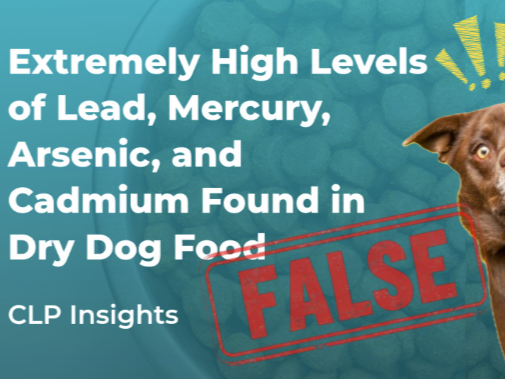
Over the past few days, pet and vet communities have been reeling from the revelation that high levels of heavy metals have been detected in dry dog food. How could this have happened? As we reviewed the findings of this report, we discovered that the headline being repeated across the internet is extremely misleading.
As pet parents, we place a certain amount of faith in the pet food industry when it comes to providing healthy, nutritionally balanced, and, above all else, safe food for our dogs. While the only way we can ever be sure about the integrity and safety of the ingredients we feed our four-legged friends would be to grow, harvest/slaughter, and produce the food ourselves, for most people, this is neither practical or possible. And so, we rely on reputable and recognized brands, AAFCO labeling, and the advice of veterinary professionals like myself to help us make the right choices.
So when a report like the one from Clean Label Project (CLP) declares that there have been “Extremely High Levels of Lead, Mercury, Arsenic, and Cadmium Found in Dry Dog Food”, it’s going to raise some red flags. However, we have discovered that not all is as it seems.
The non-profit organization, whose raison d’êtra is to provide impartial information and transparency about the products we use, consume, and feed to our pets, evaluated 79 of the top-selling dry, air-dried, freeze-dried, and fresh/frozen dog foods. They assessed multiple panels of industrial and environmental contaminants, including heavy metals like arsenic, cadmium, mercury, & lead, as well as phthalates, which can disrupt endocrine function, and acrylamide, the carcinogenic compound by-product of high-temperature production.
Understandably, without relocating our lives to a hermetically sealed biodome, we are bound to be exposed to varying levels of these compounds in our everyday lives; in the air we breathe, the water we drink and bathe in, and the food we eat. Although the metabolic system is designed to mop up and eliminate these harmful elements, there is a limit to how much the liver and kidneys can eradicate. Once that threshold is reached, these materials can cause cellular damage, organ dysfunction, cancer, hormonal imbalances, and diseases like diabetes.
In the case of dog food, it is believed that many of these contaminants come from:
- Meat by-products: Livers, lungs, kidneys, spleens, etc.
- Added vitamin and mineral premix: Specific vitamins and minerals are necessary for dogs.
- Seafood and plant-based carbohydrates: Grains, root vegetables, etc.
The Results at a Glance

In the report by the CLP, there is a stark difference between the levels of heavy metals and other contaminants in dry dog food and those of fresh/frozen meals. It is worth noting, however, that whilst most dry kibble contains around 10% moisture, fresh and frozen dog foods are often up to 70% water.
This is a significant consideration when talking about the concentration of nutrients and contaminants, something veterinarian Dr. Joseph Wakshlag, a professor and nutritional specialist at Cornell University College of Veterinary Medicine in Ithaca, New York, was quick to point out in a recent interview with CNN’s Sandee LaMotte.
“You also can’t take those numbers at face value, because a dog has to eat about 3 cups of fresh or frozen dog food to get the same calories and nutrients as 1 cup of dry food,” he said. “Therefore, the dog’s exposure to heavy metals in fresh or frozen foods goes up because it has to eat two to three times as much.”
Based on 50 dry food samples, 11 air/freeze-dried, and 18 fresh/frozen, the results from the analyses are quite an eye-opener.
| Dry Dog Food | Air/Freeze Dried | Fresh/Frozen | ||||
| Compound (ppb) | Highest | Average | Highest | Average | Highest | Average |
| Arsenic | 785.7 | 184.6 | 362.6 | 148.5 | 57.0 | 13.9 |
| Lead | 1576.5 | 180.1 | 194.4 | 53.9 | 16.9 | 8.5 |
| Mercury | 55.3 | 3.8 | 7.9 | 2.4 | 0.9 | 0.2 |
| Cadmium | 246.1 | 68.5 | 247.9 | 69.3 | 20.6 | 11.3 |
According to the FDA’s 2019 Report on Heavy Metals in Animal Food, the National Research Council (NRC) and the Association of American Feed Control Officials (AAFCO) recommend the following maximum tolerable levels of arsenic, cadmium, mercury, and lead in (complete) dog food:
| Arsenic (ppm*) | Lead (ppm) | Mercury (ppm) | Cadmium (ppm) | |
| NRC MTL** | 30 | 10 | 0.2 | 10 |
| AAFCO MTL | 50 | 30 | 2 | 0.5 |
| *ppm | parts per million | |||
| **MTL | Maximum tolerable levels | |||
With these figures in mind, the levels reported in the Clean Label Project report may, at first glance, seem highly disturbing. However, the devil is in the details… and decimal places.
When we convert the results above from parts per billion (ppb) to parts per million (ppm), we see that these levels are actually well below the maximum tolerable levels (MTLs) recommended by the FDA.

| Dry Dog Food | Air/Freeze Dried | Fresh/Frozen | ||||
| Compound (ppm) | Highest | Average | Highest | Average | Highest | Average |
| Arsenic | 0.786 | 0.185 | 0.363 | 0.149 | 0.057 | 0.014 |
| Lead | 1.576 | 0.181 | 0.194 | 0.054 | 0.017 | 0.008 |
| Mercury | 0.055 | 0.004 | 0.008 | 0.002 | 0.009 | 0.002 |
| Cadmium | 0.246 | 0.068 | 0.248 | 0.069 | 0.020 | 0.011 |
It is worth noting that the MTLs set by the NRC and AAFCO are largely based on studies involving feed used in farm animal production, and there have been relatively few studies focused entirely on the safe levels of these contaminants for cats and dogs.
“How would chronic consumption of these contaminants at really high levels affect a dog? We don’t know,” said Dr Wakshlag. “A solution would be for pet food companies to regularly test their products for toxins and report the results to consumers,” he added. “But extensive analyses take time and money.”
The Clean Label Project report notes that these figures are higher than those found in human food (which is true for some foods but not others), but research has shown that the levels found in dog food – even dry dog food – are considered safe for long-term consumption.1 Not just safe, but at the low end of maximum tolerable levels.
The highest levels in each category are higher than we would like to see in pet food; however, the average figures indicate that the levels of these heavy metals are well within the zone of safety for most of the foods tested. The results for each individual food tested have not been made available. In most cases, the average levels of heavy metals fell below the MTL for human consumption as well.2 Perhaps the title of their report needs to be updated for accuracy: “Safe Levels of Lead, Mercury, Arsenic, and Cadmium Found in Dry Dog Food.” Of course, this would make for decidedly less exciting news.
| Heavy Metal | Human MTL (ppm in most ‘at risk’ food) | Dry Dog Food (Average ppm) |
| Arsenic | 0.1 (rice) | 0.185 |
| Lead | 0.3 (fish/seafood) | 0.181 |
| Mercury | 0.5 - 1.0 (fish) | 0.004 |
| Cadmium | 0.2 (leafy vegetables) | 0.068 |
Within their report, there are startling comparisons made between dry dog food and human consumables. However, it is not made clear which ‘consumables’ are being used as a baseline, and there exists a huge range of heavy metals in human food and drink, depending on the item in question. 3,4 Contaminant risk is something that we should all be aware of, but the claims made in the CLP’s report are diabolical. Perhaps even more worrying is the number of websites, companies, and brands that have been reposting this content without fact-checking the data for themselves.

We do not wish to cast a negative light on the work being done by the Clean Label Project, as pushing for clean practices and transparency is a valiant goal, and something we should all be striving towards. However, it is a goal that should be reached on its own merits, not on the basis of exaggerated and erroneous statements.
Should We Be Worried?
It’s never a bad thing to shine a light on pet food standards, particularly as no federal regulations limit the exposure of dog food products to industrial and environmental chemicals. With new pet food brands popping up all the time, it can be difficult to know which ingredients and recipes are safest for our pets.
Although the dry foods assessed by the Clean Label Project are perfectly safe for canine consumption, that doesn’t necessarily mean they are the best option out there. Fresh/frozen foods are becoming increasingly popular due to their higher-quality ingredients and less intensive production methods. This does not, however, inherently mean they are safer or healthier than other forms of dog food, and we should always cast a critical eye over the ingredients panel. While there may be many reasons to consider moving away from dry kibble – higher levels of carbohydrates, by-products, and lack of enrichment – for now, heavy metal contamination is not one of them.
Based on the research and observations of Dr. Wakshlag’s team, one thing is certain: if you want complete transparency about the ingredients and contaminant levels in your dog’s food, be prepared to pay for it.
“If you want this kind of information, then expect your bag of dog food to go up $3 or $4 a bag, because that’s what it’s going to cost to do these tests.”

Why The “Fake News”?
Given that the figures reported by the CLP report are well within the safe zone for pet food, we can’t help but wonder why the incredibly misleading statement about “Extremely High Levels” of heavy metals was made. A fear tactic? Miscommunication? A misinterpretation of that pesky decimal place? Or perhaps they are hoping to garner support for their clean living initiative.
It goes without saying – or at least it should – that we should always be aiming for as few contaminants as possible, something that the Clean Label Project hopes to foster through the creation of their CLP Clean 16 and CLP Certification. This initiative aims to highlight products across various categories, including protein powder, coffee, snacks, and dog food, with the lowest levels of contaminants, and achieving CLP Purity Status is sure to be a feather in any brand’s cap.
We reached out to the Clean Label Project for clarification and received the following response:
“Our conclusions are derived exclusively from the data itself. The data – when interpreted with even a modest degree of technical literacy – indicates levels so markedly elevated that they would be considered detrimental to virtually any biological organism.”
However, there was no further explanation as to how they arrived at the conclusion that the levels found were “extremely” high, despite being well below the levels of safety for animal – and most human – consumption.
Whilst we agree that there needs to be more research into determining specific MTLs for pet animal species, there is nothing in the current data that indicates any cause for immediate concern. Yes, we need to ensure we are making the best and safest choices for our pets, but don’t forget to do your own research, look beyond the headlines, and don’t believe everything you read.
Feature Image Credit: Annette Shaff, Shutterstock & Clean Label Project
Did You Know?
- Our breaking news articles are included in our weekly emails. Don't miss out on the latest and sign up for our newsletter below!
Expert dog care, straight to your inbox
Vet-reviewed advice, training tips, and the best of Dogster. Free, and you can unsubscribe anytime.
By signing up, you agree to our Terms & Conditions and Privacy & Cookies Policy.
Dr. Karyn Kanowski, BVSc MRCVS (Vet)
Dr. Karyn is originally from Queensland, Australia, and has resided in the UK for the past 10 years. She graduated from The University of Queensland School of Veterinary Science in 2010, and also holds a Bachelor’s degree in Zoology. Karyn is passionate about using experience, evidence, and working with pet owners to provide the best solutions for pets. She also believes in making reliable information about animal health accessible to everyone. 5 cats and 4 dogs let her share their home with her and her husband, and when she is not practising as a veterinary surgeon, she spends her time writing, gardening, and cleaning up pet hair!
Join the conversation
Ask a question, share your story, or send private feedback.