
In this article
Note: This article’s statistics come from third-party sources and do not represent the opinions of this website.
When you’re thinking about getting a pet, you know that you can buy one from a breeder or adopt one from a shelter. Although buying from a breeder is a good way to get the exact pet you want, millions of animals in shelters all over the country and the world need loving homes.
If you’re unsure what kind of pet you want or you just would like to give a deserving animal a second chance at having a good life, you should definitely consider paying a visit to a local animal shelter and adopting. But don’t just take our word for it; check out these statistics and facts that can help you understand how big of an impact you can make by adopting.

The 17 Pet Adoption Statistics
- Around 810,000 stray animals that enter shelters are returned to their owners each year.
- Around 689,000 cats and dogs were euthanized in animal shelters in 2023.
- The number of no-kill animal shelters has doubled from 2016 to 2022.
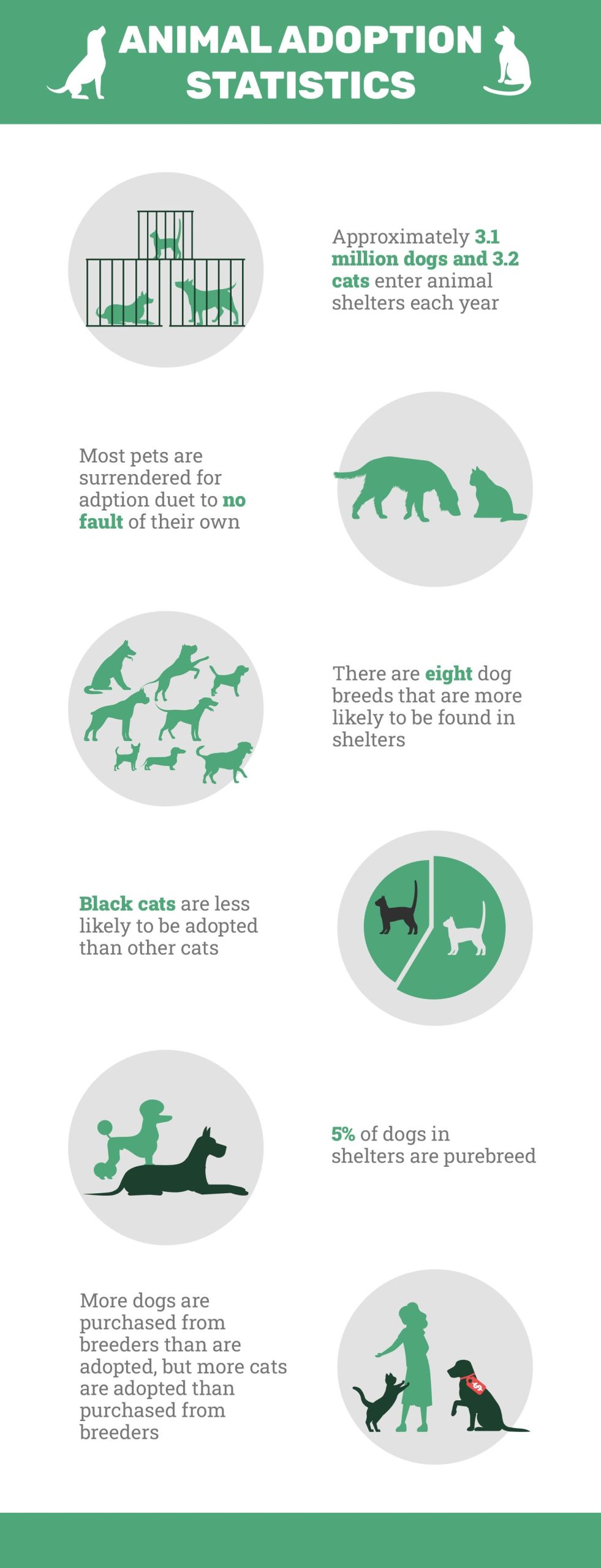
- Most pets are surrendered for adoption due to no fault of their own.
- Almost 55,000 pets were fostered in 2020.
- Approximately 3.1 million dogs enter animal shelters each year.
- In 2022, the number of dogs adopted from shelters increased.
- Adult dogs were adopted more often than puppies in 2022.
- There are eight dog breeds that are more likely to be found in shelters.
- Approximately 3.2 million cats enter animal shelters each year.
- In 2022, the number of cats adopted from animal shelters increased.
- Black cats are less likely to be adopted than other cats.
- Almost 52% of all cats that are adopted are kittens.
- There are approximately 10,000 puppy mills in the U.S.
- Only 5% of dogs in shelters are purebred.
- More dogs are purchased from breeders than are adopted.
- More cats are adopted than purchased from breeders.
General Animal Shelter Statistics
1. Around 810,00 stray animals that enter shelters are returned to their owners each year.
(ASPCA)
Of those animals, dogs are more likely to be returned to their owners than cats. Around 710,000 dogs are returned to their owners as opposed to 100,000 cats.

2. Around 689,000 cats and dogs were euthanized in animal shelters in 2023.
(USA Today)
Of the animals that weren’t adopted, about 20% of them were euthanized due to disease, illness, or overcrowding. 359,000 of the euthanized animals were dogs and 330,00 were cats. This number has decreased every year, though, from 2 million in 2015.
3. The number of no-kill animal shelters has doubled from 2016 to 2022.
(Best Friends)
In 2016, the percentage of no-kill shelters in the United States was 24%. In 2022, the percentage of no-kill shelters grew to 57%.

4. Most pets are surrendered for adoption due to no fault of their own.
(Best Friends)
About 75% of animals are surrendered for adoption due to human circumstances. Leading causes for the surrender of animals include the owner having too many pets (16.1%) and housing reasons (13.7%). The behavior or personality of the animal only accounts for 8% of surrenders.
5. Almost 55,000 pets were fostered in 2020.
(Chewy)
Fostering a pet means providing temporary care to shelter animals in your own home prior to them being adopted. In 2020, 54,500 pets were fostered. The rate of fostering for both dogs and cats increased in 2020, with 17% of dogs being fostered compared to 8% of cats.

Dog Adoption Statistics
6. Approximately 3.1 million dogs enter animal shelters each year.
(ASPCA)
Of the 6.3 animals that enter animal shelters each year, 3.1 million are dogs. This is down from 3.9 million in 2011. Of those 3.1 million, only about 2 million of them are adopted.
7. In 2022, the number of dogs adopted from animal shelters increased.
(The Humane Society of the United States)
Based on the 2021–2022 American Pet Products Association (APPA) survey, the number of dogs adopted from animal shelters or rescues as opposed to other acquisition methods was 40%. In the 2017–2018 survey, only 28% were adopted from shelters.

8. Adult dogs were adopted more than puppies in 2022.
(Chewy)
In 2022, adults were the most adopted dogs from animal shelters, at 73%. Although puppies were adopted more in previous years, some pet owners have realized how much easier it is to care for a potty-trained adult.
9. Eight dog breeds are more likely to be found in shelters.
(Pet Insurance Review)
The main reasons for these being the most common dog breeds in shelters are stereotypes, overbreeding, or requiring more care than other breeds. Of these breeds, Pit Bulls and Chihuahuas are most likely to be euthanized.
Cat Adoption Statistics
10. Approximately 3.2 million cats enter animal shelters each year.
(ASPCA)
Of the 6.3 million animals that go to animal shelters each year, over half of them are cats. Of that 3.2 million, only about 2.1 million cats are adopted each year.
11. In 2022, the number of cats adopted from animal shelters increased.
(The Humane Society of the United States)
Based on the 2021–2022 APPA survey, the number of cats adopted from animal shelters or rescues as opposed to other acquisition methods was 43%. This was an increase from 31% in 2017–2018.

12. Black cats are less likely to be adopted than other cats.
(Mount St. Joseph)
Black cats in shelters have a higher rate of euthanasia at 74% and a lower rate of adoption at 10%. This has to do with the negative stereotype surrounding black cats (bad luck) in addition to them being generally less photogenic in shelter pictures.
13. Almost 52% of all cats that are adopted are kittens.
(Chewy)
In 2022, 52% of the cats that were adopted were kittens. Although 48% were adults, the number of adult adoptions has increased significantly in the past 10 years. Young adults and older adults have similar adoption rates, but seniors are adopted the least.

Adoption vs. Breeder Statistics
14. There are approximately 10,000 puppy mills in the U.S.
(Puppy Mill Project)
This number includes both USDA-licensed and unlicensed mills. A total of over 2 million puppies are bred in puppy mills each year. Most pets from puppy mills are sold either online or in pet stores.
15. Only 5% of dogs in animal shelters are purebred.
(NAIA)
Purebred dogs are often purchased from breeders or puppy mills. Of the total number of dogs in animal shelters, only 5% are purebred. However, before the NAIA’s survey in 2015, most studies claimed that 25% were purebred canines. That percentage is more accurate for the 1990s, but with the prevalence of designer breeds, the number of purebreds has decreased.

16. More dogs are purchased from breeders than are adopted.
(ASPCA)
Around 34% of dogs that have forever homes were purchased from breeders, while 23% were adopted from a shelter. About 20% of dogs are acquired from a friend or family member, while only 6% are taken in as strays.
17. More cats are adopted than purchased from breeders.
(ASPCA)
Around 31% of cats that have a home are adopted from animal shelters. Only 3% are purchased from a breeder. About 28% of cats are acquired from friends or family, and 27% are taken in as strays.

Frequently Asked Questions About Pet Adoption
How many pets are adopted each year?
According to the ASPCA, approximately 4.1 million animals are adopted from animal shelters each year. Two million dogs are adopted and 2.1 million cats are adopted each year on average. As mentioned, more cats are adopted than are purchased from breeders as opposed to dogs, which are more often purchased from breeders than adopted.
The adoption of 4.1 million animals per year may seem like a lot. But when you consider that between 6.3 and 6.5 million animals enter shelters each year, that leaves around 2 million animals that aren’t adopted, many of which get euthanized or die in the shelter due to sickness or old age.
What is shelter life like for animals?
Due to the technological improvements we have today, animals that are taken to a shelter are usually scanned for a microchip and/or posted on social media platforms in an attempt to locate the owner. If an owner can’t be located within a certain period (which varies depending on the shelter), the animal will be housed in a kennel either by themselves or with other animals.
Usually, the animals are checked by a staff veterinarian or one they hire as a private contractor. Animals are treated if necessary and are fed, bathed, and cared for by shelter workers and volunteers until they are either adopted or have to be euthanized. Even though the animals are loved by the shelter workers, sometimes they have to make tough decisions.
Animals are usually euthanized due to overcrowding in the shelter, old age, or an illness that can’t be treated or is expensive to treat. This is one reason that adoption is so important. It can prevent overcrowding, give the animals a second chance at having loving homes, and lower the chances of them being euthanized.
Most shelters post photos of their animals on their website or social media page so you can see them and decide if you want to adopt one. If you do, consider an older cat or dog.

How long does an animal stay in a shelter before being euthanized?
The amount of time that an animal stays in a shelter before being euthanized depends on the shelter and the state the shelter is in. There are laws in place in each state that determine how soon an animal can be euthanized in order to give the shelter time to find the animal’s owner. Some states allow the animal to be euthanized within 48 hours under certain conditions, while others require at least 7 days.
However, the rates of euthanasia are causing shelters in some states to become no-kill. No-kill shelters try to do everything they can possibly do to save animals and aim for a 90% save-rate benchmark.
Although most states have at least one no-kill shelter, there are only two states in which all of their shelters are no-kill. Delaware was the first state to do so, followed by New Hampshire. They are small states with fewer animal shelters, but Delaware and New Jersey have managed to save every animal that enters a shelter.
What is pet fostering?
In some cases, animals are brought into shelters that the shelter can’t care for.
- Animals that are highly stressed in shelters
- Sick animals that need extra or around-the-clock care
- Puppies or kittens that were orphaned or abandoned
- Animals displaced by natural disasters
- Military pets awaiting a reunion with their owner
This is where fostering an animal comes in. With fostering, an animal is placed in a volunteer’s home for temporary or long-term care. The foster owner can help socialize, care for, or serve as a companion to a shelter animal until they are ready to go to another home. In some cases, the foster becomes attached to the animal and ends up keeping them permanently.
If you want to foster shelter pets, you can reach out to your local animal shelter. Each shelter may have its own requirements for fosters, such as undergoing training or being a certain age. If you have other pets, they may also require that your pets be spayed or neutered and up-to-date on their vaccinations.
If you can’t adopt or foster, what else can you do to help shelter pets?
Some people just can’t adopt a pet due to housing, finances, age, allergies, or other circumstances. But, that doesn’t mean that you can’t contribute to helping shelter pets in other ways.
- Funding
- Donating supplies
- Volunteering
Shelters always need additional funding from volunteers. Some receive funding through grants or donations from organizations or the city that the shelter is in. However, it isn’t enough, especially for non-profit shelters, which often don’t receive city funding. It can cost hundreds of dollars to care for one shelter pet when you consider the vet care, vaccinations, and supplies needed to keep the animal, especially in no-kill shelters. Monetary donations or fundraisers can make a big impact on the shelter’s finances.
If you can’t donate money, you can donate supplies to help cut down on the ones that the shelter has to buy. Donating blankets, dog and cat food, cat litter, bowls, litter boxes, and toys will help tremendously. Any food or litter that you donate should be new and unopened, but you can donate used dog beds and blankets.
If you want to help but can’t make a donation, you can consider volunteering. Most animal shelters are understaffed due to lack of funding, or they have too many animals for the staff to care for them. By volunteering your free time, you can help care for and play with the animals so they can feel loved while they wait to go to their forever homes.
Conclusion
Millions of dogs and cats end up in animal shelters every year. A large percentage of those animals do get adopted, but there are still millions that don’t, or they get euthanized before they have the chance to get adopted.
If more people adopt shelter animals, it will take a huge load off of animal shelters, many of which are overcrowded and underfunded. Even if only a few more people decide to adopt instead of shop each year, it can make an enormous difference in those animals’ lives.
See Also:
Featured Image Credit: Susan Schmitz, Shutterstock