14 Pet Ownership Statistics in Canada: 2026 Update


In this article
Note: This article’s statistics come from third-party sources and do not represent the opinions of this website.
Pets have become an integral part of our families, and the numbers worldwide confirm this fact. Although Canada is not the country with the highest percentage of pet-owning households (that honor goes to Argentina, with 80% of Argentinians having owned a pet at some point), Canadians adore their pets nonetheless.
We compiled a few of the most recent figures on pet ownership in Canada, so if you’re curious about how much Canadians love their pets, keep reading!

The 14 Canada Pet Ownership Statistics
The total pet population in Canada is expected to be 28.51 million in 2025.
8.5 million cats were owned by Canadians in 2022.
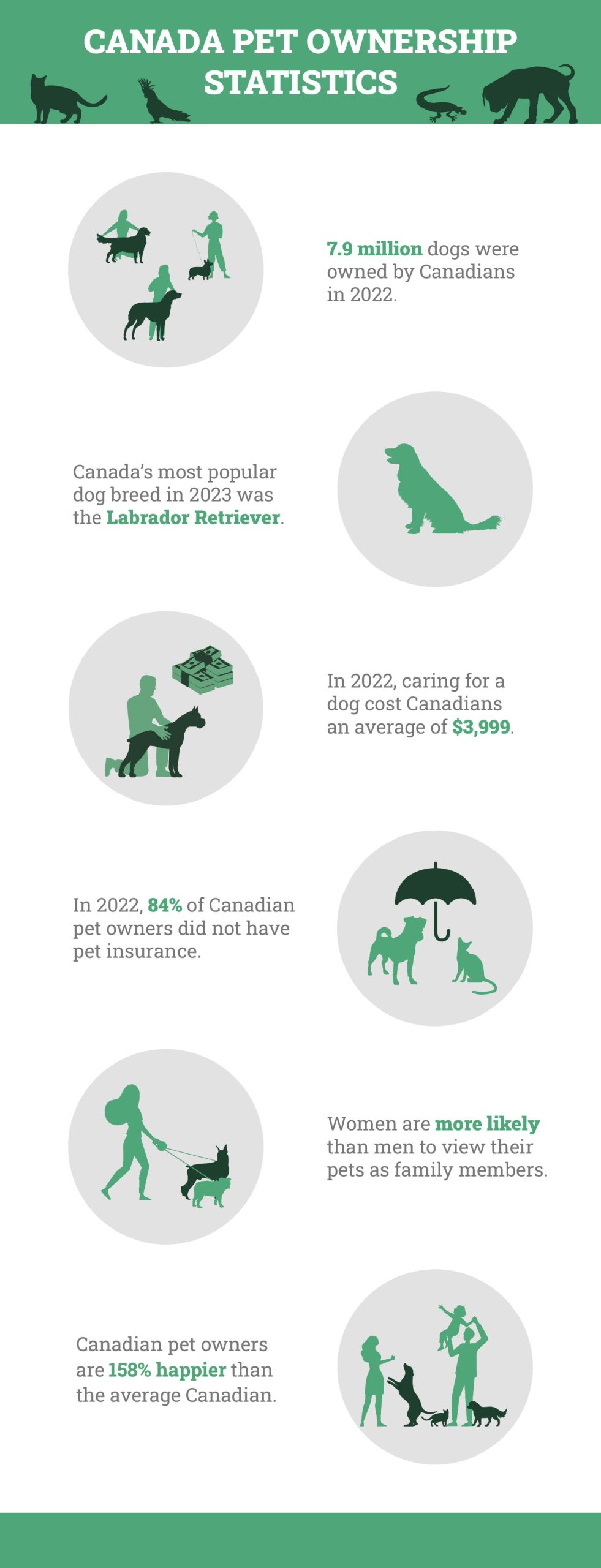
7.9 million dogs were owned by Canadians in 2022.
In 2020, Canadians owned 8.51 million fish, 2.51 million birds, 1.23 million small mammals, and 271,100 reptiles.
Canada’s most popular dog breed in 2023 was the Labrador Retriever.
Canada’s most popular cat breed in 2023 was the Domestic Shorthair.
In 2022, caring for a cat cost Canadians an average of $2,800.
In 2022, caring for a dog cost Canadians an average of $3,999.
Three in five Canadians believe that veterinarians charge too much.
Four out of five Canadians appreciate their veterinarian.
In 2022, 84% of Canadian pet owners did not have pet insurance.
Seven in 10 Canadians feel that their pet is a family member.
Women are more likely than men to view their pets as family members.
Canadian pet owners are 158% happier than the average Canadian.
Number of Pets in Canada Statistics
1. The total pet population in Canada is expected to be 28.51 million in 2025.
(Statista)
The total pet population in Canada has been steadily increasing. In 2016, there were 27.47 million, then 28.05 million in 2021, and it is projected to exceed 28.5 million by 2025. These pets include cats, dogs, small mammals, fish, and reptiles.

2. 8.5 million cats were owned by Canadians in 2022.
(Statista)
According to a 2022 nationwide survey, 8.5 million cats were in Canadian households, making the cat the most popular pet in the country.
3. 7.9 million dogs were owned by Canadians in 2022.
(Statista)
Dogs were Canada's second most popular pet in 2022, with 7.9 million dogs found in Canadian households. This means there were 600,000 fewer dogs than cats owned by Canadians at that time.

4. In 2020, Canadians owned 8.51 million fish, 2.51 million birds, 1.23 million small mammals, and 271,100 reptiles.
(Statista, Statista, Statista, Statista)
It is worth noting that most fish tanks contain more than one fish, so the number of reported fish is quite high. The number of pet fish has increased slightly from 7.91 million in 2006 to 8.51 million in 2020.
However, the number of pet birds decreased from 2.62 million in 2006 to 2.51 million in 2020. The number of small mammals remained quite stable, from 1.2 million to 1.23 million between 2006 and 2020. Finally, the number of pet reptiles increased from 237,000 in 2006 to 271,100 in 2020.
5. Canada’s most popular dog breed in 2022 was the Labrador Retriever.
(Canadian Kennel Club)
In 2024, for the 29th consecutive year, the Labrador Retriever—a Canadian breed!—remained the most popular breed in Canada. The Golden Retriever ranked second, while the German Shepherd came in third.

6. Canada’s most popular cat breed in 2023 was the Domestic Shorthair.
(Rover)
The Domestic Shorthair is not purebred at all, but there’s no question of their popularity!
Pet Care in Canada Statistics
7. In 2022, caring for a cat cost Canadians an average of $2,800.
(Statista)
Of course, these costs won’t apply to all Canadian cat owners because it ultimately depends on everyone's choices. The top three expenses were dental cleanings, which cost an average of $743, pet insurance, which cost $638, and cat food, which cost $576.

8. In 2022, caring for a dog cost Canadians an average of $3,999.
(Statista)
It shouldn’t be surprising that dogs cost Canadians more every year than cats. The average in 2022 was $3,999. The top expense was dog food, which averaged $1,200 in 2022. Pet insurance was $1,160, and dental cleanings cost an average of $743, which is the exact amount for cats!
9. Three in five Canadians believe that veterinarians charge too much.
(Angus Reid)
In recent years, the cost of living has risen sharply, causing many pet owners to struggle financially when it comes to paying for their pet's veterinary bills. As a result, in 2022, 71% of pet owners who took their pets to the vet for emergency visits felt that the cost was too high.
Similarly, 65% of pet owners found dental procedures too expensive, while 64% reported high costs for pet illnesses and 60% for routine check-ups. As a consequence, more pet parents are choosing to skip routine check-ups because they feel that they cannot afford the cost of veterinary care.

10. Four out of five Canadians appreciate their veterinarian.
(Angus Reid)
Despite the high cost of veterinary care in Canada, pet owners still value the work of their veterinarians. A 2022 survey showed that 88% of Canadians rated their vet highly for routine check-ups, 86% for treatment during pet illness, 85% for dental procedures, and 80% for emergency care.
11. In 2022, 84% of Canadian pet owners did not have pet insurance.
(Angus Reid)
In 2022, 84% of pet owners without pet insurance either were unable to obtain it or simply did not want it. For those who did have pet insurance, 30% found it to be unhelpful when they needed it. However, 22% of pet owners felt that their pet insurance was a lifesaver.

Statistics About Canadians’ Love of Pets
12. Seven in 10 Canadians feel that their pet is a family member.
(Angus Reid)
71% of Canadians consider their pets an important part of the family, while only 6% feel that they are not close to their pets. Among all pets, dogs are more likely to be regarded as family members by 80% of Canadians, while cats are close behind, with 68% of people considering them family.
Moreover, the survey found that 17% of dog owners and 26% of cat owners rated their relationship with their pets as close or very important.
13. Women are more likely than men to view their pets as family members.
(Angus Reid)
75% of women, as compared to 67% of men, consider their pets to be close family members. As far as age, 18- to 34-year-olds and those 55 and older are also more likely to feel their pets are family members than those in the 35 to 54 age group.

14. Canadian pet owners are 158% happier than the average Canadian.
(PetPlan)
According to the analysis, Belgian pet owners are happiest compared to those without pets, with a 172.8% difference. Canada comes in second place, with pet owners being 158% happier than Canadians without pets.
Overall, Canada was seventh among happy pet owners, with 76.6% (New Zealand was first). Canada came in fifth place with happy cat owners at 78.2%, but it didn’t break the top 10 for dog owners.
Interestingly, rabbits have the happiest overall owners with 71.4%, followed by dogs and cats.
Frequently Asked Questions About Pet Ownership in Canada
What Canadian provinces are more likely to bring a pet into their home?
Ontario residents are the most likely to bring home a new pet with a percentage of 37%, while British Columbia and Northern Canada are the second most likely at 36%. The least likely people to bring home a pet are those living in Atlantic Canada, with a percentage of 19%. (Newswire)
What provinces prefer cats and dogs?
Quebec loves its cats, with 67% of residents being cat owners, while B.C., Northern Canada, and the prairies are more inclined to dog ownership. Ontario and Atlantic Canada have an even split between cat and dog owners. (Newswire)

What province owns the most pets?
Quebec tops the list of provinces with 65% pet ownership, and the Atlantic provinces come in second with 64% pet owners. (Statista)
What is the most popular pet in the world?
The dog is thought to be the most popular pet in the world, and estimates say that 1/3 of households own at least one dog. (World Population Review)
Conclusion
The pet industry is rapidly growing worldwide, and Canada is no exception. Our love for pets extends beyond just cats and dogs to include all animals with fur, feathers, and scales. As long as we all continue to view our pets as members of our families, the pet industry will continue to expand, which can be seen as both good and bad. There are more options but also more expenses.
Fortunately, we are much more knowledgeable about pet care today than we were 20 years ago. That’s a good thing because we are definitely so much better off with pets in our lives!
You may also want to read:
Sources
Featured Image Credit: Roman Zaiets, Shutterstock
Expert dog care, straight to your inbox
Vet-reviewed advice, training tips, and the best of Dogster. Free, and you can unsubscribe anytime.
By signing up, you agree to our Terms & Conditions and Privacy & Cookies Policy.
Kathryn was a librarian in a previous lifetime and is currently a writer about all things pets. When she was a kid, she hoped to work in a zoo or with wildlife in some way, thanks to her love for animals. Unfortunately, she's not strong in the sciences, so she fills her days with researching and writing about all kinds of animals and spends time playing with her adorable but terribly naughty tabby cat, Bella. Kathryn is hoping to add to her family in the near future – maybe another cat or two and a dog.
Join the conversation
Ask a question, share your story, or send private feedback.