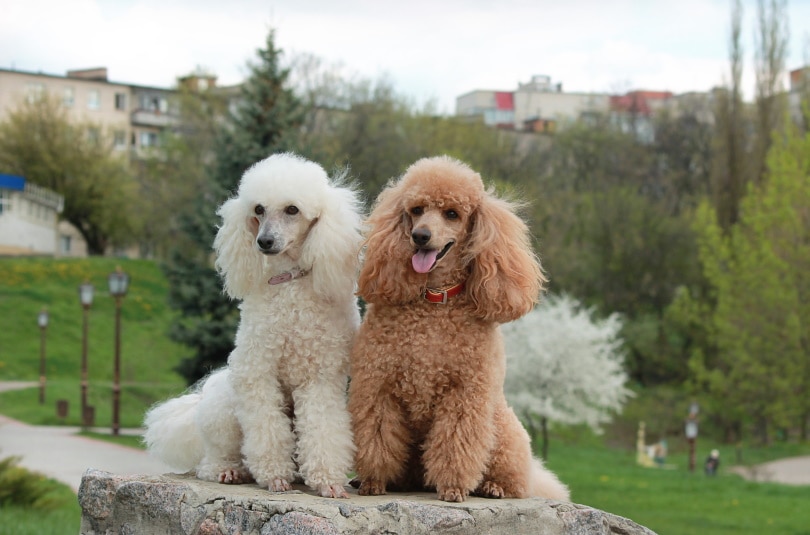
Poodles have a long and controversial history. Poodle origins trace back to 14th-century Europe. While the breed name itself comes from the German word “Pudel,” Poodles are the national dog breed of France. Originally bred as a water hunting dog, Poodles are accomplished swimmers. Their famous haircuts were chosen to help the dogs swim easily and keep them warm while doing so.
This dog breed has been owned by royalty, has been cross-bred to develop dozens of other dog breeds, and is still one of the most popular breeds in the world. Let’s take a look at the rich history of the Poodle.
The Earliest Poodles
Poodles can be found in documentation dating back to the early 14th century in Europe, and it’s believed that they were introduced in North America in the late 17th century. The American Kennel Club officially recognized the breed in 1887 as one of the first registered dog breeds.
While modern Poodles exist in three different sizes (miniature, toy, and standard), standard-sized Poodles can be traced back the furthest. In 1400s Germany, ancestors of these were dogs of royalty and upperclassmen. Standard poodles became commonplace hunting dogs over the next couple of hundred years, even used to hunt truffles.

Poodles in the 18th Century
The French monarchy owned Poodles as pets for several generations between the “Sun King” Louis XIV (ruled from 1643–1715) and King Louis XVI (ruled from 1774–1792), the last king of France before the monarchy was destroyed during the French Revolution. Toy poodles were known to roam the palace of King Louis XVI and Marie Antoinette prior to their beheadings. King Louis XVI’s favorite Poodle was one named Filou, the French word for “trickster.” Given the couple’s propensity for over-indulgence, it’s safe to say that these were pampered poodles!
During this final reign of the French monarch, the Poodle became the national dog breed of France. Appearances were extremely important in French courts, and the dogs were popular for their coat, which could be groomed and styled elaborately. The dog became commonly known as the “French Poodle.”
Breed historians believe that during the 17th and 18th centuries, the standard Poodle was selectively bred into the toy and miniature versions that we see today. This may be because small dogs can be carried around like trophies. There are reports of people in the French court using poodles as “sleeve dogs” that were carried to keep people warm.
Within the French court, Poodle coats mirrored the fashion of the time. The reign of Louis XVI and Marie Antoinette was known for its extremely elaborate fashion, designed to show off wealth and status. Poodles often had high pompadours and mustaches that mimicked their owners. Some were dyed different colors, while others had a family coat of arms shaved into their fur. The dogs were then paraded around by their owners as fashion accessories.
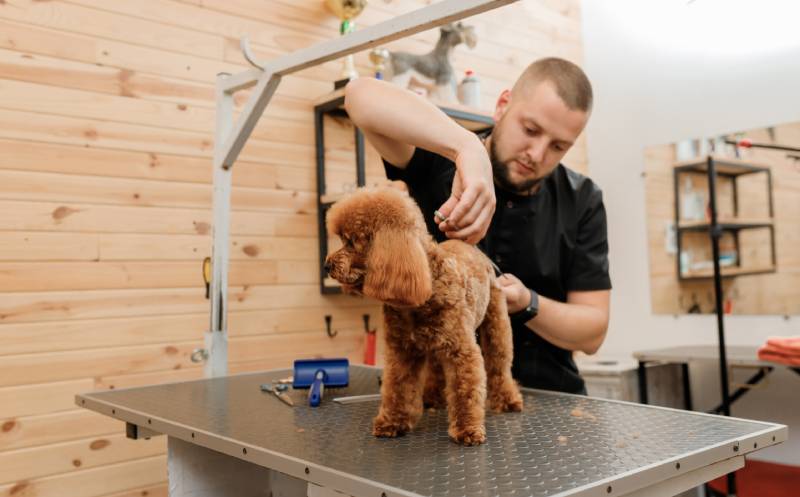
The Poodle’s popularity led to the emergence of dog grooming as a profession in the 18th century. Artwork from the time depicts women grooming Poodles in the street, with some styles similar to those seen in modern show rings. These original dog groomers experimented with styles and cuts that led to the iconic Poodle cut that’s so famous today.
Poodles After the French Revolution
The Poodle remained popular after the French Revolution, but they became circus performers instead of being shown off for their fashionable hairdos. The traveling circus employed many Poodles as entertainers, often with pom-poms clipped to their heads to match clown outfits.
Poodles in the 20th Century
Poodles remained popular as pets in France in the 20th century, with many celebrity owners showing them off as pets. Within the general French population, the Poodle’s popularity has declined in modern times, as the Poodle’s image has been thrown around in the context of an insult.
British Prime Minister Tony Blair was accused of being U.S. President George Bush’s “poodle”, and pop culture typically depicts them as snobby, vain, and spoiled dogs. This is thought to be part of the reason for the declining Poodle population, at least in France.
Poodle Origins: French or German?

There has been much debate over the years as to where the Poodle breed originated. Many believe that Poodles come from France, but research indicates that the standard Poodle came from Germany. German paintings of Poodles can be dated back to the 15th century. The world-famous artist Rembrandt even featured his pet Poodle in his self-portrait. These paintings all show Poodles as pets that belong to upper-class society members, implying that Poodles were primarily a luxury that most peasants couldn’t afford.
The Poodle’s skills made them ideal for use as working farm dogs, but their prestige meant that they became a dog for the wealthy. It may, in fact, be part of the reason that this dog breed gained the reputation for being “snobby.”
It’s likely that these dogs were brought to France by German soldiers, who used them for their tracking skills. Despite the evidence, there is still resistance from French dog authorities to allow Germany to lay claim to its national breed.
The British Kennel Club, American Kennel Club, and Canadian Kennel Club are all in agreement that standard Poodles originated in Germany. The Federation Cynologique Internationale, a widely respected dog authority in both France and Germany, claims that Poodles are descendants of the French Barbet, and therefore, originated in France. As two founding members of this organization are from France and Germany, respectively, Germany has agreed to accept the Poodle’s French origins in order to avoid friction.
Name Origins
Poodles were originally bred as water retrievers and used by hunters to gather wild game from water bodies. The word “Poodle” comes from the German word “Pudel”, which means “puddle”.
In French, the Poodle is called the Caniche, a term derived from the word “cane,” which means female duck. This is a credit to the dog’s amazing swimming abilities and their primary use as a water retriever.

Poodle Sizes
The American Kennel Club recognizes three sizes of poodles: standard, miniature, and toy. They all have the same physical appearance and characteristics; miniature and toy dogs are simply smaller-sized versions of the standard Poodle.
Toy Poodles are bred as companion dogs, with some of them competing as show dogs. Miniature Poodles are also companion dogs but have been used extensively as truffle-hunting dogs. Their finely tuned sense of smell combined with small paws that don’t damage the fungi that they’re hunting down make them a valuable resource for truffle hunting.
Standard Poodles, of course, are the oldest version of this dog breed. They are frequently used by hunters and celebrated for their swimming capabilities and intelligence. They have exceptional tracking abilities that enable them to sniff out shot down animals.
Historical Poodle Facts
- The traditional Poodle haircut was not designed as a fashion statement but was a practical choice for dogs that needed to swim through water to retrieve birds. Removing hair in some areas made it easier to cut through the water while leaving hair in some areas helped them retain body heat.
- Poodles have been companions to many famous historical figures, including Winston Churchill (whose dog’s name was Rufus), the French royal family, the Duke of Cumberland, Prince Rupert of the Rhine, Charles Dickens, and Victor Hugo.
- In 1988, a team of Poodles participated in the Iditarod Trail Sled Dog Race. The race is usually restricted to northern dog breeds, like the Siberian Husky, due to the extreme weather conditions that must be endured during the race. The Poodle team had to be dropped off after the first few checkpoints as they were unable to adapt to the cold.
Oodles of Doodles

Poodle crossbreeds are known as “Doodles.” This term has become a catch-all for any designer dog breed that involves a Poodle-cross. There are Chicago Doodles, Sheepadoodles, Goldendoodles, Labradoodles, and Bernedoodles, to name a few.
Monica Dickens, the great-granddaughter of Charles Dickens, was the first to breed a “Doodle” in 1969. She bred a Golden Retriever with a Standard Poodle in hopes of a puppy that would inherit the most endearing traits from each breed. It seems that she was successful, as Goldendoodles have become a well-known breed, with the gentle nature of the retriever and athletic intelligence of Poodles. They also lack the Golden Retrievers’ famous tendency to turn your floor into something resembling a shag rug.
The Labradoodle was first bred by an Australian named Wally Conron in 1988. He needed a service dog for a blind woman, but her husband had serious allergies. He bred a Poodle with a Lab after attempting and failing to train a shed-free Poodle as a guide dog.
Smaller Poodle mixes, like Cockapoos, are also popular as companion dogs, although they lack the catchy “Doodle” name.
While many Doodles are sold as being hypoallergenic, there is actually no such thing. However, there are dog breeds and crosses, such as Doodles, that elicit fewer allergy symptoms than others. Doodles aren’t without behavioral problems entirely, either. While the Labradoodle’s popularity exploded after one was used as a guide dog, many forget that they are a crossbreed between two highly energetic dogs, which can lead to behavior problems for inexperienced owners.
By and large, however, most Doodles are energetic, lovable, and fun to be around. Crossbreeds also play an important role in creating genetic diversity in dog populations, helping to decrease inherited health problems and inbreeding caused by a lack of diversity in purebred populations.

Conclusion
Poodles have played a prominent role in European history, most notably in France, where they became a dog of royalty. They have long been viewed as dogs of the rich and a social status symbol, but they are actually talented water retrievers. Their reputation as “dogs of the rich” prevented them from becoming common working dogs.
That reputation persists in modern times, with the breed’s popularity declining in France. Many designer crossbreeds, or “Doodles”, have become more popular than purebred Poodles.
You Might Also Be Interested In:
Featured Image Credit: Anna_Bondarenko, Shutterstock
 The Earliest Poodles