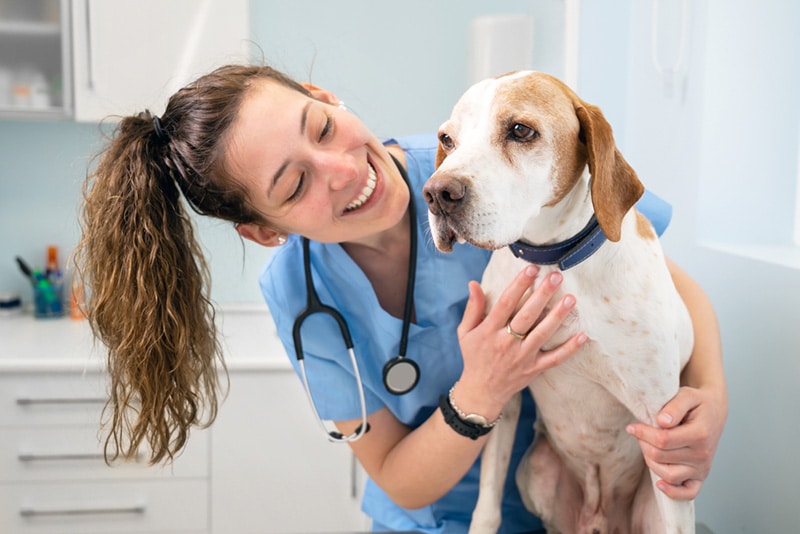
During a physical exam, your veterinarian should always listen to your dogs’ chest with their stethoscope. This will include placing their stethoscope in more than one area, to listen to both different areas of the heart and the lungs. Your veterinarian is listening for two main things when auscultating the heart: a murmur, or abnormal sound of the heart, and an arrhythmia, or an abnormal rhythm of the heart. Your dog may have one or both of these. An irregular heartbeat (arrhythmia) in your dog may or may be a cause for concern, and will usually need further testing to determine the cause.

What Is an Irregular Heartbeat?
An irregular heartbeat, or rhythm, in a dog is known as an arrythmia. A dog’s heart has a very normal cadence or beat. Each beat and rhythm that your veterinarian hears correlates to some type of activity in the heart. Without getting too much into the specifics, each dog has a normal pacemaker, or area of the heart that determines the rate and rhythm that the heart contracts. In a dog, this is called the sinus node.
As the heart contracts and relaxes, different things occur in the heart, such as valves opening and then closing, blood being contracted or pushed out of one chamber of the heart into another, and blood coming and going from the lungs and other parts of the body. A normal rhythm means that not only is the pacemaker working appropriately, but that all of the domino effects that occur once that signal is sent, are also working appropriately.
An arrhythmia means that there is a break in the pathway of a normal heart contraction and relaxation. Depending on where this break occurs will determine what abnormal sounds may occur, what occurs with the rhythm, and what abnormal signs your dog may exhibit.

What Are the Signs of an Irregular Heartbeat in Your Dog?
Signs of an irregular heartbeat in your dog are sometimes mild. You may notice your dog panting more than normal, or panting when the weather is not hot and/or your dog has not done any activity. You may notice your dog occasionally coughing or even gagging, or they may seem more lethargic than usual. Sometimes dogs will develop weakness due to poor circulation and you may notice your dog having difficulty getting up or walking; they may sway, stumble or even act as if they are drunk sometimes.
Obvious signs of an irregular heartbeat are collapse, especially during excitement. Your dog may have very pale, blue or muddy gums and tongue. Exercise intolerance, or an increase in the effort and rate of their breathing with very little activity can be very noticeable.
Unfortunately, you may not notice anything in your dog at first. Arrhythmias can sometimes only be found by your veterinarian hearing it during their exam. Other times, your veterinarian may suspect something abnormal, and further testing such as a Holter monitor, EKG, and echocardiogram by a veterinary cardiologist are needed.
If you suspect your pet has an irregular heartbeat, you should contact your vet directly for an assessment. They can provide you with more information and a care plan.
If you need to speak with a vet but can't get to one, head over to PangoVet. It's our online service where you can talk to a vet online and get the advice you need for your dog — all at an affordable price!
What Are the Causes of an Irregular Heartbeat in a Dog?
There are some arrhythmias that are caused by the heart muscle itself being abnormal. In other words, sometimes the heart muscle is very thick and cannot contract and relax like normal. Other times, the heart chambers can become very dilated and large, causing a thinning of the heart muscle. Both of these conditions can cause an irregular heartbeat.
Other structural problems that can cause an arrhythmia are abnormal valves of the heart. Sometimes these valves do not work properly or are anatomically abnormal. Whenever there is one or more abnormal valves in the heart, this will cause abnormal blood flow through the heart. In turn, this can lead to abnormal rhythms or even congestive heart failure. Depending on what valve(s) are affected will determine what can happen in your dog.
Other times, dogs can inherit problems with their heart from their parents or others within their breeding line. If you are working with a breeder to purchase a purebred dog, it’s always recommended to ask about any history of heart problems within the breeding line. A responsible breeder will have records of appropriate exams and testing within all of their dogs.
Dogs that have significant internal disease such as cancer, bleeding disorders, or a low red blood cell count (anemia), may have arrhythmias secondary to these conditions. If these other diseases can be treated and/or managed, the arrhythmia may go away.

How Do I Care for a Dog With an Arrhythmia?
The only way that you can effectively manage an arrhythmia in your dog is by working closely with a veterinarian. I wish I could say that there are over the counter medications and/or treatments you could do, but there truly is nothing safe or recommended without a prescription.
Your regular veterinarian may or may not be able to appropriately manage your dog. Some heart conditions, similar to people, can be very complex. Board-certified Veterinary Cardiologists are trained and boarded in dealing with all types of conditions of the heart. Your veterinarian may recommend you bring your dog to a cardiologist immediately, or they may send you only after your dog’s heart rhythm has become unmanageable.
Depending on the type of arrhythmia and the cause, different treatments may be available. Some dogs are put on medications to help control the rate and/or rhythm of their heart. Other times dogs have to be hospitalized and put on IV medications to help convert their rhythm to normal. Other dogs may be candidates for pacemakers and other surgical treatments. Still there are some arrhythmias that will not respond to treatment, and your dog may unfortunately need humane euthanasia.
Frequently Asked Questions
How Is an Irregular Heartbeat in a Dog Diagnosed?
The first line of diagnosis is regular physical exams by your veterinarian. Some arrhythmias can be easily heard on normal chest auscultation. Other times, arrhythmias will need further testing such as an EKG and/or echocardiogram. A more advanced test is the use of a Holter monitor. This is something your dog will wear that records its heart rhythm and rate for an extended period of time. A veterinary cardiologist will then evaluate all of these results to determine the type of arrhythmia and the next steps.
Will My Dog Die?
Unfortunately, many dogs will die from underlying heart issues. Some dogs with arrhythmias will eventually suffer from myocarditis, congestive heart failure, and/or valve problems. Other times dogs will just acutely die from an irregular heartbeat. Your dog’s specific prognosis will be determined by what kind of arrhythmia they have and what other underlying heart issues may or may not be present.
Are There Any Abnormal Heartbeats That Can Be Normal?
Yes! What’s called a sinus arrhythmia can be completely normal in your dog. This is when the rate of your dog’s heartbeat speeds up and slows down with the speed of their breathing. In other words, as your dog breathes faster, their heart will beat faster, and vice versa. Your veterinarian may still want to pursue additional testing to make sure that this is, in fact, a normal finding in your dog.
Conclusion
An irregular heartbeat in a dog is known as an arrhythmia. Arrhythmias occur when there is any type of break in the normal pattern of events from the time there is a signal sent to start a heart contraction, down to the relaxation and start of a new “beat”. Some arrhythmias can be easy to diagnose on just a physical exam, while others require advanced testing such as an EKG, echocardiogram, and Holter monitor. Treatment is dependent on what your dog has and may include IV medications, oral medications, or even placement of a pacemaker. Unfortunately, treatment may not be effective in some dogs, and they may pass from an arrhythmia. Dogs with an irregular heartbeat should always be under the management of a licensed veterinarian, and only medications prescribed for your dog should be given.
- See also: How Many Hearts Do Dogs Have?
Featured Image Credit: 135pixels, Shutterstock