
5 Different Types of Pit Bull Dog Breeds (With Info & Pictures)

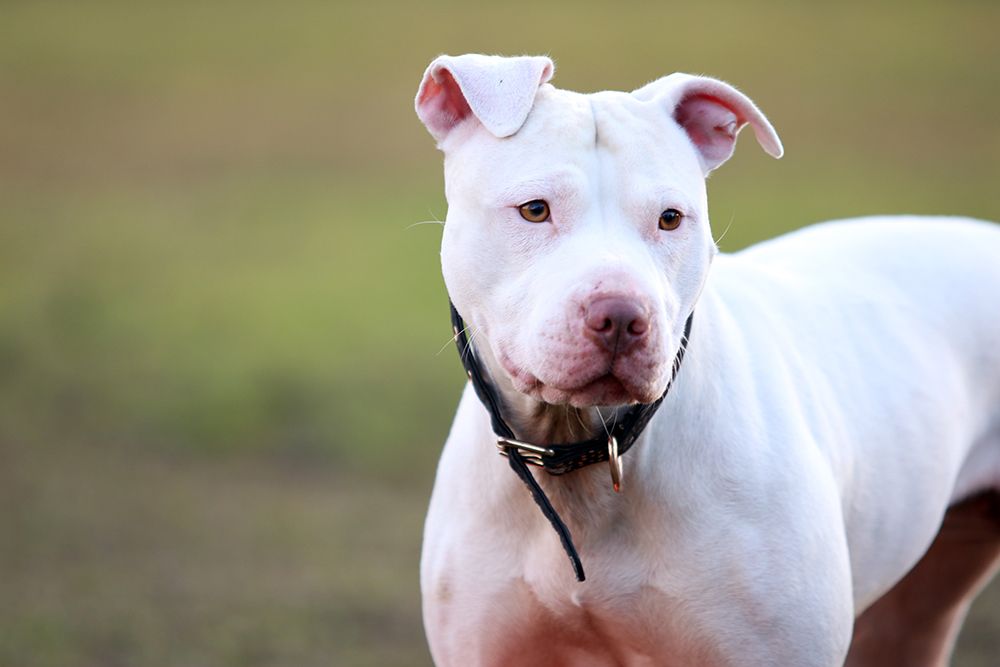
The classification and clarification of the Pit Bull breed is one that is fraught with contradictions, controversy, and confusion, which is just part of the reason this wonderful breed of dog has not been formally recognized by the American Kennel Club (AKC). In fact, the refusal of the AKC to officially recognize the breed prompted an avid lover and breeder to form a separate kennel club in 1898,1 the United Kennel Club (UKC), not to be confused with The Royal Kennel Club of the United Kingdom (KC)!
Part of the reason behind the AKC’s reluctance to include the Pit Bull Terrier amongst their 200 recognized dog breeds is to do with the process of breed recognition, but it is also influenced by Breed Specific Legislation (BSL) that restricts or bans dogs that fit the “pitbull” description of almond shaped eyes, a heavy and muscular neck, a tail medium in length that tapers to a point, a smooth and short coat, and a broad chest. It is difficult enough that these descriptors could be applied to any number of dog breeds in order to enforce a dog ban, but if a dog is officially classified as being a Pit Bull Terrier, it is going to be subjected to BSL, depending on where they are located.
For a dog breed to be considered by the AKC, it must first be entered into the Foundation Stock Service, and after proving itself in various events and activities, the breed must be able to prove a population of at least 150 dogs with three-generation pedigrees in its studbook and a viable breed standard. They must also have one club that will represent the breed as its “parent club” in the United States.2 This is where things get tricky for the Pit Bull, as their origins are somewhat muddy in terms of how the breed was created, and how recently they stopped being simply a ‘mixed breed’ and became a pure bloodline of Pit Bull Terriers. Some still consider the American Pit Bull to be a ‘crossbreed’ rather than a distinct pedigree.
This particular obstacle becomes quite obvious when you start to compare and contrast different individuals of the American Pit Bull Terrier, the only ‘true’ pitbull breed. The UKC provides a detailed description of the American Pit Bull Terrier (APBT) breed standard, but many Pit Bulls still share many similarities with their parent breeds. Let’s take a look at five dog breeds that are believed to have given rise to the American Pit Bull Terrier we know and love today.

The 5 Pitbull Dog Breeds
1. English Bull Terrier

The English Bull Terrier did not always have the pronounced dome head which makes them particularly recognizable today, and sometime during the 19th century, dog fanciers in England, Ireland, and Scotland started experimenting with crosses between this and the more athletic old English Bulldog, with some terrier breeds, including the Staffordshire Bull Terrier, thrown into the mix, trying to make the ultimate bull baiting and fighting dog. Fortunately, both these horrible sports are all but extinct, and the English Bull Terrier has become a popular companion dog.
2. Olde English Bulldogge

You may be more familiar with the short and squat British Bulldog, but believe it or not, these lovable, slobbery couch potatoes actually have more streamlined and active origins. Although selective breeding towards the more popular, though decidedly less healthy, companion variety almost led to the extinction of the original bulldog form, recent efforts have managed to bring back the much fitter and agile Olde English Bulldogge, in an effort to both restore the breed and encourage more humane and healthy breeding practices.
3. Staffordshire Bull Terrier

Well known for their fiercely loyal, tenacious nature, the Staffordshire Bull Terrier, as the name suggests, was originally bred primarily for use in cruel bull baiting and dog fighting. Their powerful jaws, short but muscular bodies, and refusal to let injury get in the way of a good battle made them perfectly suited to these bloody spectator sports. Fortunately, the loving nature of these dogs has been the focus of breed selection over the last century, and although they can sometimes be somewhat more reactive towards other dogs if not properly socialized, they have proven themselves to be wonderful family members.
4. American Staffordshire Terrier

Also referred to as the AmStaff, this breed is sometimes mistakenly said to be another name for the American Pit Bull. However, the history of the American Staffordshire Terrier is essentially the same as their English counterparts, with genetics that include the Old English Bulldog and Bull Terrier, as well as some extinct breeds like the White English Terrier and Black-and-Tan Terrier3. The Staffordshire Terrier landed on American soil during the 1800s, and like the English variety, their breeding over the past century has shaped them into an affectionate and loyal companion rather than a fighter.
5. American Bulldog

The precise origins of the American Bulldog are not completely known, but the breed has been seen in the US since the early to mid-1700s. Given the timing and the similarities in their appearance, it is likely that the American Bulldog has its origins with the Olde English Bulldog, before they started their evolution into the less sporty, more portly British Bulldog we know today. Bred for athleticism, power, and stoicism, the American Bulldog was ideal for guarding, farmwork, and, unfortunately, bloodsports. But, like most of the dogs with this sad history, the American Bulldog is now the ideal companion for those looking for a loyal dog with lots of energy.
American Bully
You might be forgiven for thinking that American Bully is another name for the American Bulldog, but this is actually a completely separate breed - how confusing! These dogs do not make it to the list because it is not one of the breeds that make up the Pit Bull, but are a breed that has come from the American Pit Bull. As you can probably guess, the AKC doesn’t recognize the American Bully either.
What is interesting about the American Bully is that it was created as recently as the 1980s by mixing the American Pit Bull with several of its parent breeds, including the American Bulldog, English Bulldog, and Olde English Bulldogge.4 This has resulted in three sub-categories based on size: Pocket, Standard/Classic, and XL Bully, the latter of which has been shrouded in controversy. Having been implicated in a worrying number of fatal attacks on humans, the XL Bully became the first dog breed to be placed on the list of banned dog breeds in the UK since the Dangerous Dogs Act was created in 1991, despite not actually being an officially recognized breed.

Conclusion
Whichever way you look at it, the American Pit Bull Terrier is a breed not easily defined; something that might actually be of benefit whilst breed-specific legislation puts them at risk of restriction, even destruction, in some locations. Despite their reputation, the Pit Bulls of today are more likely to shower you with slobbery kisses than land you in the hospital. However, their physical capacity for inflicting harm, as well as the tendency for people to label any unknown bulldogs or mastiff dogs as Pit Bulls, has led to them being overrepresented in dangerous dog statistics.
As with any dog, particularly those with large and powerful jaws, the Pit Bull must be brought up with clear boundaries, strong leadership, and plenty of socialization from a young age. With the right ingredients, the Pit Bull should be no more dangerous than any other dog.
Sources:
https://www.akc.org/expert-advice/dog-breeds/how-dog-breed-become-akc-recognized/
https://www.akc.org/dog-breeds/american-staffordshire-terrier/
Featured Image Credit: Chris Anabalon, Shutterstock
Expert dog care, straight to your inbox
News, insights, expert advice, and everything dog.

No spam — unsubscribe anytime.
By signing up, you agree to our Terms & Conditions and Privacy & Cookies Policy.
How useful was this post?
Click a star to rate. You can leave written feedback afterwards. (We read all feedback.)

Dr. Karyn Kanowski, BVSc MRCVS (Vet)
Dr. Karyn is originally from Queensland, Australia, and has resided in the UK for the past 10 years. She graduated from The University of Queensland School of Veterinary Science in 2010, and also holds a Bachelor’s degree in Zoology. Karyn is passionate about using experience, evidence, and working with pet owners to provide the best solutions for pets. She also believes in making reliable information about animal health accessible to everyone. 5 cats and 4 dogs let her share their home with her and her husband, and when she is not practising as a veterinary surgeon, she spends her time writing, gardening, and cleaning up pet hair!