

In this article
Teaching your dog to leave things alone is vitally important to keep them safe. They learn that not everything in their environment is theirs to take (and eat!) and helps to teach them impulse control.
Lucky for you, there’s no reason why you can’t teach your dog how to perform this simple task. All it will take is a little persistence and patience on your part. Without further ado, here’s how you can teach your dog to “Leave it” and stop them picking up rubbish and other unwanted items on walks and at home.
The 10 Steps to Teach Your Dog the “Leave It” Command
Here is a brief description of how you can teach your dog to leave something alone once and for all.
1. Set Your Expectations
Before you start any kind of training, you need to set your expectations. For instance, you can’t expect your dog to learn this instantaneously. Any kind of training is a process, and it will take them time to get the hang of it.
Instinctually, your dog is going to want to get into things. They have a nose for a reason, and they love to use it. The will battles strongly with the desire to obey you and to do what they want.
So, you need to understand what a challenge it is for them and have the appropriate amount of patience for the given situation. You need to understand that teaching your dog to leave something alone will take a different amount of time for each dog.
It’s easier to say exactly how quickly a dog will pick it up if you know the attention span, intelligence level, and obedience potential of your dog. So don’t expect anything spectacular up front.
If your dog seems to get the hang of it quicker, that’s fantastic. But just expect that this is going to take quite some time, and it will potentially prevent a little frustration on your end. Like children, dogs require consistency. So just remember to do your part, and the rest will follow.
2. Get Some Motivational Treats
When it’s time to reward your dog, you’re already going to want to have treats on hand. You can choose from a broad selection of treats you can purchase online or in-store. Keep in mind that treats should be relatively small, easy to chew, and baked.
If you and your dog are just learning one another, you might not know what treats they love the best yet. However, most dogs aren’t picky and will gobble up just about anything you give them.
Usually, the more they like the treat, the more motivated they will be to get one. So, that’s always something to keep in mind when you are selecting the proper rewarding snack.
3. Place Treats in a Closed Hand
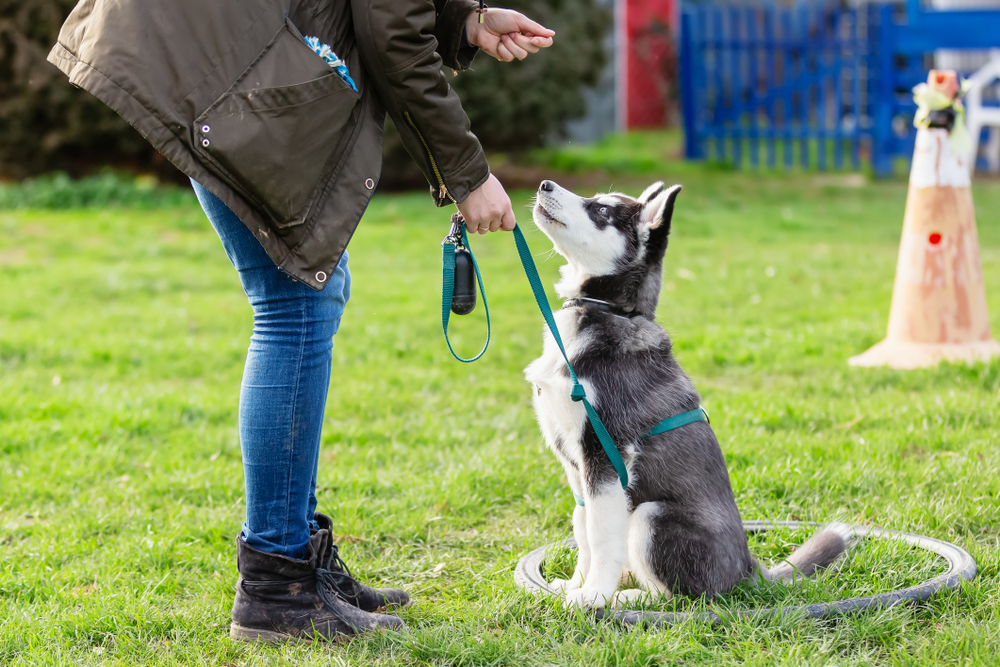
Hold a treat in your hand with your fist closed around it so that your dog can smell but not see it. They will probably try to nudge, lick or paw at your hand to get at the treat, but keep your hand closed. Once they stop and make any motion to move away, mark with a click (if using a clicker for training), or a marker word such as “yes”, and then give them the food in your hand.

4. Repeat!
Repeat the above stage multiple times until your dog reliably chooses to take their nose away from the food in your hand.
5. Add “Leave It” Cue
Add the words “Leave it” while your dog is moving their head away from the treat so they build up an association between the cue and the action. Ask your dog to “leave it” as you present your hand with the treat in it to them, and reward them when they move or turn away from it.

6. Show Them the Treat
Now it’s time to up the ante! This time place the tasty treat in an open hand so your dog can also see it , making it harder to resist! Have a second treat in your other hand placed behind your back.
Present the treat in your open hand and calmly cue “leave it”. If your dog does not make any movement towards the food in your open hand, click or use your marker word and reward with the food from behind your back. At this step in the training the reward needs to come from elsewhere, your dog shouldn’t get the food you’ve asked them to leave.
7. Putting the Treat on the Floor
Once your pup has got the hang of leaving food in your open hand you can start to place food on the floor and ask them to “Leave it”. Mark and reward quickly when they ignore it initially, and then gradually increase the amount of time before rewarding them. If your pup moves towards the treat you can use your foot to cover it, it’s important not to let them get the food once it’s on the floor.

8. Drop the Treat
Now start dropping the treat to train your dog to be able to leave moving pieces of food. Start a few inches above the floor and gradually increase the height you are dropping the food from.
9. Move on to Other Objects
Now you need to start generalizing the “Leave it” command. Start to incorporate different items into your training that your dog may have shown interest in, for example socks or shoes. Practice in different environments as well, outside there are lots of distractions that can make it harder for them to focus. You may need to use a very high value treat when you first start training outside.

10. Gradually Phase Out the Treats
Once your dog consistently understands the “Leave it” command, you can phase out the treats. Maybe give them a treat every other time, and so on and so forth. Eventually, they will perform the command without the treat reward.
Top 4 Tips for Training
If you aren’t sure how to approach training, we have some tips for you. Any type of training can be very lengthy and mentally taxing. So, here are a few things that might make it a little simpler.
1. Be Patient
We know, we know. It sounds so trite. But still, it rings true. Being patient is the number one thing you have to do when training any canine.
Make sure your pup has mastered the step you are on before moving to the next one. If your dog is struggling, go back to a stage where they were successful and take it more slowly. Short, regular training sessions are better than long ones where your dog loses focus.
2. Be Consistent
Being consistent is equally as important as being patient. If you want your dog to learn how to leave something alone, you have to repeat the process every single time they require this command. When teaching your dog to “Leave it” it is important that you make sure your dog does not get the food or item you have asked them to leave.

3. Practice Timing
Timing is everything. When you’re trying to train your dog to leave something alone, you have to make sure that you’re giving them a treat and rewarding them at precisely the right moment.
It might take you both a little while to get acclimated to it, but it is entirely possible, so keep it up!
4. Opt for Professional Training
If you are a first-time dog owner or you have a particularly challenging dog on your hands, you can always opt for professional training. This is actually a really fantastic resource to not only help you train your dog, but bond with them as well. You and your dog can learn together, responding to one another accordingly.
Professional training can range from basic to advanced. You can enroll in whatever program gives you access to the goals you wish to achieve. Professional training can range in cost depending on the individual trainer and their rates. Always look around for recommendations and choose a trainer that uses positive reinforcement.

Final Thoughts
So, hopefully, this article will give you an idea of the steps you need to take to teach your dog a new skill. The more you train your dog, the better your relationship will be.
Training doesn’t have to be difficult, but it does require consistency and patience. Understand that your dog is learning all of this for the first time, so remember to cut them a little slack when you or they are feeling overwhelmed with training.
Featured Image Credit: supercat, Shutterstock























2 Responses
what’s the most common mistake people make when teaching their dog ‘leave it,’ and how can it be avoided?
Hello there,
this is a very good question. I would say that the most common mistake is that people are often confusing the dog by not teaching "leave it" but rather "wait". This happens when people show a treat to the dog, tell them to "leave it" and once the dog looks away from the treat, they say "Good boy!" and reward them with THAT specific treat. The dog then learns that "leave it" actually means "wait a little bit, look away and then you are free to eat". This could be very dangerous because dogs won't learn that once you tell them to "leave it" they can't ever touch the thing again.
You can avoid this mistake by rewarding your dog with some other, higher-value treat. They then learn that if they will leave the treat be, as told, they will get rewarded with something better.