Japanese Chin Dog Breed: Info, Pictures, Facts & Traits

In this article
The Japanese Chin, also sometimes known as the Japanese Spaniel, is a toy dog with an aristocratic history and many redeeming personality traits. These pups have an air of prestige and elegance about them and are known to make fantastic companions. As easygoing and affectionate as this breed is, they aren’t suitable for every household. Read on to learn more about Japanese Chins to determine how well one would fit into your lifestyle.
Breed Overview
Height:
Weight:
Lifespan:
Colors:
Suitable for:
Temperament:
The Japanese Chin is a fantastic dog for first-time dog owners. They’re relatively easy to care for, as they don’t require a lot of exercise or grooming, and their small stature makes them easy to live and travel with. They can live happily in smaller dwellings like apartments or houses with or without a backyard. These easygoing and versatile pups are loving toward their family members, making them a great introduction to dog ownership.
Japanese Chin Characteristics

Japanese Chin Puppies

Japanese Chins are relatively easy to find. At the time of writing, there are over 25 litters currently available for adoption on the American Kennel Club’s marketplace. Since this breed is prone to numerous genetic conditions, potential adopters must do their research before choosing a breeder. All reputable breeders should happily provide proof of genetic testing for their breeding pairs to reduce the likelihood of their puppies inheriting genetic mutations in their DNA.
Japanese Chin puppies are adorable and affectionate, but they require proper training and socialization from a young age to grow into well-balanced adults.
Japanese Chin Origin & History
The exact origin of the Japanese Chin is a hotly debated topic. Some believe the breed was a product of China, while others think it originated in Korea. Still, it is generally accepted that the Chin was developed primarily by the Japanese nobility between 500 and 1,000 years ago. The first Chin was brought to England in the 1600s, but they weren’t introduced to the West until the mid-1800s when Japan was reopened for trade after hundreds of years of isolation.

Temperament & Intelligence of the Japanese Chin 🧠
Japanese Chins are one of the most cat-like dog breeds. They are intelligent and independent and even groom themselves like their feline counterparts. Some Chins enjoy resting on high perches and have a decent sense of balance. Of course, they’re much more fragile than cats, so care needs to be taken to prevent injury when allowing your Chin in high places. A poorly executed jump off the sofa can result in serious injuries.
Chins are highly affectionate toward their family members. They’re bright, happy, and charming dogs that enjoy a good play session as much as a snuggle on the couch. Though they were originally bred to be companions of royalty, they aren’t content with lazing on the couch all day. Chins need exercise to stay happy, healthy, and stimulated.
The Chin is typically standoffish with strangers, which is why it’s so important to provide enough socialization early on in puppyhood to prevent this behavior. Chins are generally a quiet breed, but they won’t be shy when alerting the arrival of visitors, making them quite useful as watchdogs. However, their small stature won’t do much to scare away a burglar or protect their family.

Are These Dogs Good for Families? 👪
The size and temperament of Japanese Chins make them a great option for families. They generally do well with children, though all interactions should be supervised, especially when the kids are young. Chins are a toy breed, after all, and could be unintentionally injured during play. For this reason, potential owners should consider waiting until their kids are older to adopt a Chin.
Chins can develop separation anxiety, but this can be addressed through crate training and slowly introducing them to the idea of being left alone for short periods. However, because they’re very loyal companions, they generally don’t do well with being left alone for long periods.
Does This Breed Get Along With Other Pets? 🐶 😽
Japanese Chins are generally easygoing when it comes to other household pets, so long as they’ve been properly trained and socialized as puppies. It’s important to remember, however, that Chins are a toy breed, so you may want to reconsider adopting one if you have an extra-large breed, as Chins are extremely fragile and can get hurt easily.

Things to Know When Owning a Japanese Chin
Food & Diet Requirements 🦴
The Japanese Chin may be prone to obesity, so they need to be fed a high-quality diet in appropriate portions. The exact portions will vary from dog to dog, depending on their age and activity levels. A veterinarian can help owners determine exactly how much to feed to ensure adequate nutrition without the risk of overfeeding.
The best food will also vary from Chin to Chin. It’s important to ensure they’re eating high-quality food that meets the nutritional recommendations, according to the Association of American Feed Control Officials (AAFCO). It’s essential to feed a life-stage-appropriate diet, especially during the first year of life, as Chin puppies require higher calories to allow for proper growth during this time. Once they reach a year old, they won’t grow any further, so the diet should slowly transition to a maintenance food designed for small breeds.
As for feeding frequency, most Chin owners opt to feed their dogs three times daily to prevent hypoglycemia.

Exercise 🐕
Though they may be small, the Japanese Chin is a fairly active little pup. They enjoy going for slow-paced walks with their owners and exploring their fenced-in backyards. Thirty minutes of physical activity daily is all this breed needs to stay happy and healthy.
Due to their flat-faced facial anatomy, Chins can be prone to overheating and heat stroke, so it’s best to avoid overexerting them during warmer weather.
Training 🎾
The Japanese Chin is an intelligent dog breed, but that doesn’t mean they’re easy to train. These pups can have an air of superiority about them, which can make training a challenge. It’s easy to see how they’ve developed this attitude when you consider that Chins were bred specifically to act as companions for royalty. Their only job throughout their centuries-long existence has been to comfort and charm their humans. Some owners describe their Chins’ temperament during training as cat-like, so it’s important to remember that when training. Owners must always use positive reinforcement and have plenty of high-value rewards on hand. Chins will shut down at the first sign of harshness, so keep sessions short, fun, and engaging.
If you have problems training your Chin, it’s okay to need professional help. Experienced trainers can provide useful advice to help you get back on the right track.
Grooming ✂️
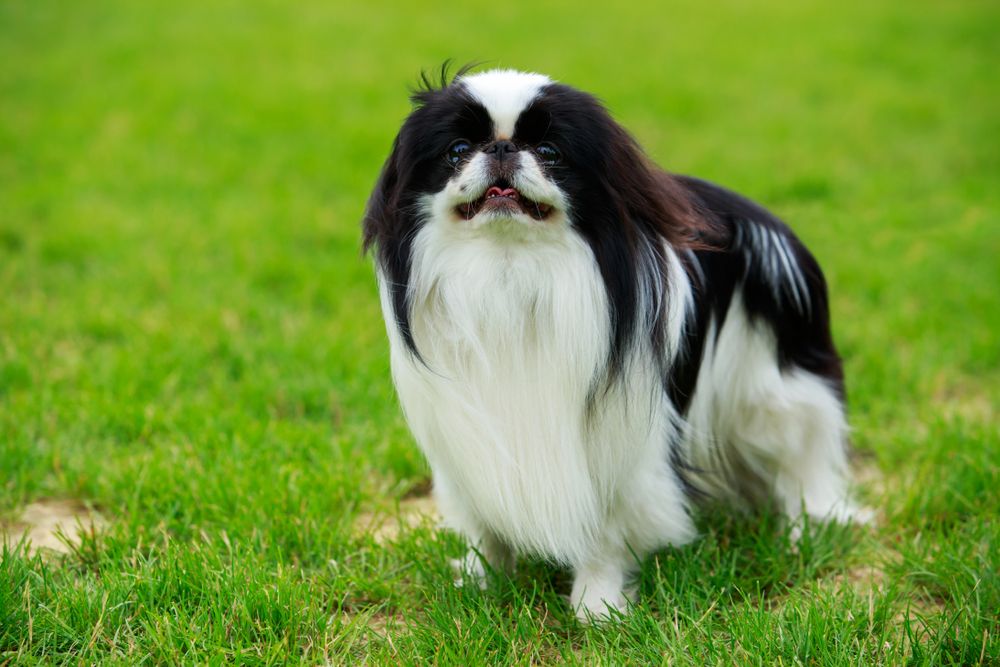
Japanese Chins have long, silky coats that look high maintenance but are relatively easy to maintain. They need to be brushed once weekly and bathed monthly, but that’s all that’s required of Chin owners to keep their coats in tip-top shape. Special care should be given to the skirt and under the ears and legs.
Chins have single coats and don’t shed much. Additionally, they’re great at self-grooming.
The breed’s unique facial anatomy does require regular cleaning. The skin folds around the nose can trap moisture, which may lead to fungal problems. The face should be wiped with a damp cloth, and the folds cleaned with a dry cotton swab occasionally. Pet wipes are also great for spot cleaning.
Of course, nails will need trimming, probably more often than you think, as they grow quite fast. Ears and teeth should be checked and cleaned regularly to avoid ear infections and dental issues.

Health and Conditions ❤️ 🏥
The Japanese Chin has a shorter average lifespan than other similarly sized toy dog breeds. Papillons, for example, are around the same size as the Chin, but their average life expectancy is between 13 to 15 years, compared to the Chin’s 10 to 12 years.
The Chin can be predisposed to numerous health issues.
Brachycephalic airway syndrome (BAS) is noted in flat-faced breeds and may cause snoring, snorting, gagging, coughing, and heavy breathing. BAS can make Chin’s highly sensitive to warmer temperatures and prone to overheating.
GM2 gangliosidosis is a fatal, inherited disease only found in the Japanese Chin. It is noted by loss of nervous system functioning, which causes incoordination, tremors, difficulty eating, and vision loss. This condition is entirely preventable if responsible breeders would test their breeding line.
Eye issues like cataracts, entropion (the inward rolling of the eyelid), and distichiasis (extra eyelash growth) are sometimes noted in this breed.
Some heart conditions, such as myxomatous mitral valve degeneration (MMVP), can develop in some Chins.
Male vs. Female
There aren’t any notable differences between male and female Japanese Chins. Unlike most dog breeds with clear differences in height and weight between genders, both male and female Chins grow to be around the same size.
3 Little-Known Facts About the Japanese Chin
1. Chins and Pekingese are very similar.
So similar, in fact, that the two dogs were, at one point, considered the same breed. However, Pekingese were further developed to have a double coat and longer fur around their neck and shoulders. Additionally, despite weighing a smidge more, Pekingese are slighter and shorter than their Chin counterparts.
2. They were purposely bred to be as small as possible.
Japanese Chins are so small because original breeders needed them to be tiny enough to be carried in the sleeves of a woman’s kimono. Some historians claim that Chins were occasionally kept in cages and fed sake to stunt their growth.
3. They’re known for the “Chin spin.”
The Japanese Chin is an intelligent breed that can be taught to perform tricks if they have the right motivation (a.k.a. lots of tasty treats). One of their favorite tricks is the “Chin spin,” in which they spin around at high speeds, often on two legs.


Final Thoughts
The Japanese Chin is a decidedly cat-like dog breed with many redeeming characteristics. These lively and affectionate dogs form strong bonds with their humans and want nothing more than to feel like part of a family. However, we don’t recommend adopting one if you have small children, as the Chin’s toy breed stature makes them extremely fragile.
Chins are great for first-time dog owners, though training them can be a challenge. Potential owners should be open to calling in reinforcements (professional dog trainers) if they run into issues while training or socializing their pups.
Featured Image Credit: Olga Aniven, Shutterstock
Expert dog care, straight to your inbox
News, insights, expert advice, and everything dog.

No spam — unsubscribe anytime.
By signing up, you agree to our Terms & Conditions and Privacy & Cookies Policy.
How useful was this post?
Click a star to rate. You can leave written feedback afterwards. (We read all feedback.)
Chantelle is passionate about two things in her life – writing and animals. She grew up on the prairies of Canada surrounded by animals and as an adult, she choose to share her home with five cats, two guinea pigs, and a bearded dragon. Chantelle, her husband, and their child take great pride in being great animal parents- the ones who spend a thousand dollars on wall-mounted cat shelves so that their cats can have an indoor jungle gym all year round. When Chantelle isn’t snuggling her cats on the couch or taking pictures of them being funny, she’s outside exploring in the Rocky Mountains, binging the same shows on Netflix over and over, and reading about whatever random topic pops into her brain.