
In this article
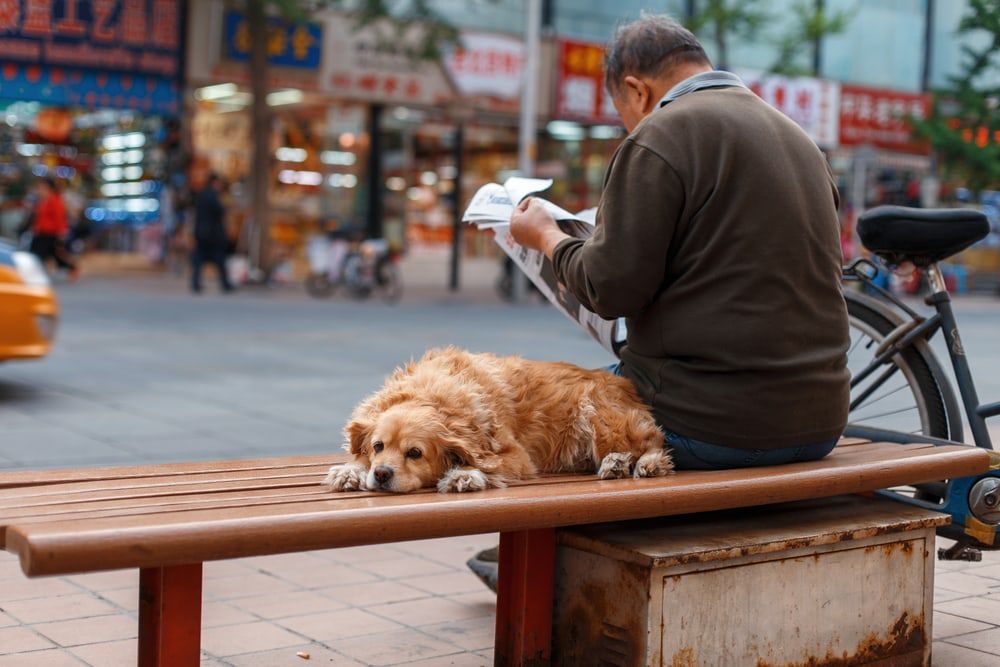
While dogs are loved and generally accepted as man’s best friend worldwide, it isn’t that way for every country. For example, China has a very long and complicated history with canines that run the gamut from working on farms to acting as sacrifices and providing a meat source. It shouldn’t be surprising that China has such a complex relationship with dogs considering they are the oldest domesticated animal in the country. So, there have been thousands of years for the perception of dogs to transform and shift.
Keep reading to learn more about the place of dogs throughout Chinese culture and history.

Early Domestication of Dogs
Dogs are the oldest domesticated animal in China, with evidence suggesting they were present in the country as long as 15,000 years ago.
Archeologists found remains of dogs in Neolithic graves, and their bones have been found in middens from that same era. Middens are heaps of domestic waste full of shells, bones, excrement, and artifacts. Testing on these remains suggests that the neolithic bones have similarities with dogs from today, especially the Shiba Inu.
Dogs as Workers
Dogs were initially bred to be guardians but were also used for transporting goods, working on the farm, and hunting. Dogs in ancient China weren’t thought of as pets but instead as workers. They were considered a potential food source if the need for meat ever became so high that it outweighed the dog’s usefulness on the farm.
Banpo Village, a Neolithic site, provides much insight into dogs’ early domestication. The site was occupied from 4500–3750 BCE. The people of the village were hunter-gatherers who shifted to a farming culture. There is evidence that residents kept dogs as pets, as their bones were found in abundance. Though the village people were primarily vegetarian, they hunted wolves, sheep, and deer. Dogs were put to work hauling the dead animals back to the village. It’s theorized that once the dogs became too old to be of much use hauling carcasses, they were likely killed and used for their coats.

Dogs as Food
Dogs were a significant source of animal protein in ancient China. Eating dog meat dates back to around 500 BCD in China but may have begun earlier.
Dogs are mentioned as meat in several historical texts and by many historical people. For example, the Bencao Gangmu, an encyclopedia of medicine, natural history, and Chinese herbology, divides dogs into watchdogs, barking dogs, or edible dogs. Mencius, a Chinese Confucian philosopher who lived between 372 and 289 BCE, talks about dog meat being edible.
Dog meat was served at banquets and became a great delicacy.
Even today, dogs are killed for food in some places in China, though consumption seems to be on a decline. Consuming dogs is legal throughout the mainland except in Shenzhen, where a law was put into place in 2020 to ban consuming and producing dog and cat meat.
The consumption of dogs is prevalent today in only certain areas of China as the government released new guidelines in 2020 reclassifying dogs as pets rather than livestock. These rules made the commercial slaughter and sale of dog meat illegal; however, slaughtering for personal use is still legal.
Despite the guidelines declaring dogs as pets, a dog meat festival in Yulin, Guangxi, continues. The Lychee and Dog Meat Festival occurs during the summer solstice and is marked by the preparation and consumption of dog meat and lychees. As you can imagine, a festival such as this is not well-received in many places in the world. Festival organizers fight back at animal activists saying that the dogs slaughtered for the event are bred specifically for consumption. Objectors report that some of the dogs slated for slaughter are strays or pets that organizers have stolen. Thousands of dogs were killed yearly for this festival, though these numbers are decreasing as well as the number of attendees.
Dogs as Sacrifices
Ritual sacrifices were not uncommon in Ancient China. For example, the rulers and elites of the country regularly sacrificed animals and humans to appease the spirits of their own ancestors.
A study from 2018 shows that people of the Shang dynasty often relied on sacrificial puppies to accompany them into the afterlife. Many of the elites in this period would have dogs sacrificed and buried beside them, though it was assumed that these dogs were the pets of the dead.
However, archaeologists discovered many of these buried dogs were puppies and that their presence next to the dead was much more prevalent than initially thought. Approximately one-third of the 2,000 Shang-era graves studied contained a deceased dog under the coffin. The bodies did not show clear indicators of death, suggesting that someone may have drowned or suffocated the animal. In addition, archaeologists determined that many of the graves containing dogs belonged to people in the middle class rather than the elites.
References to dogs are also found on inscriptions of oracle bones during this time. Oracle bones are pieces of ox scapula and turtle shells used for divination. Diviners would carve questions for the deities into the bone or shell, and intense heat would be applied until the bone or shell exploded. They would then examine the pattern in the cracks and inscribe the prophecy into the piece. The inscriptions on the bones mention the “rite of ning,” which involved dismembering dogs to honor the winds.
The Erya, the first surviving Chinese dictionary, mentions a custom where dogs were dismembered to “bring the four winds to a halt.” They would also sometimes be dismembered and sacrificed to drive away pestilence,

Dogs as Defenders
As time passed, they began using straw dogs instead of sacrificing real animals. They would place them in front of homes or before city gates to protect the people inside. Straw dogs eventually gave way to stone statues known as Foo Dogs. Foo Dogs were supposed to be lions, but since the Chinese artists of this time had never seen a lion in real life, they had to use what they knew to create the statues. Their take on a lion resembles dog breeds that they were familiar with, like the Pekingese.
Foo Dogs are imperial guardian lions and an architectural ornament. They come in pairs and are often situated outside city gates or buildings’ exteriors for protection. One statue is female to represent yin to protect the people inside the city or dwelling. The other statue is male and represents yang to protect the structure itself.
Dogs in Modern China
People began keeping dogs as pets during the 20th Century. Unfortunately, dogs in China encountered a significant setback during the rule of Mao Zedong. Pet ownership was considered a “bourgeois affectation,” and keeping dogs as companions was banned. Mao claimed they were consuming too much of China’s already limited food supply and that dogs were symbols of the Western capitalist elites. Those with pet dogs were shamed and forced to watch their pets be beaten to death. When Mao died in the mid-70s, his revolution ended along with his extreme views on dog ownership.
Dogs were banned again in the country between 1983 and 1993 due to rabies running rampant through China. This ban felt necessary at the time as there were over 50,000 fatalities in the country in a ten-year span, nearly all due to exposure to dogs.
Thankfully, legislation has slowly relaxed over the past several years, and dog ownership rates are rising.

Final Thoughts
China’s historical relationship with dogs is complex but ever-changing. There’s no denying that man’s best friend is slowly carving a name for itself in the country as a worthwhile companion. Who knows where dogs will stand in China over the next few decades? Only time will tell.
Related Read:
Featured Image Credit: Alones, Shutterstock































2 Responses
I enjoyed this article and learned a great deal! Thank you for writing and publishing this.
Hello Joshua,
thank you very much for your lovely feedback! We are glad that you found information in our article interesting and helpful!
All the best!