In this article
View 3 More +Labradoodles and Goldendoodles are equally adorable Poodle mixes with hypoallergenic coats and naturally sweet natures. Choosing between one or the other can seem like an impossible task, but understanding their subtle differences can help.
The main difference between the two breeds is their parentage. While a Labradoodle is a cross between a Poodle and a Labrador, a Goldendoodle is a cross between a Poodle and a Golden Retriever. This means that both Labradoodles and Goldendoodles come in a variety of sizes—miniature, medium, and standard—depending on the size of their Poodle parent.
In this article, we’ll compare the Labradoodle vs Goldendoodle and tell you everything you need to know about each of their features and characteristics!

Labradoodle vs Goldendoodle: Visual Differences
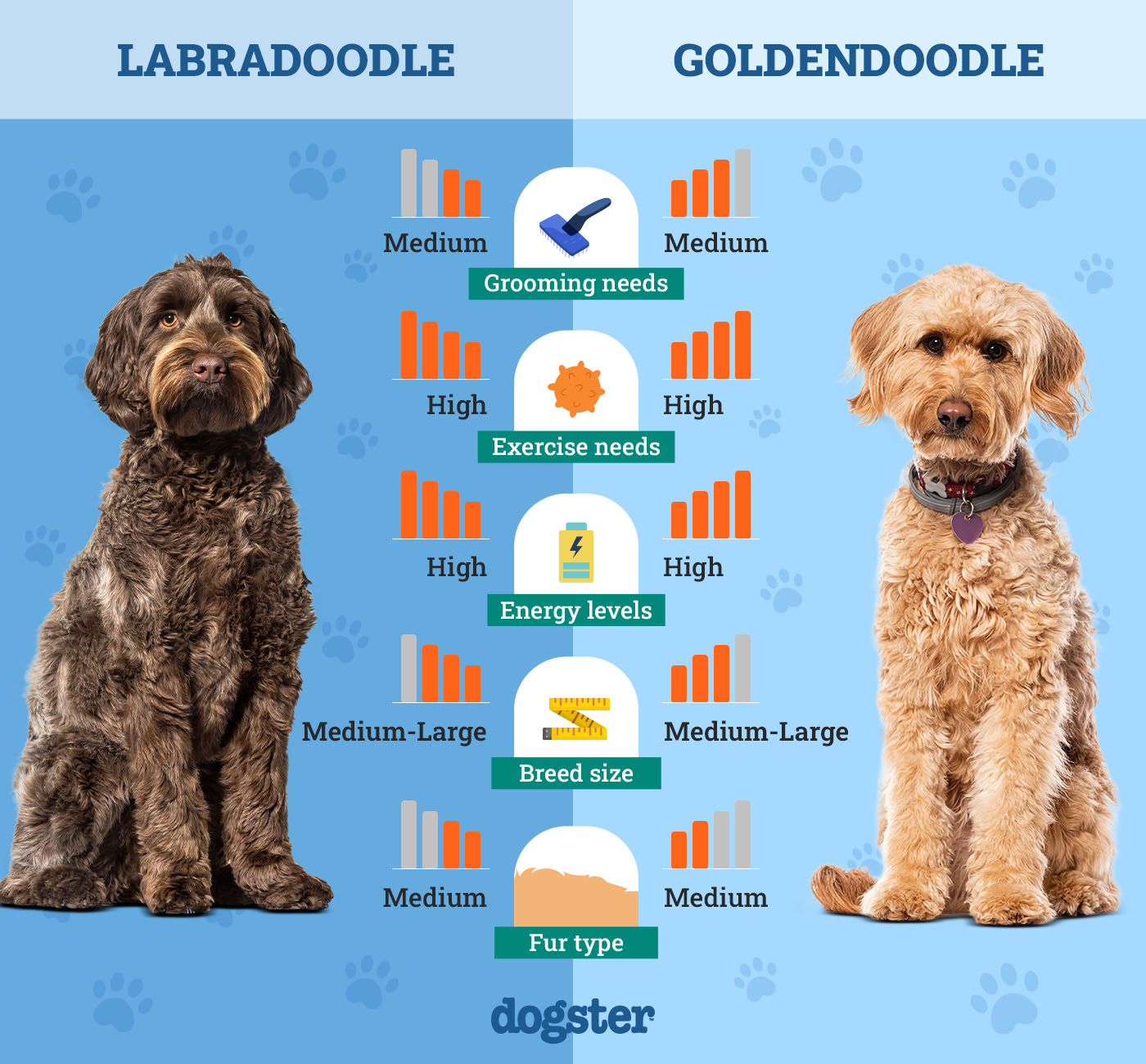
At a Glance
- Average height (adult, standard): 21–24 inches
- Average weight (adult, standard): 55–95 pounds
- Lifespan: 12–15 years
- Exercise: 1–2 hours a day
- Grooming needs: Moderate
- Family-friendly: Yes
- Other pet-friendly: Often
- Trainability: Loyal and eager to please, easy to train
- Average height (adult, standard): 20–24 inches
- Average weight (adult, standard): 50–90 pounds
- Lifespan: 10–15 years
- Exercise: 1–2 hours a day
- Grooming needs: Moderate
- Family-friendly: Yes
- Other pet-friendly: Often
- Trainability: Friendly and patient, easy to train

Labradoodle Overview
Labradoodles inherit the affectionate and loyal temperaments of their Labrador parent and the intelligence and hypoallergenic coat of their Poodle parent. They make great guide, assistance, and therapy dogs, as well as family pets. Their intelligence and obedience make them ideal for both first-time dog owners as well as experienced owners alike.
A Labradoodle’s coat can be wiry or soft, wavy and free-flowing, or curly. They come in a variety of colors, including:
- Chocolate
- Caramel
- Red
- Cream
- Parchment
- Parti
- Apricot
Labradoodles also inherit their Labrador parent’s affinity for water, making them strong swimmers.

Personality
If you’re looking for a dog with a loving nature, then you can’t go wrong with a Labradoodle. These dogs are loyal and obedient, and they like to make friends with everyone, so don’t rely on them as guard dogs! If you’re looking for a pup that’ll join you in most activities, a Labradoodle will be happy to oblige. When you’re up for playing, a Labradoodle will jump up in a heartbeat, but they’ll be equally eager to sit beside you and chill.
Being such social animals, Labradoodles won’t be happy in a home where they are regularly left alone for long periods. They love being around their humans, so leaving them home alone regularly can lead to problems such as separation anxiety.
Exercise
Labradoodles are high-energy dogs, especially as puppies and young adults. They usually need about 1-2 hours of exercise a day. Without plenty of physical and mental exertion, Labradoodles may get bored and turn to less desirable methods of passing the time like chewing, digging, or barking excessively. Labradoodles are happy to serve as running or hiking partners or engage in long backyard play sessions with the family kids.

Training
Labradoodles are incredibly smart and eager to please their humans, which tends to make them easy to train. You should begin training them while they are puppies, using positive reinforcement, and routines, and by remaining consistent.
Even as adults, Labradoodles are not only able to learn new tricks, but they’ll enjoy the training sessions! They’ll need plenty of mental stimulation with fun and interactive games.
Grooming
Their Poodle parents’ ensure the Labradoodles coat will be both low-shedding and also require some work to maintain. Ideally, the Labradoodle should be brushed daily, but at least three to four times per week to keep the coat from tangling and matting will suffice.
Regular trimming or shaving is also necessary to keep the dog’s coat healthy and under control. A trip to the groomers every 3 months or so is often required, especially if the Labradoodle inherits more of a tight, curled Poodle coat.

Health & Care
As a hybrid breed, the health of Labradoodles depends strongly on how healthy their parents are. Unfortunately, the popularity of Labradoodles has led to many dogs being produced by irresponsible breeders more interested in making money than breeding healthy pets. Some common health issues Labradoodles can suffer from include the following.
- Hip and elbow dysplasia
- Allergies
- Epilepsy
- Von Willebrand’s disease
- Progressive retinal atrophy
- Addison’s disease
Don’t be afraid to ask hard questions of your chosen Labradoodle breeder. A responsible breeder will be open and honest about their dogs and the health checks and certifications they possess.

Suitable For:
Labradoodles love their humans. They’ll fit perfectly into families with children and other pets, as long as they don’t get left alone for too long. Standard Labradoodles are large dogs and may be better suited to living in a house rather than a small apartment, though an apartment is fine as long as they get plenty of exercise and mental stimulation. This dog is a great choice for first-time dog owners!
- Friendly and social
- Intelligent and eager to learn
- Energetic and need lots of exercise
- Prone to separation anxiety if left alone

Goldendoodle Overview

A Goldendoodle is a cross between a Golden Retriever and a Poodle. As such, they are highly intelligent dogs that are also affectionate, friendly, and loyal. Like Labradoodles, Goldendoodles also tend to inherit the Poodle’s hypoallergenic, low-shedding coat.
Goldendoodles are great for families and first-time dog owners, and they make fantastic therapy and service dogs.
As with the Labradoodle, the Goldendoodle comes in a variety of coat colors, including:
- Cream
- Apricot
- Red
- Chocolate
- White
- Black
- Parti
Personality
The energetic Goldendoodle is friendly, loyal, and gentle. They’ll trust just about anyone, including strangers, which—like the Labradoodle—makes them terrible guard dogs. They do, however, make excellent family pets. Goldendoodles have a low prey drive, which means they’ll get along with other pets, including cats. Their natural patience makes them great with kids.
If you’re looking for an obedient dog with a loving nature, Goldendoodles are a great option.
Exercise
Goldendoodles have plenty of energy, especially for the first two years of their lives. Young Goldendoodles usually need more exercise than mature adults. Up to 2 hours of exercise may be needed to tire out a young Goldendoodle. As they age, Goldendoodles require less and less vigorous exercise. Because of their intelligence, Goldendoodles need regular mental exercise and one-on-one engagement with their owners, as well as plain physical exertion.

Training
As the offspring of two incredibly intelligent and obedient breeds, Goldendoodles are easy to train, even for first-time dog owners. Using training techniques, rewards, and positive reinforcement, it won’t take long for your Goldendoodle to learn new commands.
Grooming
Thanks to their Poodle parents, Goldendoodles are generally low-shedding dogs. However, their coats do require some care to keep them in shape. Their coat types can vary quite a bit and the amount of grooming required depends on that type.
Curly, Poodle-coated Goldendoodles need daily brushing and regular haircuts to keep their coats from becoming matted. Wavy or straight-haired Goldendoodles need less frequent cuts but still require regular brushing. These coats can benefit from regular trimming as well.
Health & Care
Because of their mixed breed status, Goldendoodles could suffer from the same inherited diseases as either of their parents. Starting with healthy breeding stock is the best way to ensure healthy Goldendoodle puppies. Some health conditions that Goldendoodles may be prone to include the following.
- Heart issues
- Epilepsy
- Hip and elbow dysplasia
- Eye issues, including cataracts
- Cancer
Responsible breeders will screen for any inherited conditions before they breed their dogs. When choosing a Goldendoodle breeder, look for one who offers a health guarantee and has had the recommended certifications done on their dogs.

Suitable For:
Goldendoodles are ideal for families that are looking for a loving and patient pet. These dogs will enjoy being near their pack members, and they’ll equally get along with other pets. The intelligence and patience of Goldendoodles make them a great fit for those who are new to dog parenting!
Like Labradoodles, Standard Goldendoodles are large dogs. If you are bringing them home to an apartment, make sure you can give them plenty of exercise and mental stimulation throughout the day.
- Gentle, patient nature
- Highly trainable
- Don’t do well if left alone
Which Breed Is Right for You?
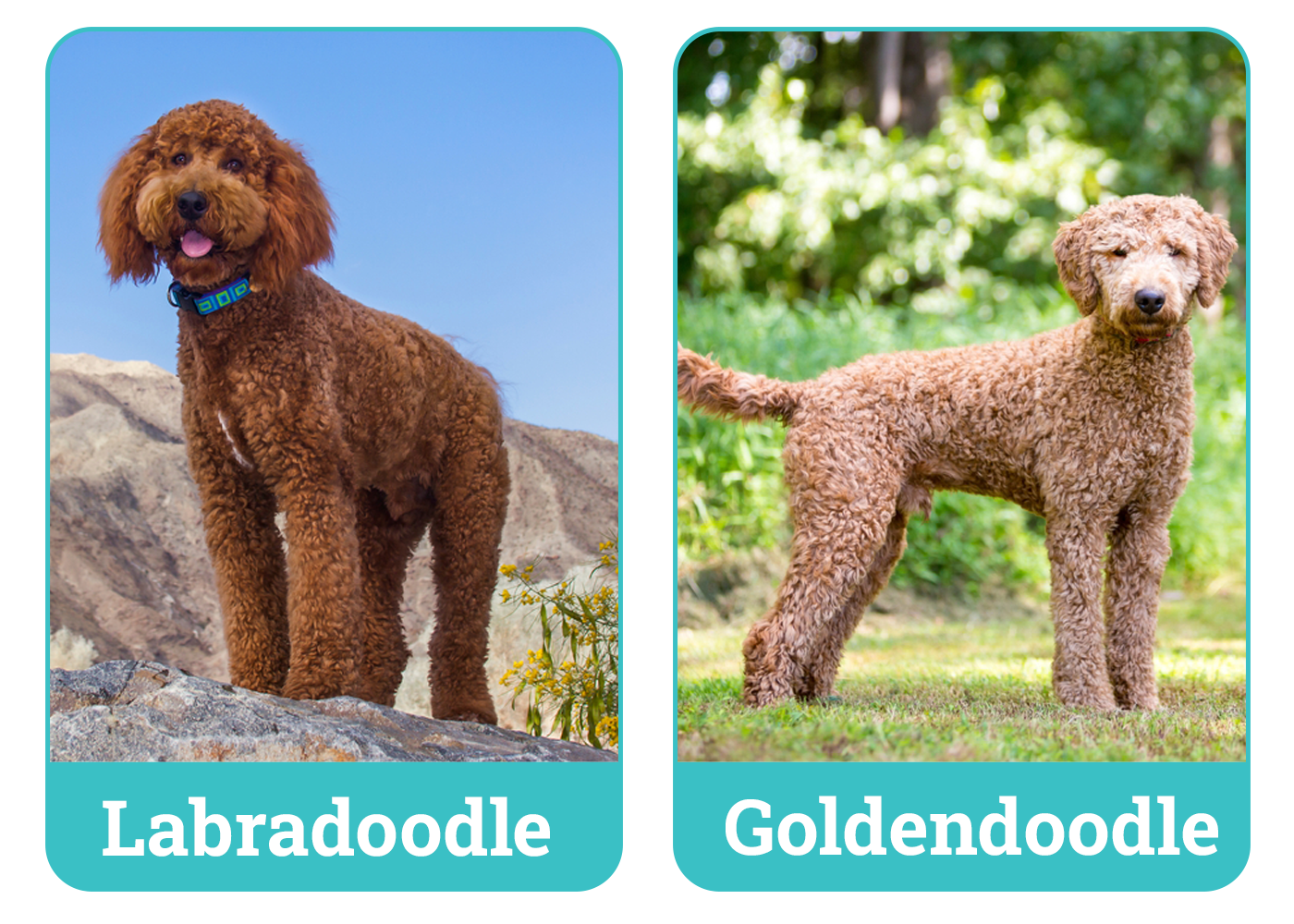
Both Goldendoodles and Labradoodles are great with kids. They are both highly social breeds that need companionship and lots of exercise, and they’re equally intelligent. Goldendoodles are more popular as therapy dogs, though Labradoodles can do this job, too.
So, how do you choose? We recommend that you ask reputable breeders about their litter’s parentage and medical history before deciding on bringing one home. Whichever breed you choose, if you have the time to give these dogs the attention they need, they both make wonderful pets!
See Also:
- Mini Bernedoodle vs. Mini Goldendoodle: The Differences (with Pictures)
- Sheepadoodle vs Goldendoodle: The Differences (With Pictures)
Featured Image Credit: Top – Boys in Bristol Photography, Pexels | Bottom – ALTEREDSNAPS, Pexels