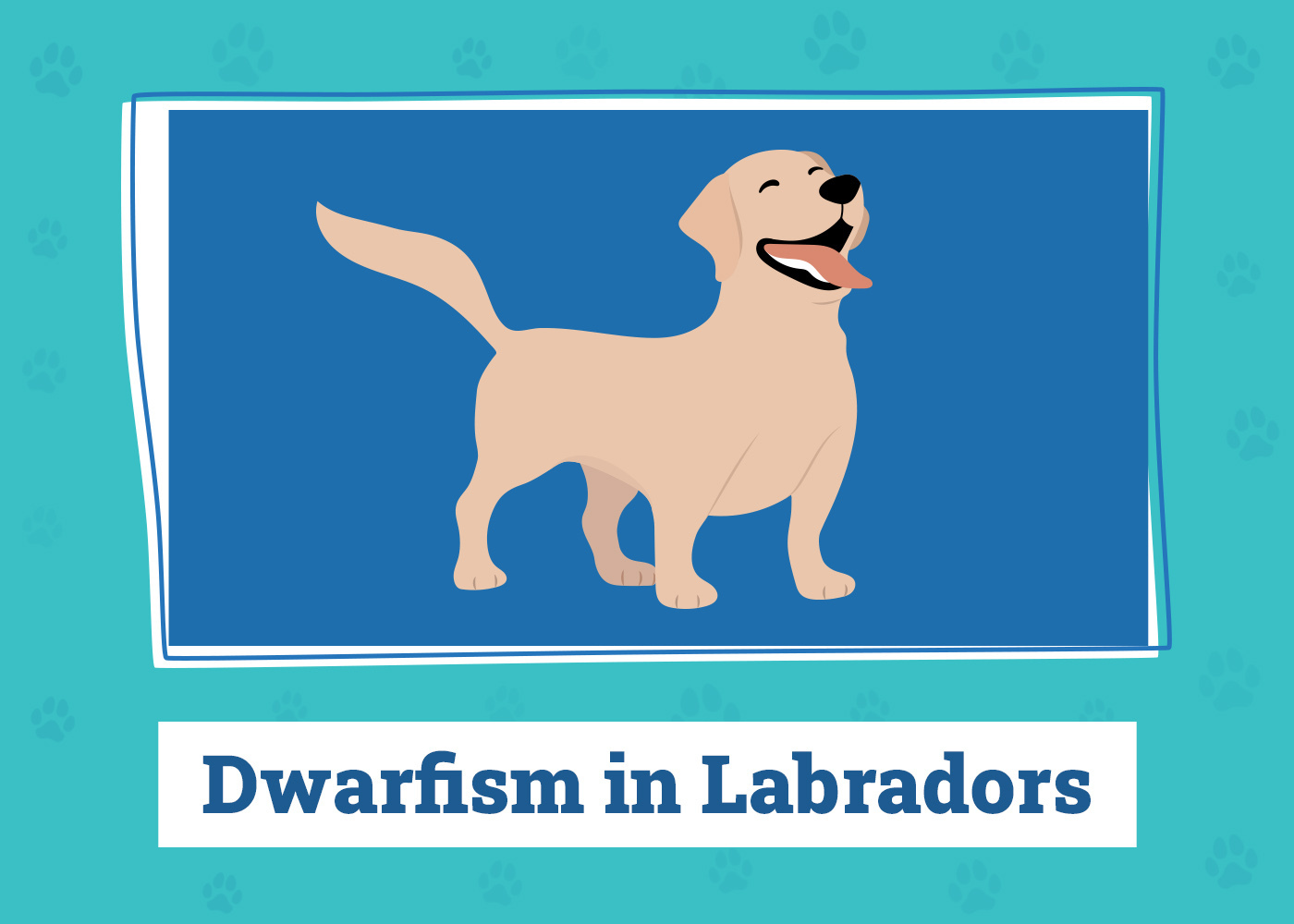
If you’ve never seen a Labrador Retriever with dwarfism, try to imagine a Basset Hound’s or a Dachshund’s legs on a standard Lab’s bulky frame. Dwarfism, or skeletal dysplasia 2, can occur in Labrador Retrievers as an inherited genetic disorder from both parents. This type of dwarfism stops the growth of leg bones early, which can cause abnormal growth and development. This may present as shorter legs, gait abnormalities, or limb deformities.

What Is Dwarfism in Labradors?
Dwarfism in Labradors is an inherited disease that causes a Lab’s legs to be shorter than normal. This is known as disproportionate dwarfism, as their body length and width are normal but their legs are shorter. The front legs are often more affected by this disorder than the hind legs. This type of dwarfism is also referred to as skeletal dysplasia 2, or SD2. Dwarfism seems to occur more frequently in the “working” line of Labradors rather than the “show” line.
What Are the Signs of Dwarfism in Labradors?
The signs of dwarfism may include:
- Shorter legs than normal
- Shorter front legs compared to hind legs
- Shorter, thicker, slightly curved leg bones
- Slowed growth
- Normal body length and width
- Difficulty walking
What Are the Causes of Dwarfism in Labradors?
Dwarfism in Labrador Retrievers is caused by a single nucleotide mutation on the gene known as collagen alpha- 2(XI) chain, or COL11A2. Two copies of the gene mutation are required to cause the defect, which is known as an autosomal recessive disease. Male and female Labradors can be equally affected, though not all affected Labs will show the physical characteristics of dwarfism. This allele is rare in this breed, occurring with a frequency of less than 1%.
If you’re concerned about your pet’s well-being, we recommend you contact a veterinarian online for advice.
If you need to speak with a vet but can't get to one, head over to PangoVet. It's our online service where you can talk to a vet online and get the advice you need for your dog — all at an affordable price!
How Do I Care for a Labrador With Dwarfism?
Testing for skeletal dysplasia 2 can help identify affected dogs and those that are carriers of the gene. Breeders can therefore use the test to avoid mating pairs of dogs that may produce affected offspring. Since not all dogs may show dwarfism, it is important to test all dogs for this disorder, as they may be carrying the mutation.
Both Labrador Retrievers and Labradoodles are breeds appropriate for this particular testing. Samples are collected from the dog’s cheeks and gums by using a cytology brush to gently swab for cells for DNA testing (also known as a buccal swab). Testing can also be completed through blood samples.
The results may include the following.
| Results | Explanation |
| N/N genotype | No copies of the mutation were detected, and the dog is normal. They will not have dwarfism and cannot transmit it to offspring. |
| N/SD2 genotype | One copy of the SD2 mutation was detected. These dogs are not affected by dwarfism but are carriers. They may transmit it to 50% of their offspring. Mating between two carriers can produce 25% skeletal dysplasia 2-affected pups. |
| SD2/SD2 genotype | Two copies of the mutation were detected. These dogs may develop dwarfism and will transmit it to all their offspring. |
To diagnose your dog with dwarfism, your veterinarian may take a complete medical history and perform a thorough physical examination, X-rays, and blood testing for an evaluation. You may be referred to an orthopedic specialist to help correct any mobility issues. In some cases, surgery may be required to improve your dog’s quality of life.
Unfortunately, developmental abnormalities may lead to joint pain and arthritis. Your dog may benefit from being on a lifelong pain management plan developed by your veterinarian. Supplementing your dog’s diet with omega-3 fatty acids, glucosamine, or chondroitin sulfate may also help decrease joint pain and inflammation, though you should only administer these under the guidance of your veterinarian.
Labrador Retrievers can be prone to obesity, so it is vitally important to keep your dog at their ideal body weight to prevent the worsening of joint disease, damage, and pain. Providing ramps and stairs can help decrease the stress on their joints when they decide to get on or off furniture, out of cars, etc. Keeping their nails trimmed to an appropriate length can further help decrease joint strain and stress.

Frequently Asked Questions (FAQ)
Can a Normal Adult Labrador Retriever Develop Dwarfism (Skeletal Dysplasia 2) Later in Life?
An adult Lab may carry the gene but may not show the typical characteristics of dwarfism. A normal adult dog will not suddenly develop dwarfism, but as an affected puppy grows, the characteristics may become more obvious.
How Can I Help My Labrador Retriever With Skeletal Dysplasia 2?
Help your dog stay healthy by keeping them at their ideal body weight, which reduces stress on their joints. Provide a ramp or stairs to help them get up and down from heights easily, and use non-slip flooring to prevent them from slipping and injuring their joints. Maintain appropriate muscle strength through short daily walks of about 20 minutes, adjusting as needed depending on how much pain they’re in. Regularly visit your veterinarian for checkups, follow the pain management plans, and buy any recommended joint supplements.

Conclusion
Skeletal dysplasia 2, also known as dwarfism, can occur in Labrador Retrievers when they inherit specific genes from their parents. Although not all Labs may show the physical characteristics of dwarfism, they can carry the gene mutation and pass it on to their offspring. Signs of dwarfism include shortened legs, slowed or stunted growth, skeletal deformities, and gait abnormalities. Genetic testing can diagnose the disorder and confirm if a Lab is carrying the genes, which is useful prior to breeding them.
Featured Image Credit: You are free to use this image but we do require you to link back to Dogster.com for credit