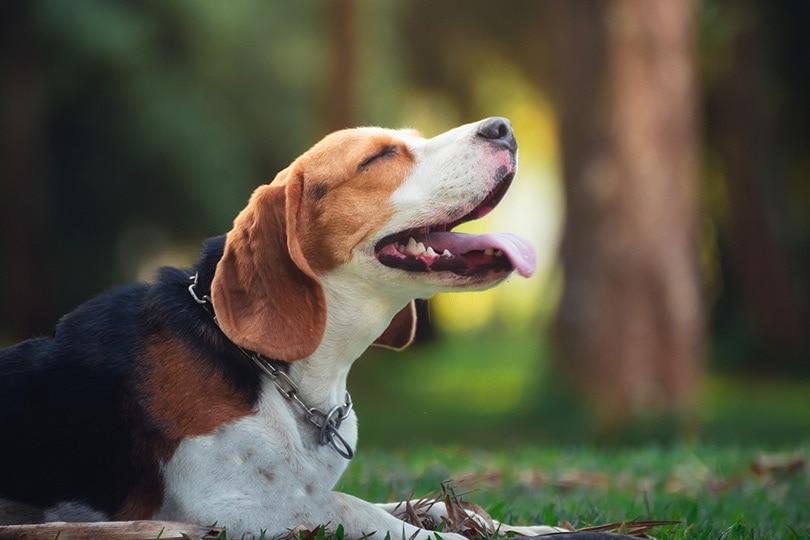
The adorable and popular Beagle almost needs no introduction. According to the American Kennel Club (AKC), they are currently the seventh most popular breed and are known for their happy and friendly dispositions. Beagles fall under the Hound Group, which should immediately answer the question posed by this article: What were Beagles bred for?
Beagles have been used from their early origins to even today as hunting dogs. Here, we get into the origins and history of the Beagle, and hopefully, you’ll learn something new about these joyful little dogs.

The Mysterious Origins of the Beagle
Where Beagles came from is actually a thing of mystery. There are no official records or documentation, only theories and educated guesses.
However, there are a few accounts that dogs about the size of a Beagle were used for hunting hares in 400 B.C. in ancient Greece and in England around 200 A.D. There were no formal names given to these dogs, but they are thought of as the early ancestors of Beagles.
It’s believed that during the Roman conquest of Britain, the Romans brought their own small hounds, which interbred with the local British hounds. Then, more interbreeding probably occurred between British and European hounds over the following centuries.
The Talbot Hound
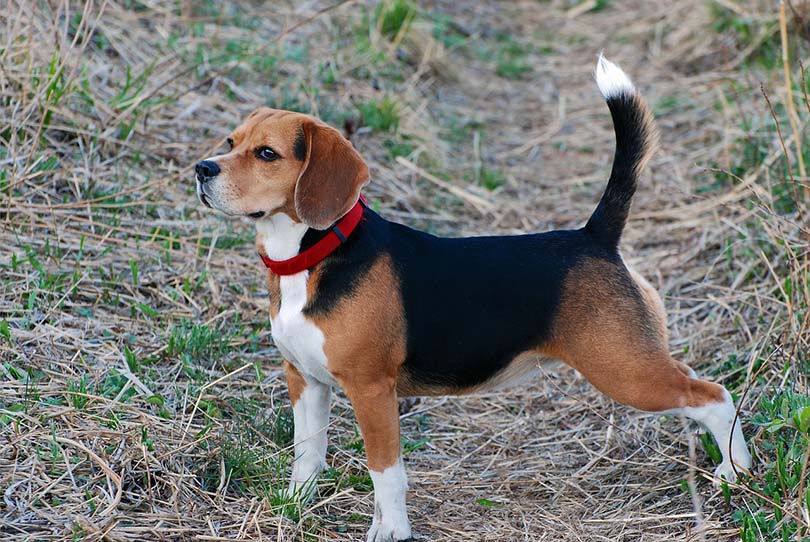
By the 8th century, the St. Hubert hound was documented, which was responsible for the eventual origins of the Talbot Hound. William the Conqueror brought Talbot hounds to Great Britain in the 11th century, they were used for hunting but were thought to be rather slow runners. Talbot hounds were then bred with Greyhounds to speed them up.
Eventually, the Talbot hound is believed to have contributed to the origins of the Foxhound, Southern Hound, and the Beagle.
Tiny Beagles
The earliest records for dogs called “Beagles” were small hounds that were established by the 15th century in England, France, Italy, and Greece. It’s thought that the name “Beagle” came from the Celtic word, “beag,” which translates to “small.”
These tiny Beagles became popular with the Royal Family as pets, particularly for their “singing” voices. Queen Elizabeth I even owned a pack of these 9-inch hound dogs.
By the mid-1700s, using Beagles to hunt hares became a popular sport among the aristocracy. However, they eventually lost their popularity to the larger hounds used for foxhunting. This led to the English Foxhound becoming the favored dog with nobility.
But farmers and landowners continued to hunt with the Beagle throughout the U.K., so the breed continued to flourish.

Reverend Phillip Honeywood
Reverend Phillip Honeywood of England is credited with establishing the breeding program in 1830 that led to the origins of the modern Beagle. He was interested in producing hunting dogs but moving away from the tiny Beagle. Not much is known about all the breeds used to create the Honeywood Beagle, but Southern Hounds and North Country Beagles were used in the program.
Honeywood produced Beagles that were all white and larger, but they were still small at only 10 inches at the shoulder. He used his pack for hunting rabbits, which earned the nickname, the “Merry Beaglers of the Meadows.”
Next Step Goes to Thomas Johnson
While Honeywood was focused on breeding an excellent hunting dog, Thomas Johnson, also from England, decided to concentrate on making a good hunting dog with an attractive appearance.
His breeding led to two different breeds: one with a rough coat and one with a smooth coat. The rough coat eventually became extinct by 1969, but the smooth coat continued.

Beagles by the 1840s
By the 1840s, there were four different types of Beagles: the rough-coated/terrier Beagle, the dwarf/lapdog Beagle, the medium Beagle, and the fox Beagle (which was a slower and smaller version of the Foxhound). This is also when the standard Beagle really started to develop.
By 1887, there were only about 18 known Beagle packs in England, so Beagle lovers created The Beagle Club and the Association of Masters and Harriers and Beagles in 1890 and 1891. Both were to help preserve the Beagle lineage, and they successfully increased the Beagle packs from 18 to 44 by 1902.
The Beagle Comes to America
Around the 1870s, General Richard Rowett of Illinois imported a few Beagles from England and started a breeding program in the U.S. Rowett’s Beagles are thought to be the first American standard of the modern Beagle.
The Beagle’s popularity took off, and the first United States Beagle Club was established. Blunder was accepted into the AKC in 1885 as the first Beagle.
The National Beagle Club of America was established in the late 1880s, and the standard of the Beagle was accepted. Captain Assheton and James Kernochan both brought more Beagles over from England and eventually bred these dogs into the familiar-looking Beagle that we see today.

Today’s Beagle
Beagles certainly started as popular dogs for hunting, which continues today. But they are more commonly kept as family pets these days. Beagles started winning prizes as show dogs as early as 1928, at the Westminster Kennel Show. A Beagle by the name of K-Run’s Park Me In First (or Uno) eventually won the title of “Best in Show” in 2008 at the Westminster Kennel Club dog show.
It’s also interesting to note that the Beagle is the only breed that has been in the AKC’s top 10 of “America’s 10 Most Popular Dog Breed List” since they were registered in 1885.
Summing Up
Beagles have been successful in so many areas, everything from hunting and working in a pack to the show ring. They’ve also been used with great success as sniffer dogs in airports and at border crossings, as well as therapy dogs in retirement homes and in hospitals.
There’s a reason that Beagles have been so popular for so long. They get along wonderfully with other animals, and those melting brown eyes and joyous temperaments make them truly excellent family pets.
Related Read:
- How Big Do Beagles Get? Average Weight & Growth Chart
- Beagle Pain Syndrome: Our Vet Explains Steroid-Responsive Meningitis-Arteritis
Featured Image Credit: laureettaawilliams, Pixabay
 The Mysterious Origins of the Beagle