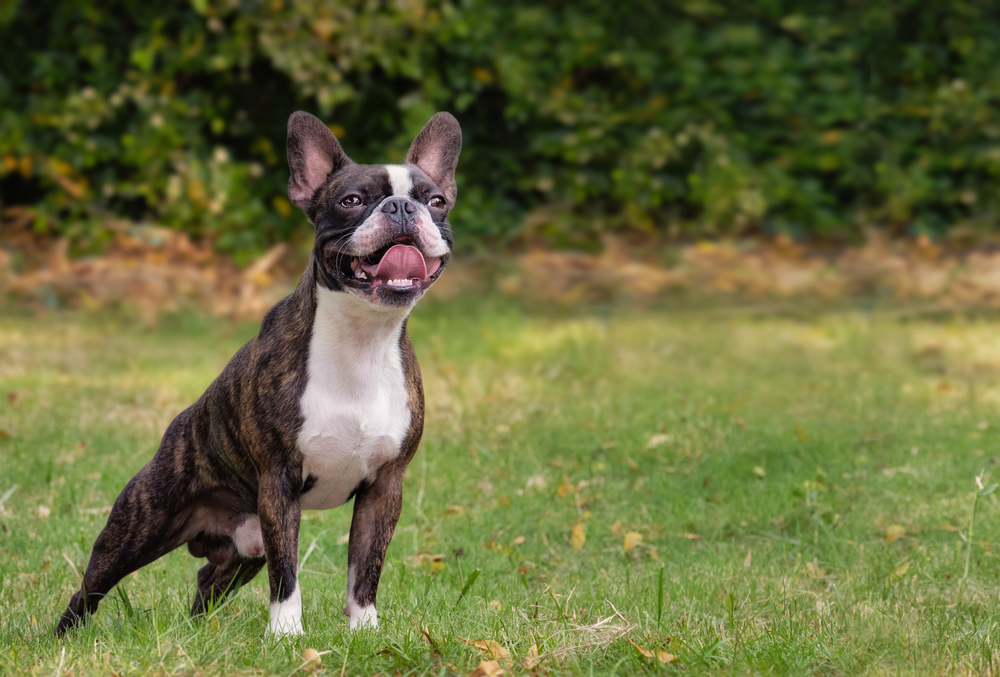
The Boston Terrier is a brachycephalic breed. “Brachy” translates into “shortened,” while “cephalic” means head. In other words, the Boston Terrier is a breed with shortened skull bones and a face that appears pushed in. They are commonly known as the “American Gentlemen,” largely because they were refined in America, in addition to the fact that they usually have a tuxedo-like coat pattern.
How fast can they run? Well, on a good day, Boston Terriers can push themselves to 25 miles per hour. However, it depends on their health, age, fitness level, energy levels, environmental conditions, parent genes, and many other factors.

Boston Terrier History
We don’t know when exactly the Boston Terrier was bred, but experts speculate that it could have been in the late 1800s. Robert C. Hopper, who resided in Boston at the time, bought a Bulldog from Edward Burnett so that he could pair her genes with those of his dog, an English Terrier.
The puppies were then interbred with a French Bulldog, consequently creating a new breed that we now know as the Boston Terrier.
Why Was the Boston Terrier Initially Bred?
Dog fighting was a common practice in the past, and it’s one of the reasons why the demand for the Boston Terrier skyrocketed. The other reason was the need to create a dog that was efficient at hunting vermin, which wreaked havoc in New England’s garment factories. The original Boston Terrier was the perfect candidate for this type of job.
If you’re wondering why this doesn’t sound like the Boston Terrier you know, it’s because it isn’t. The modern breed has been developed to be comparatively smaller, calmer, and milder in temperament.
Distinguishing Physical Features of the Boston Terrier
The Boston Terrier has a very broad head. Their muzzles are relatively short but always proportional to the size of the head. Compared to other breeds, their eyes are usually wide and large. Their ears are small and erect, and their nose is black.
Owing to their smooth, short coats, they don’t shed much. What we like most about the Boston Terrier is the expression of liveliness and determination on their faces.

Is the Boston Terrier an Athletic Breed?
Contrary to popular belief, the Boston Terrier is an athletic canine. People quickly assume that they don’t have much athletic ability, probably because they are a brachycephalic breed. Although they don’t have the physical capacity to complete a marathon, they’re still pretty energetic.
We’ve seen them register remarkable scores in performance-based activities, including flyball, water sports, agility drills, and tracking. If you want to see how fast a Boston Terrier can run, unleash them in an open area or field.
Is the Boston Terrier’s Athleticism an Inherited Trait?
When you examine the Boston Terrier’s ancestry, you’ll learn they inherited their athletic genes from the White English Terrier. You don’t hear about them often because the White Terrier is a breed that went extinct shortly after 1895. Even though they were bred to be performance dogs, they were significantly plagued by deafness and health problems.

How Fast Is the Boston Terrier?
Compared to other species, the Boston Terrier is nowhere near the fastest animal on the planet. They are certainly faster than their ancestors, the English Bulldog, but on a running scale, they are considered average.
| Animal | Running Speed (mph) |
| Cheetah | 75 |
| Greyhound | 45 |
| Racehorse | 44 |
| Grey Wolf | 38 |
| Domestic Cat | 30 |
| Boston Terrier | 25 |
How Much Exercise Does a Boston Terrier Need?
Ensuring an athletic breed always stays in top shape is not easy. You’ll have to dedicate much of your time and other resources to ensure they get the required physical and mental stimulation. The Boston Terrier will certainly demand regular daily exercise.
You’ll need to provide at least a 60-minute walk every day, but it should be divided into two sessions—30 minutes in the morning and the other 30 in the evening. In addition to the walks, you also have to incorporate a high-intensity activity into their program. This will depend on your preference, as it should be something that both parties enjoy.
Running is always an option, but you must check in with your vet first. If your Terrier has brachycephalic syndrome or other underlying medical conditions, running fast can harm them. A rule of thumb is that they get a 5-minute walk for every month of age. Therefore, if your pup is only 2 months old, they’ll have a 10-minute walk. They also need some age-appropriate toys to curb boredom and get their daily dose of mental stimulation.
If you need to speak with a vet but can't get to one, head over to PangoVet. It's our online service where you can talk to a vet online and get the advice you need for your dog — all at an affordable price!

Do Boston Terriers Ever Experience Zoomies?
We often say that a dog is experiencing a case of zoomies if they have so much pent-up energy that it ends up overflowing. You’ll be able to tell because they’ll keep running around uncontrollably just to expel whatever they can. Of course, the number one cause for this phenomenon is a lack of sufficient physical stimulation, but it can also be triggered by boredom.
Since the Boston Terrier is an athletic breed, they’re susceptible to zoomies occasionally.
Summary
For a small pup, the Boston Terrier is pretty fast. Depending on their level of training, age, health, and several other factors, they can clock speeds of 25 miles per hour. It’s important to note that this is a brachycephalic breed. They are prone to breathing problems, thus making them unsuitable for long-distance running.
- Related Read: Boston Terrier vs French Bulldog
Featured Image Credit: Zero Degrees Photography, Shutterstock
 Boston Terrier History