In this article
When you’re watching a puppy play and tumble, chasing their tail, or barking at shadows, it can be easy to forget how impressionable they are, and that they are always observing and learning. The first three to four months of a puppy’s life are arguably the most important when it comes to socialization, training, and conditioning, and the habits and lessons they learn in those early months will set the tone for the rest of their lives.
Everything from play and toilet training to obedience and feeding, are all learned during the puppy stage, and although it is certainly possible to teach an old dog new tricks, it is a lot harder to override habits learned in those first few months.
So if you’ve been hand-feeding your puppy, you might want to take a moment to think about how often you are doing it, whether your puppy will happily eat without being hand-fed, and what lessons they are taking away from the interaction.
Hand-feeding your puppy can be a good way to establish trust and reward good behavior, but if you’re not careful, you could end up making life more difficult for yourself.
Let’s take a closer look at the benefits and drawbacks of hand feeding, and how to make sure you are setting yourself – and your puppy – up to win.

The Benefits of Hand-Feeding Your Puppy
Most puppies are motivated by food, which is why treats are often the key to training. And here’s a little tip: for most puppies (and dogs), the praise and hand-feeding that go with the treat is usually much more important than what the food is. Using pieces of their regular kibble can be just as effective as treats, and can actually reduce the risks of your pup becoming a picky eater.
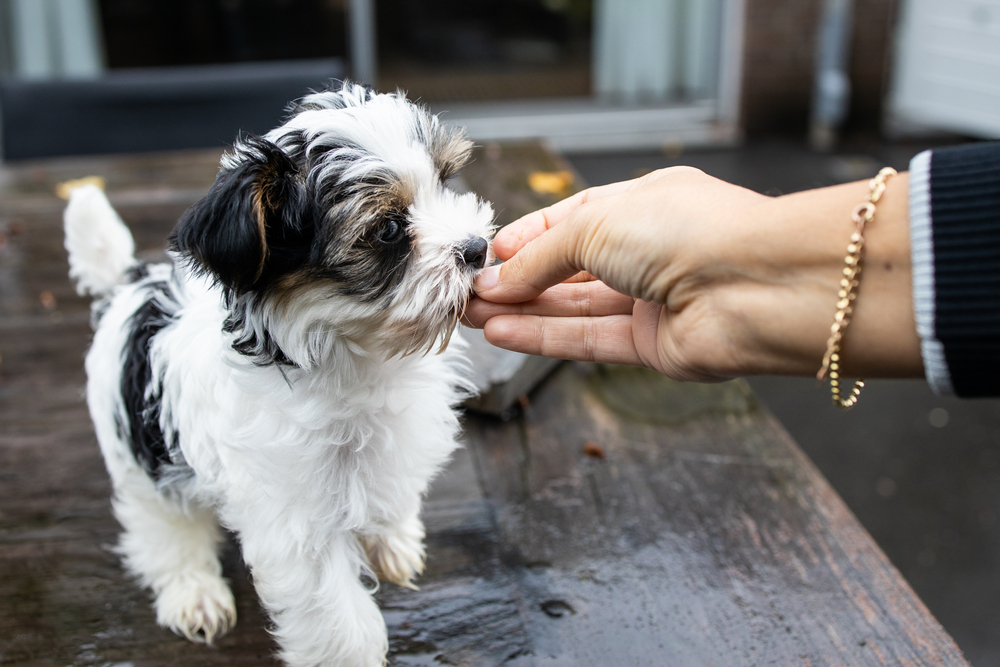
Hand-feeding your puppy is an important way to establish your role as feeder and provider, and strengthen your relationship. It is also an essential part of training your dog to take food gently from your hand.
How To Avoid Giving Mixed Signals
Actions and behaviors that might seem lighthearted and fun when they are puppies might not be so desirable when your dog reaches adulthood, so it’s important to constantly ask yourself:
Is this something I would want my adult dog to do?
If the answer is no, then you need to stop it now. It’s not fair to expect your dog to understand why they are suddenly getting in trouble for a behavior that was considered acceptable when they were young. For example:
- Play biting
- Jumping up
- Being possessive over food or toys
- Licking faces
- Pulling on the lead
These are all behaviors that are often tolerated, even encouraged, when they are tiny and cute, but then we suddenly turn the tables as our puppies grow into dogs. It might feel a bit mean at times to put a stop to your puppy’s fun, but in the long run, it’s far better to shut down unwanted behaviors in an impressionable young pup before they become the ingrained habits of an adult dog.
So, what does this have to do with hand-feeding a puppy? I’m glad you asked!
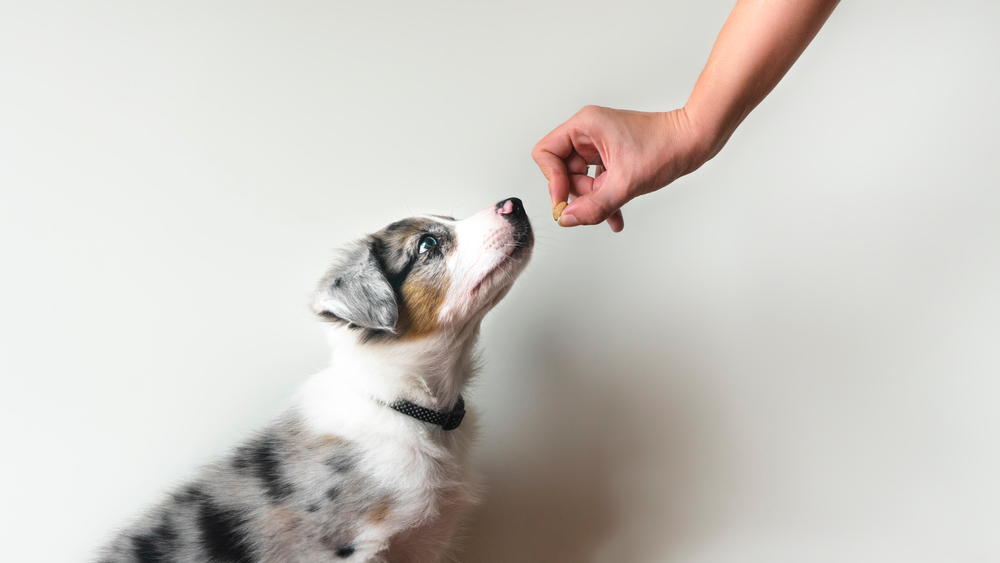
The 6 Steps to Teach Your Puppy to Take Food Gently
1. Get your puppy to sit and make sure you have their full attention.

2. Hold the treat firmly in your fingertips and offer it to your pup, saying the word “nicely” or “gently” (or whatever you would prefer to use).

3. If they gently take the treat, let them have it and offer lots of praise.

4. If they try to snatch or bite your hand, curl your fingertips away while saying “no” or “Ah!”
5. Repeat step 2. until you get to 3. (do not stop until they take the treat nicely, and do not let them have the treat until they have taken it nicely).

6. Repeat this training regularly – greedy dogs will often need reminding!

The Problems with Hand Feeding Your Puppy
Hand-feeding your puppy the occasional treat or snack can be a great way to strengthen your bond, but it can become a real problem if you are also hand-feeding them meals. Habits formed as a puppy are hard to break in an adult, and if you get sucked into hand-feeding them now, you will find it difficult to break that habit later on.
Although hand-feeding your puppy is great for treats, it is not a good method for meals. If you hand-feed a puppy too often, it stops being a novelty, and it loses its effectiveness as a training reward.
Do Picky Eaters Really Exist?
I’m sure many of you feel very strongly that the answer is ‘YES!’ but in most cases, we can inadvertently teach our dogs to be picky eaters. Equally, we can also teach them to be greedy. And some of this training happens before we even bring them home.
The Effect of Litter Size
Puppies that have come from a very small litter, or from a breeder that separates the puppies for feeding, have not had to scramble and fight for a full tummy, and will often be more laid back and slow when it comes to eating. They might even skip the occasional meal, or come back later to finish.
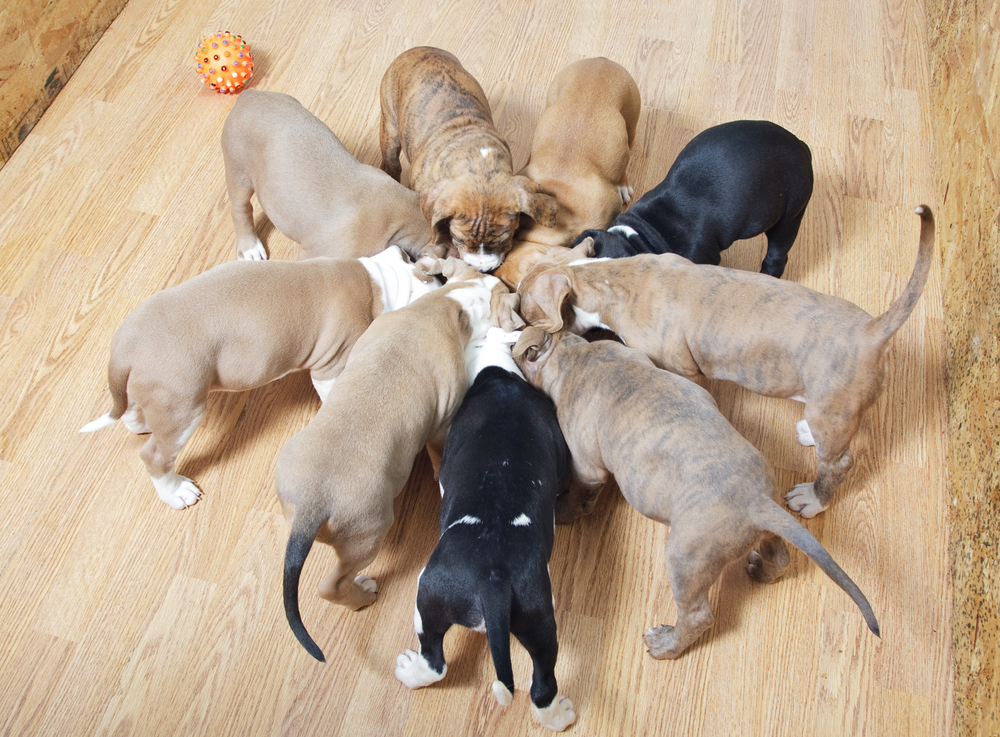
Puppies from larger litters that are fed together usually approach mealtimes with the enthusiasm and desperation of a lively game of Hungry Hungry Hippos. It often takes them quite a bit of time to realize that they can actually stop and breathe during a meal!
Picky vs. Greedy
In most cases, puppies that start out as enthusiastic eaters will usually stay that way. Those who have a more reserved attitude towards mealtimes will usually go one of two ways, depending largely on our approach: picky, or good/greedy appetite.
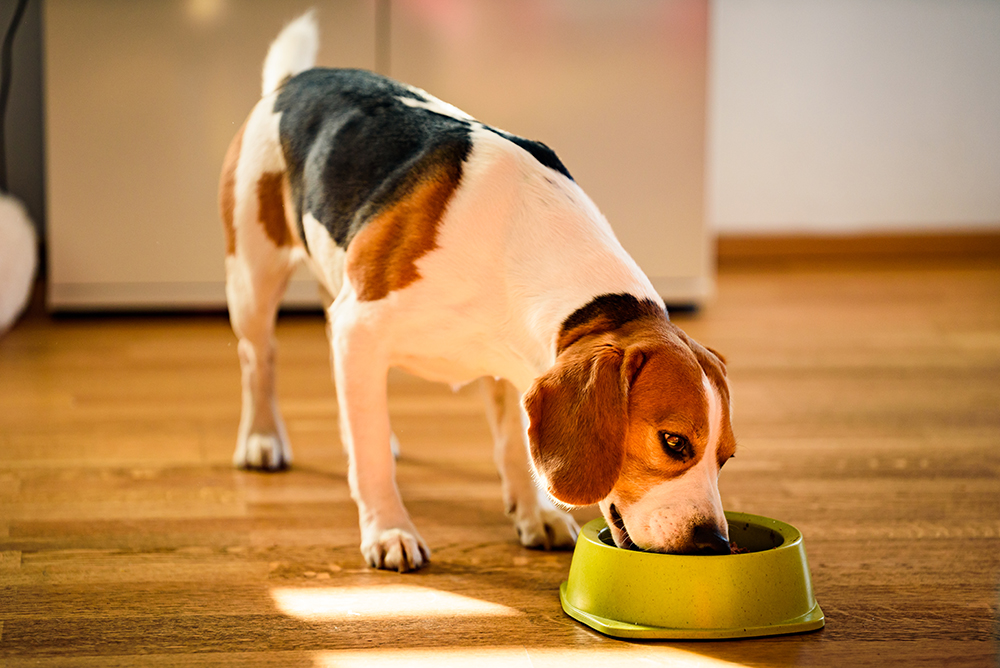
If we place our pup’s food down at mealtime, we should take up anything leftover after approximately 15 minutes, even if they haven’t touched it. In the vast majority of cases, they will tuck into their next meal! Sometimes, the more discerning (stubborn) pups will hold out a little longer, to see if they might be offered something better. If they skip more than two meals, however, it’s time to offer them something else or check in with a vet.
Sometimes puppies aren’t hungry, and by coaxing them to finish their bowl or eat when they aren’t hungry, we are essentially training them to be greedy and eat more than they need to.
When a pup skips a meal and we offer them something really tasty instead, they will quickly learn that refusing food gets them special treatment and more interesting food, and this is how we get a picky eater. And if you hand-feed them that special food, you may end up with a very high-maintenance canine!
Final Thoughts
Puppies have lots of habits and behaviors that are adorable when they are little, but not so cute when they are full-grown, so it’s important to establish rules and boundaries early on. It’s not fair to confuse our dogs by allowing them to get away with certain behaviors when they are young, only to reprimand them for doing them when they are older.
When it comes to hand-feeding your puppy, this is an important part of strengthening the bond between you, establishing yourself as the provider of food, and teaching them how to take food gently from your hand. However, it is not a good idea to get into the habit of hand-feeding meals. Remember that habits formed in the first few months are much harder to break, so if it’s something you don’t want to be doing for the next 12 years or so, you might want to put a stop to it now!
Most of the time, a treat is more about the action of giving the food by hand rather than what the food is. If you hand-feed a puppy too often, it stops being a novelty, and it loses its effectiveness as a reward. So reserve hand feeding for training and treats, and always start as you mean to go on.
Featured Image Credit: Angeline Dobber, Shutterstock