Get

In Your Inbox

Dogster is reader-supported. When you buy via links on our site, we may earn an affiliate commission at no cost to you. Learn more.

Are Retractable Leashes Bad For Dogs? Vet-Verified Pros & Cons

Share

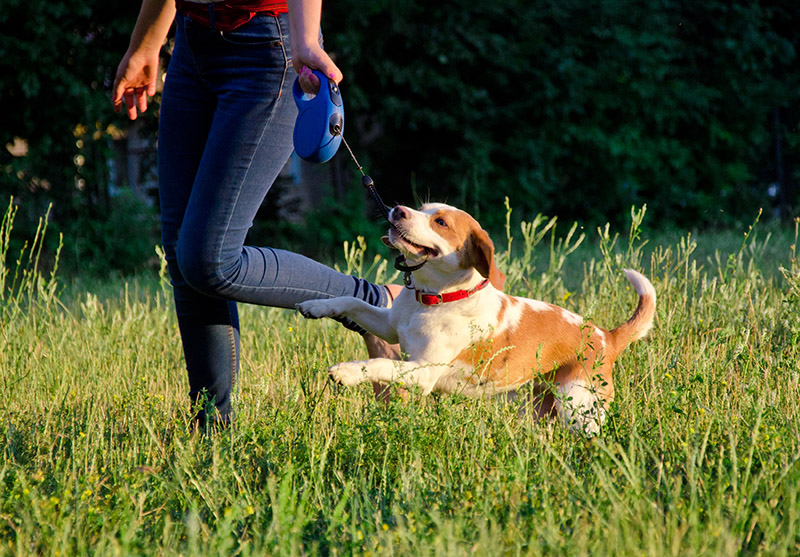
person running with beagle with retractable leash

Retractable leashes sound like a great idea because they allow your pet to have more freedom when out on a walk, and you don’t need to manage a long leash. However, many people wonder if they are as safe as the old-fashioned variety. Unfortunately, retractable leashes are not considered safe for dogs for various reasons. Keep reading as we take a closer look at these modern devices, discuss their pros and cons, and go over what you can do to keep your pet safe.

divider single dog paw oct 2024

Pros of Using a Retractable Leash

1. Increased Freedom of Movement

One of the biggest benefits of using a retractable leash is that it gives your pet more freedom of movement. While the typical leash is about 6 feet long, many retractable leashes will allow your dog to roam 20 feet away or more. They can sniff around, walk ahead, or lag behind without constant tugging on the leash, which can be beneficial for their mental and physical health.


2. Adjustable Length

Retractable leashes have an adjustable length that with the press of a button, enables you to give your pet more room in open areas but keep them close when you get into a crowded or dangerous area. You will no longer need to carry multiple leashes with you for different situations.

schnauzer puppy with retractable leash waiting to go walk
Image Credit: Maximilian100, Shutterstock

3. Convenience for Owners

Retractable leashes can also make the walking experience more fun for you because you can keep walking while your pet marks their territory. You won’t have to stop every few seconds to try to convince them to move along.

divider dog faces oct 2024

Cons of Using a Retractable Leash

1. Lack of Control

One of the biggest problems with using a retractable leash is the lack of control that you have over your pet, especially if they’re prone to running off or if you need to pull them away from danger quickly. It can take much too long for the leash to retract in an emergency, giving your dog plenty of time to run into traffic or get into a scuffle with another dog, possibly leading to harm to your pet or another animal.


2. Injury Risk

The thin cord can easily lead to rope burns if you need to pull on it suddenly. It can also trip or wrap around you or your dog, and the stopping mechanism can jerk your dog back or cause you to drop the device.
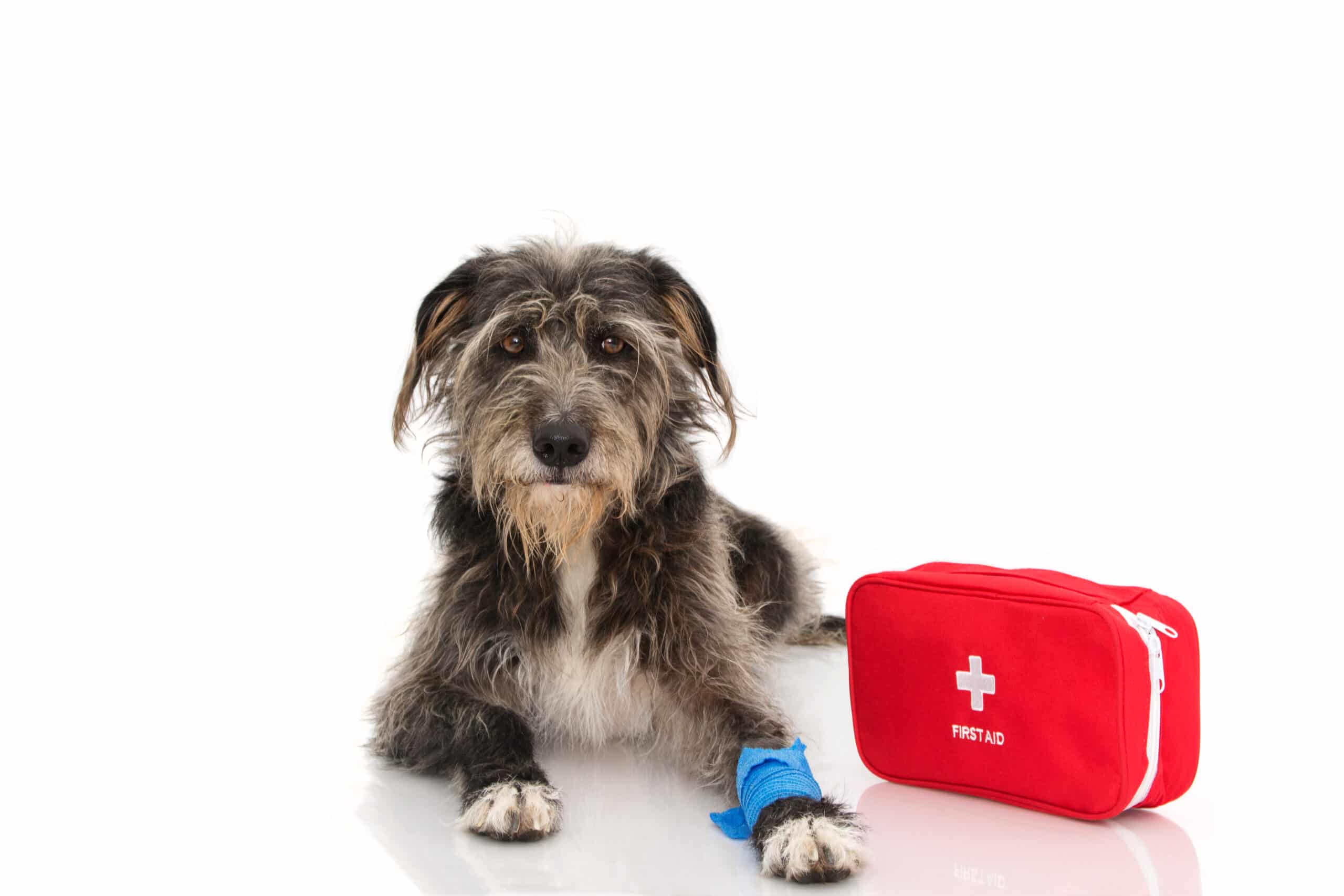
SICK OR INJURED DOG. PUPPY LYING DOWN WITH A BLUE BANDAGE OR ELASTIC BANDAGE ON FOOT AND A EMERGENCY OR FIRT AID KIT. PAIN EXPRESSION. ISOLATED ON WHITE BACKGROUND.
Image Credit: ©smrm1977, Getty Images

3. Fright Risk

If you suddenly drop the retractable leash handle by accident while you are out on your walk, it will start retracting toward your pet, which can scare them and even cause them to run in fear, which might put them in danger.


4. Durability

While most companies at least try to make their retractable leash durable, constant use will quickly wear out even the best brands, especially if you have a larger or more active dog. In many cases, the first problem is that the mechanism inside the handle breaks, rendering the retractable feature useless and potentially putting your dog at risk.


5. False Sense of Security

Retractable leashes can give owners a false sense of security, thinking that they can control their dogs at a distance. However, if a dog decides to run or misbehave, it can be challenging to reel them back in quickly, especially if the lock mechanism fails.


man walking his Staffordshire Bull Terrier dog with retractable leash
Image Credit: Christine Bird, Shutterstock

divider dog paws oct 2024

Tips and Tricks for Using a Retractable Leash

While retractable leashes are not recommended over a standard one, there are ways to use one safely:

  • If you’re new to retractable leashes, begin in areas where there are fewer risks, like open fields or parks without nearby traffic or crowds, to help you and your dog get used to using the new leash.
  • Familiarize yourself with the leash’s locking mechanism, and practice using it until you are an expert.
  • Always keep the leash at a manageable length near busy streets or when encountering other animals or unfamiliar people.
  • Keep your dog within your line of sight at all times to prevent them from getting too far away and encountering danger.
  • Teach your dog commands like “come,” “stay,” and “sit” to use in conjunction with the retractable leash to help keep your pet safe.
  • Never grab the cord of a retractable leash with your bare hands if your dog runs away suddenly, as it can cause rope burns. Instead, use the locking mechanism to prevent your dog from getting farther.
  • Check the leash before each use for signs of damage, and replace it if you notice any.
  • Ensure that the retractable leash that you choose is suitable for your dog’s size and strength. There is usually a size limit printed on the packaging.
  • Always use a standard leash near traffic due to the potential for them to run if they hear a loud noise and the difficulty of reeling in a retractable leash quickly.
  • Attaching the retractable leash to a harness instead of a collar can provide more control and take the strain off your pet’s neck.

divider dog paws 3 oct 2024

Summary

Unfortunately, due to the limitations of the device, a retractable leash can expose your pet to many dangers due to the increased freedom that it provides your pet and the slow speed at which you can gain control of them in an emergency. The thin leash can also break or cause rope burns, and the mechanical device often wears out quickly. If you want to use one of these devices, we recommend doing so only in open areas, far away from any danger, after selecting a high-quality device rated for your pet’s weight.


Featured Image Credit: Olena Kurashova, Shutterstock

Want content like this delivered to you?

Sign Up For Our Newsletter

News, insights, expert advice, and everything dog

* By submitting, you agree to our Terms & Conditions and Privacy & Cookies Policy.


How useful was this post?

Click on a star to rate (you can leave written feedback after clicking submit)

Help us improve Dogster for pet parents!

Your feedback really matters.

What did you like about this post? Also how can we improve it?

Join the conversation

Leave a Reply

You’re very welcome to leave a comment or question. Please know that all comments must meet our community guidelines, and your email address will NOT be published. Let’s have a positive and constructive conversation.


Talk With A Vet Online

Peace of mind,
anywhere, anytime

Affordable vet advice

Dogster’s Weekly Photo Contest Winners: Best Easter Photo (April 9, 2026)

Every week our team gets the privilege of sorting through our readers photos to choose what dogs will win this weeks contest! See...

We Didn’t Just Add a Dog to Our Life – We Built a Life With Him

“We didn’t just bring a dog home—we built a life together.” Most people are quietly taught a version of pet ownership that looks...

What Most Airlines Won’t Let You Do With Your Dog (Even If You Pay Extra)

Airline pet policies are notoriously hard to navigate. The information is scattered across different pages, buried in FAQ sections, and often contradicts what...

Designer Breeds: Best of Both? New Study Says No

“I’ll take a highly trainable, low-shedding lapdog, hold the heart disease and anxiety!” Something I always found amusing was when people would point...

More related

What Noise Levels Are Healthy for Dogs? Vet Reviewed Decibel Guide

Dog owners know that their pups seem to have super-powered hearing. As soon as a bag of food is rustled, no matter how...

Saint Bernard Dog Breed: Info, Pictures, Facts & Traits

The first time you meet a Saint Bernard (or St Bernard) you won’t forget it, their size alone is enough to overwhelm you....

What to Do When Your Dog Bites Someone: 10 Vet-Approved Steps

Our dogs are precious to us, but we really can’t anticipate events that can just suddenly happen. A combination of certain circumstances can...

Can Dogs Eat Salt? Vet-Verified Facts, Risks & FAQ

Salt is a pantry staple, used to cook with, season with, and preserve. Some people can’t enjoy a meal without adding an extra...

Keep reading

Can Dogs Eat Yogurt? Vet-Verified Nutrition Facts & FAQ

Yogurt is one of the rare treats that blends a delicious flavor with potential health benefits. If you’re a diehard fan of the tasty dairy delight, you’ve probably wondered whether your pets could enjoy it as much as you do....

Can Dogs Eat Yogurt

10 Foods With Vitamin C for Dogs: Vet Reviewed Nutrition Facts & Info

Vitamin C, also known as ascorbic acid, is incredibly important for normal immune function in mammals, including dogs. It promotes the activation of white blood cells, which is the body’s principal means of fighting off infection. It also has some...

woman giving broccoli to her dog

Are Greenies Good for Dogs? Vet-Approved Nutrition Guide

Dental disease is one of the most common canine health problems. Dental problems can be painful and make it difficult for dogs to eat. Severe periodontal disease can make dogs more vulnerable to tooth root abscesses and organ disease. That’s...

Greenies bites out of package

7 Best Dog Foods for Vizslas in 2026 – Reviews & Top Picks

If you’re the owner of a Vizsla, you understand the energy and active lifestyle these dogs are prone to. Not known as a lounge-around dog, Vizslas like to be on the go and exude energy. This is why choosing the...

hungarian vizsla puppy dog eating food from a bowl

Can Dogs Eat Takis? Vet-Verified Nutrition Facts & Risks

Takis are rolled corn chips that are fried and then coated with one of many flavorings, including Blue Heat, Nitro, Crunchy Fajitas, Guacamole, and Fuego. All the flavors are spicy (and quite salty), but they’re available in various heat levels,...

Can Dogs Eat_takis

Can Dogs Have Grape Jelly? Vet-Verified Facts & FAQ

Dogs love to sample from the garbage can if it’s within reach. One food they might accidentally get into is grape jelly. But what’s wrong with that, you ask? Can’t dogs eat grape jelly? Grape jelly can be dangerous for...

Can Dogs Have Grape Jelly

Can Dogs Eat Crab Apples? Vet-Verified Nutrition Facts, Benefits & Risks

Have you ever been out on a walk with your pup in the fall season and seen tiny apples littering the ground? Those are crab apples (Malus sylvestris), an older version of European cultivated apple species. These small apples are...

Dogster-Can-Dogs-Eat-Crab Apples

Can Dogs Eat Gravy? Vet-Reviewed Facts & Alternatives

Gravy can seem like a treat that many dogs can enjoy. Gravies are often meat-based, and many dogs lap them up enthusiastically. However, it’s generally not recommended for dogs to eat gravy because it can contain harmful ingredients, and it...

Can Dogs Eat Gravy

Love Dogs? So Do We! Join the Dogster Community

Stay informed with expert pet care insights delivered straight to your inbox! Discover professional guidance on animal behavior, feeding tips, trusted product picks, and much more.


Sign up for the Dogster Email Newsletter