In this article
Dogs are known as man’s best friends for a reason. They provide us with companionship, affection, and a lot of laughter. But sometimes our furry friends can be unpredictable. They may bark at the mailman or run after a squirrel without warning. Naturally, obedience is a core concern for responsible dog owners, and walking to heel is one of the most important dog-training exercises. A well-trained dog is a pleasure to take for a walk. There is no doubt about it. What many people don’t know, however, is how to get their dog to heel. It’s not as difficult as you may think! With a little patience and a lot of practice, you can teach your dog to heel like a pro.
If you’re looking for tips on how to teach your dog to heel, you’ve come to the right place. Dogs that heel are less likely to pull on their leash, which makes walks more enjoyable for both of you. Heeling also helps your dog stay safe since they’re less likely to get tangled in the leash or run into something. Read on to learn 7 tips and tricks you need to master this valuable lesson with your best friend.

Before Getting Started
There are a few things to keep in mind before beginning to train a dog to heel. First, it is important to have realistic expectations for the dog’s behavior and to have a good understanding of how your dog learns. Your dog may not be able to immediately learn the desired behavior and may need some time to adjust. Secondly, it is necessary to be consistent with the commands and rewards given during training.
Dogs learn best through positive reinforcement, so it is important to use rewards when teaching the heel command. In order to teach a dog to heel effectively, a great deal of patience and positive reinforcement is required. Without these two key elements, it is unlikely that the dog will learn this important behavior. Lastly, if your dog is not responding to your commands, it is important to try—and perhaps layer—different tips and tricks until an effective method is found.

Equipment
The process of teaching a dog to heel begins with acquiring the appropriate equipment. One of the most important things to consider when teaching a dog to heel is the equipment you will use. A properly fitting collar and leash are essential for both the safety of the dog and the handler. A head collar or harness may also be used, depending on your individual dog’s needs. The type of collar or harness you use will be based on your dog’s size, breed, and temperament. When it comes to positive reinforcements, you will also want to purchase treats or a toy to use as reward.
Preparation
When teaching a dog to heel, it is important that they are able to walk easily on a leash first. This will help them to understand the concept of heel and what is expected of them. If they are struggling to walk on a leash, it will be more difficult for them to learn this new behavior. Therefore, it is important to make sure that your dog is comfortable walking on a leash before beginning to teach them to heel.
The 7 Tips on How to Teach a Dog to Heel
1. Make Sure You Have a Lot of Treats
When training your dog to heel, it is important to have a plentiful supply of treats on hand. This will help to reinforce the desired behavior and keep your dog motivated. Without enough treats, your dog may become frustrated or less willing to cooperate. Having plenty of treats available will also help keep your dog’s attention focused on you and make the training process more enjoyable for both of you.

2. Short and Frequent Training
When teaching your dog to heel, it is important to engage in short and frequent training sessions. Ideally, you should aim for 2–3 training sessions per day. This will help your dog to learn the desired behavior more quickly and effectively. Training for 5–10 minutes per session is a good way to speed up your dog’s learning process without frustrating your dog. It is also important to be consistent with your training; if you only train sporadically, your dog will have a harder time learning the desired behavior.
3. Decide on the Heel Position
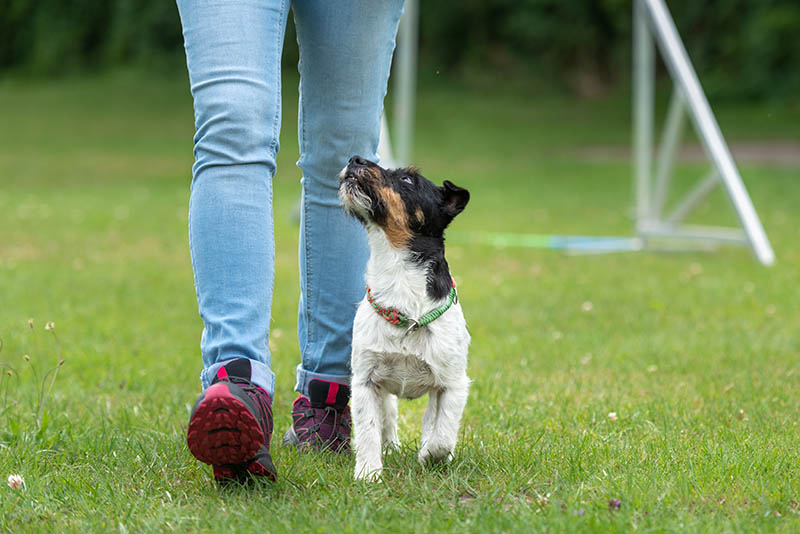
When teaching your dog to heel, you should aim to have your dog’s shoulder or collar level with your knee. This will ensure that your dog is walking in a straight line and not pulling ahead or lagging behind. If your dog is leading or trailing behind, it may be difficult to keep them under control and they could end up getting tangled in their leash.

4. Position Your Dog on Your Non-dominant Side
When teaching your dog to heel, you will most likely want to position them on your non-dominant side. This is because, in the future, you may want to use your dominant hand for other tasks, such as carrying groceries. So, if you are right-handed, it is best to keep your dog on your left when teaching them to heel.
5. Keep Your Dog Close to a Wall
It will help you keep your dog close to you and in the right position if you stand next to a wall with a small gap between you and the wall for the dog to fit through. Creating a naturally narrow space for your dog to occupy will ensure they come up snugly against your leg.

6. Use Treats to Circle Your Dog into Position
Stand in front of your dog, holding a treat in each hand. Extend your right hand to your dog, so they can smell the treat, then move your hand behind your back. As your dog circles behind you, close your right hand and begin offering the treat from your left hand. Draw your dog around to the heel position on your left and reward them with the treat from your left hand. Repeat this a couple of times, then continue without the right-hand treat, instead using a pointing gesture to initiate the exercise. Your dog will figure out that when you point back with your right hand, they need to move to your left knee. Once they are consistently standing in the correct position you can add the verbal cue “heel”. Reward immediately for them moving into position.
7. Add One Step at a Time
Don’t overwhelm your dog by adding too many steps at once. Point behind you and when your dog circles you to the heel position, take a single step forward and treat them as they follow you. When your dog completes this variation, add another step. Keep adding one step at a time. Gradually increase the distance. The leash can be added at this point since you’ll need to leash when you go out and about in public; it’s a good idea to add it to the exercise early on.
Practice walking up and down the driveway or a stretch of pavement with few distractions. Gradually you will be able to increase the distance and distractions.

Summing Up
In conclusion, teaching your dog to heel is an important skill for both of you to master. With patience, practice, and our tips and tricks, you can have your dog heeling by your side in no time. Remember to break down the task into small, manageable steps and to use positive reinforcement throughout the training process. Your dog will learn to heel in no time.
Featured Image Credit: thka, Shutterstock