In this article
The Goldendoodle is a stunning dog that is a mix of the Poodle and the Golden Retriever. This canine is loving, intelligent, and family oriented, which is why they would make a great pet for any dog lover. Goldendoodles are usually easy to care for, though their grooming needs could vary based on the type that they have.
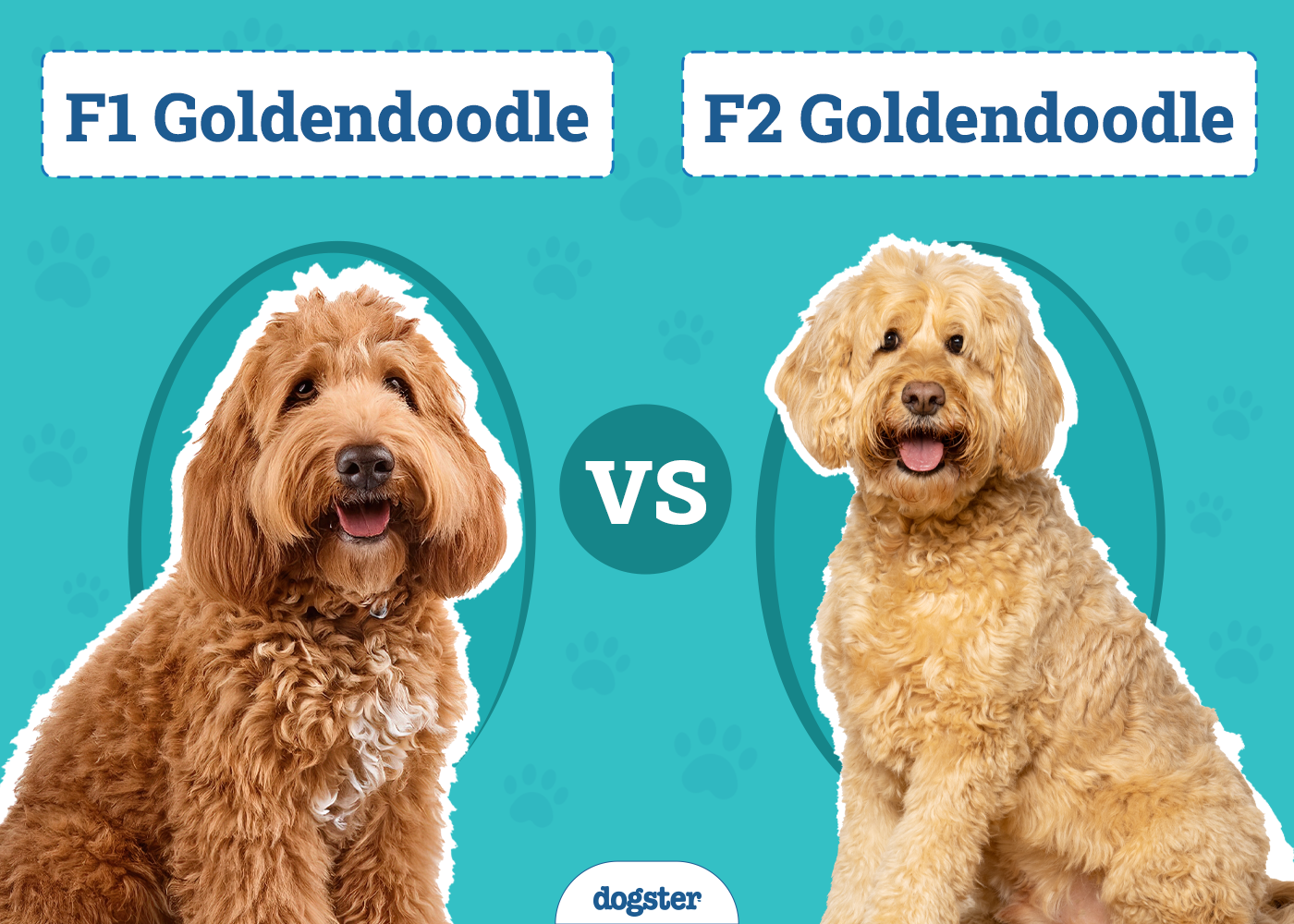
The two main types of Goldendoodles are classified as F1 and F2, but what is the difference between them?
In this article, we talk about F1 Goldendoodles and F2 Goldendoodles, discussing their differences so you can determine which type is right for you.

Visual Differences
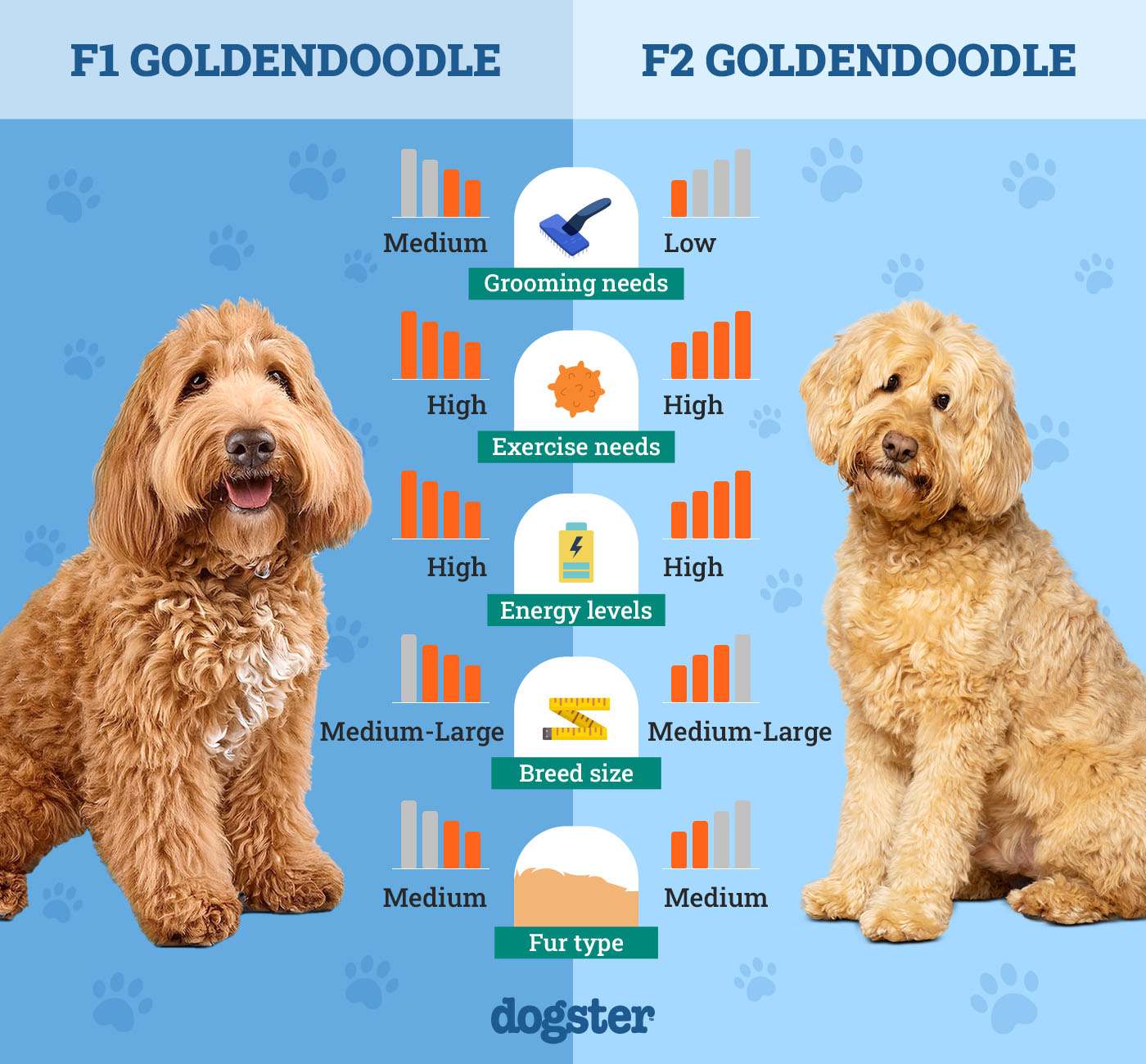
At a Glance
- Average height (adult): <14 – >21 inches
- Average weight (adult): <25 – >51 pounds
- Lifespan: 12–15 years
- Exercise: 1+ hours a day
- Grooming needs: Moderate
- Family-friendly: Yes
- Other pet-friendly: Often
- Trainability: Intelligent, loyal, easy to train
- Average height (adult): <14 – >21 inches
- Average weight (adult): <25 – >51 pounds
- Lifespan: 12–15 years
- Exercise: 1+ hours a day
- Grooming needs: Moderate
- Family-friendly: Yes
- Other pet-friendly: Often
- Trainability: Intelligent, loyal, easy to train

F1 Goldendoodle Overview
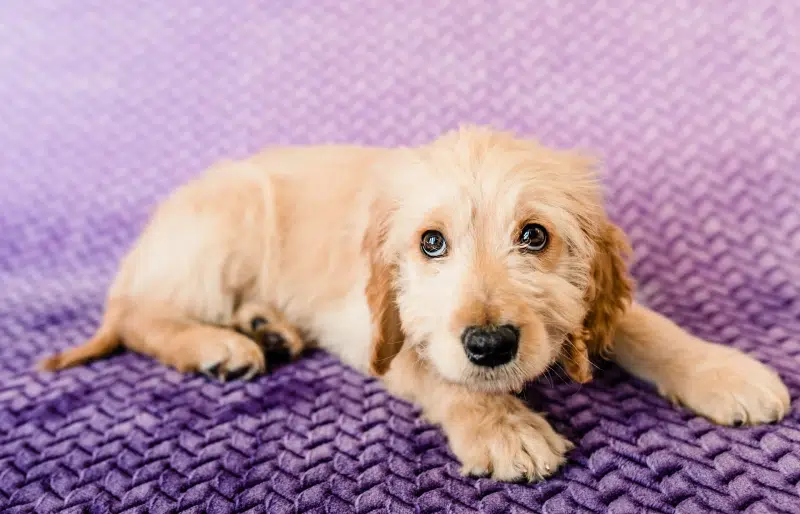
The F marking stands for “filial,” showing the generational relation between the dog and their parents.
An F1 Goldendoodle represents the first generation of this crossbreed, which means they are a direct result of breeding a purebred Poodle with a purebred Golden Retriever. They are genetically 50% Poodle and 50% Golden Retriever.
Goldendoodles, though a mixed breed, are usually healthier than both parental lines thanks to a phenomenon called hybrid vigor or heterosis.
Appearance & Characteristics
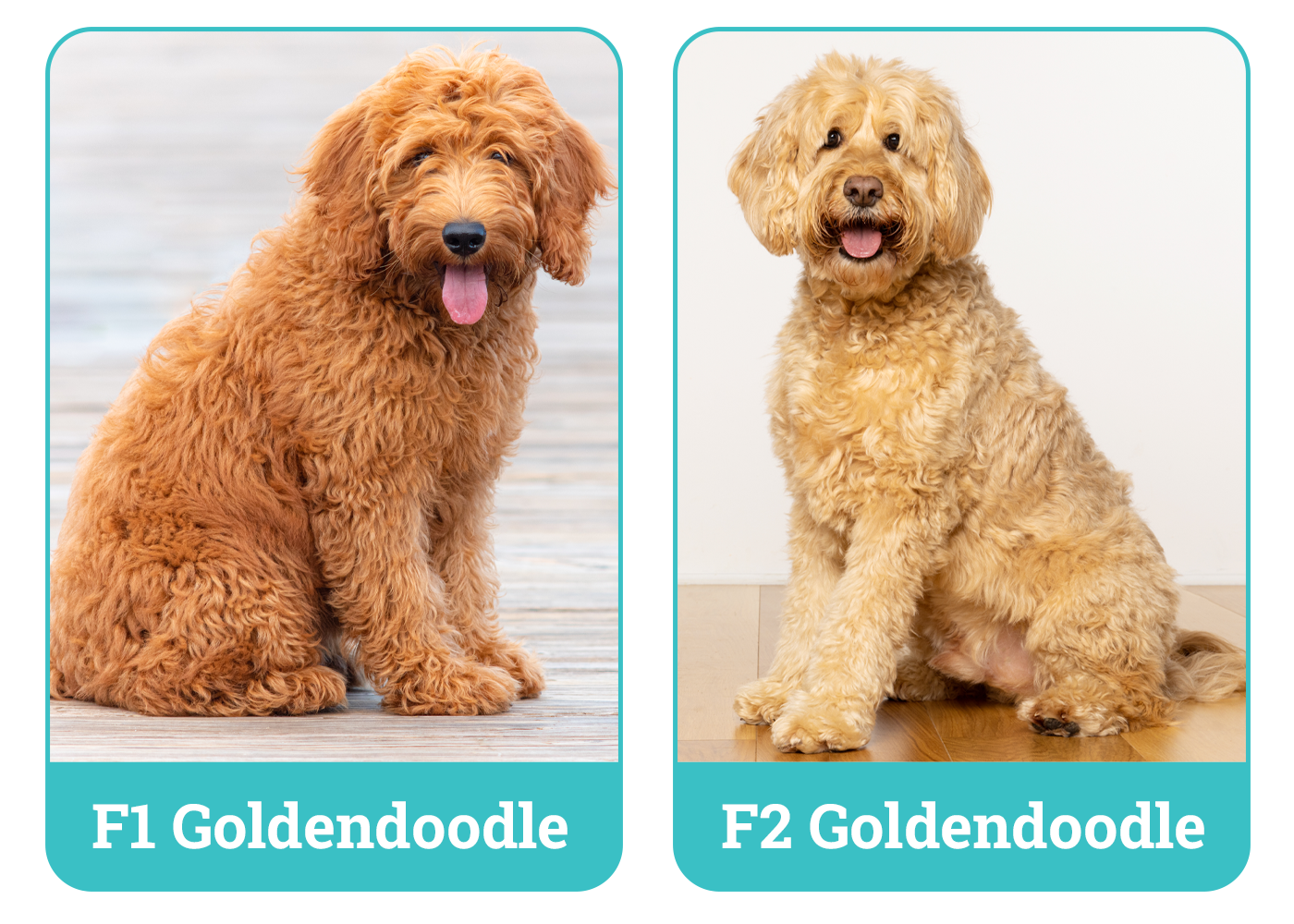
The F1 Goldendoodles can come in various colors and several coat types, including:
- Straight
- Wavy
- Slightly Curvy
Due to their heritage, F1 Goldendoodles are usually still moderate sheders. These dogs will shed more or less depending on their coat type, the curlier the pup, the less likely to shed.
F1 Goldendoodles are active and social, and they love spending time around family and friends. They are often good swimmers due to their Poodle genetics and enjoy being outside.
Grooming
The grooming needs of F1 Goldendoodles are usually high, though these dogs still require regular brushing, bathing, nail trimming, ear cleaning, and dental care. Most F1 Goldendoodles are more likely to shed, especially if they have straight coats. Those with wavy or curly coats may shed less.
These dogs should get brushed daily to every other day to prevent tangling, and you should bathe them about once a month, depending on how dirty they get. Since F1 Goldendoodles are active, they might wear down their nails by themselves, but it’s still important to trim their nails every 3–4 weeks to keep them in good shape.
Suitable For:
F1 Goldendoodles are suitable for anyone looking for a playful and active dog. Due to their loving and family-friendly nature, an F1 Goldendoodle can make an excellent pet for people with kids and large families. Due to them having only 50% Poodle mix, this generation of Goldendoddles is not recommended for allergy sufferers, as they might still shed a considerable amount.

F2 Goldendoodle Overview
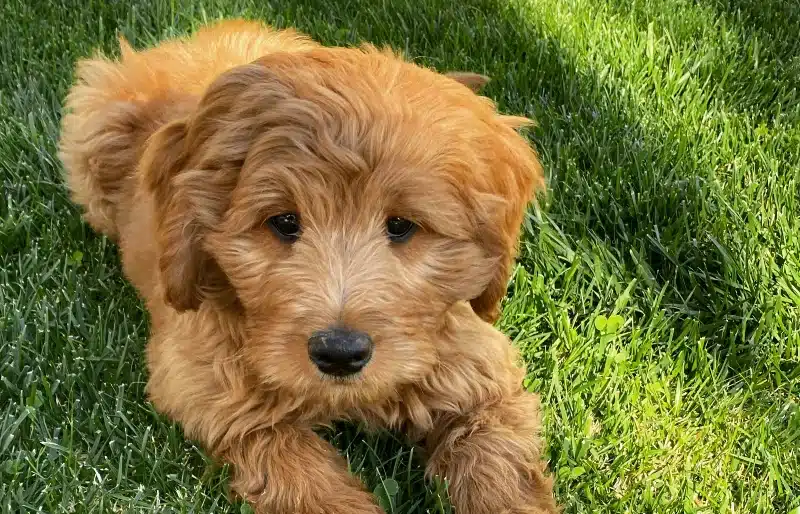
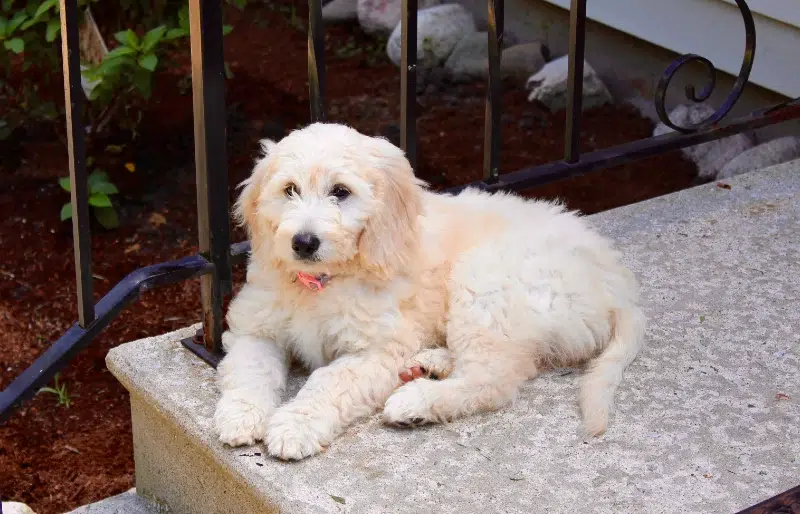
F1 Goldendoodles are similar to F1 Goldendoodles, but they don’t have the exact same heritage.
An F2 Goldendoodle is the result of breeding two F1 Goldendoodles which means these dogs are not entirely 50% Poodle and 50% Golden Retriever, which removes them from the purebred lineage that F1 Goldendoodles have. The result of such a mix could have more or less of the Poodle percentage in their genes, and that is unpredictable.
Appearance & Characteristics
When it comes to their appearance and characteristics, there are not too many differences between F1 and F2 Goldendoodles, though a few things stand out.
F2 Goldendoodles can have several coat types and some individual might shed less than F1 Goldendoodles, depending on their coat type and the percentage of Poodle genes they inherit. Therefore, many consider F2 Goldenodles to be more allergy-friendly (as there is no such thing as a truly hypoallergenic dog). For those looking for a dog that sheds less, an F1b Goldendoodle resulting from the mix of an F1 and a Poodle might be a better option. You can also look for a multigenerational Goldendoodle directly from a breeder who has developed a more curly or low-shedding dog out of carefully selecting parental lines through generations. However, there is never a guarantee for allergy sufferers as their sensitivity degree plays a very important role in the development of the signs.
Another visual difference between F1 and F2 Goldendoodles is that F2 Goldendoodles can have more color varieties. Breeders can more closely select the genetics of the parents to combine different pigmentation genes.

Grooming
F2 Goldendoodles require the same grooming as F1 Goldendoodles, meaning they need regular brushing, baths, and dental, ear, and nail care. The only difference is that some of these dogs may require less brushing than F1 Goldendoodles because they tend to have wavy or curly coats.
Suitable For:
F2 Goldendoodles can make excellent pets for any dog lovers. They have vivid personalities and loving natures. This breed can be a good fit for singles, couples, families with kids, or almost anyone looking for an active, lovable companion. They can also be ideal for those who have dog allergies.
Which Goldendoodle Is Right for You?
Both the F1 and F2 Goldendoodle can make an excellent pet for any dog lover, regardless of their prior experience with dogs. These canines have gentle and loving natures that can easily adapt to new environments and people.
Both Goldendoodle types have a similar lineage. Though F1 Goldendoodles have the advantage of hybrid vigor, they are more likely to shed, while F2 Goldendoodles are more unpredictable due to a higher genetic mix. Therefore, F2 Goldendoodles can have more variety when it comes to their appearance and shedding level.
Either way, both Goldendoodles have similar temperaments, so you won’t make a mistake regardless of your choice! If you are searching for a Goldendoodle with certain physical characteristics, an F1b or multigenerational Goldendoodle breed from parental lines displaying the desired characteristics might be a better choice.
See also:
- Double Doodle vs. Goldendoodle: The Differences (With Pictures)
- Australian Labradoodle vs Goldendoodle: The Differences (with Pictures)
Featured Image Credit: Top – Cavan-Images, Shutterstock | Bottom – Quionie Gaban, Pexels