Do Yellow Australian Shepherds Exist? Vet-Reviewed Info, Pictures & History


In this article
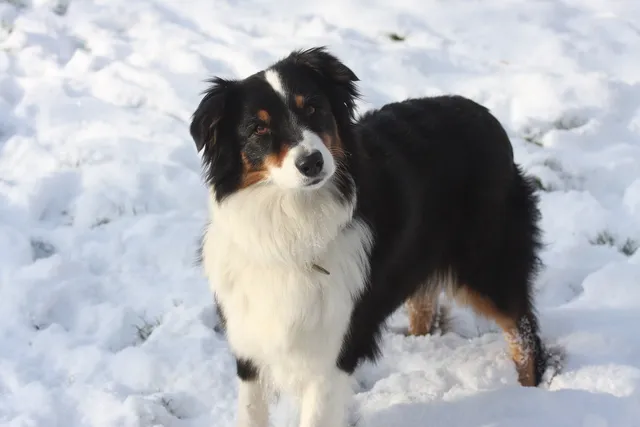
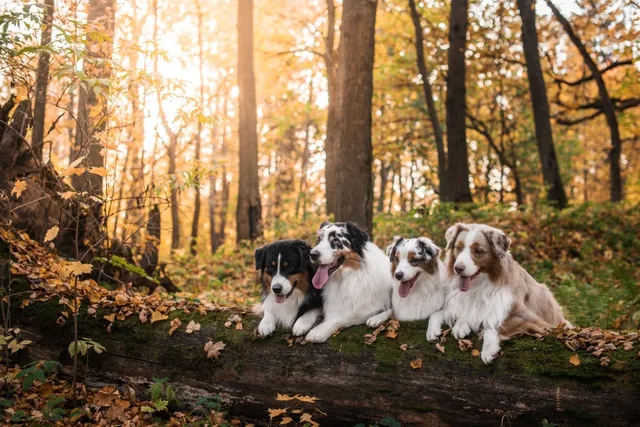
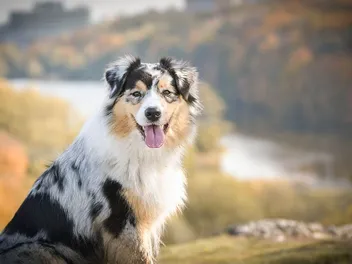
Australian Shepherds have gained in popularity in recent years due to their exuberance and loving temperament. These beautiful dogs are all medium-sized with medium-length, wavy coats that come in many different colors. When you think of an Aussie, you probably picture a striking merle coat, but do they come in other colors, like yellow? Australian Shepherds have four recognized colors and several unrecognized, atypical ones, including yellow.
Here, we look at what makes an Aussie yellow and the other colors that you can find them in.

A Little About the History of the Australian Shepherd
Australian Shepherds likely had their beginnings as sheepherding dogs associated with the Basque region of Spain. The Basque shepherds used several herding dogs, including the Pyrenean Shepherd, for herding, which is thought to have contributed to the ancestry of the Aussie.
The shepherds took their dogs to Australia, where they were bred with Border Collies and Collies. The Basques then traveled to California, where their dogs became quite favored by cowboys and ranchers for their herding abilities. They also became popular attractions at rodeos.
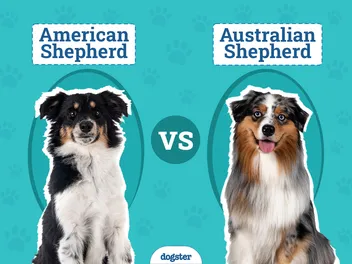
However, Californians believed that these dogs were Australian, likely due to their association with Australian sheep, which is where the Aussie got its name. Australian Shepherds were further bred and refined primarily in the western United States until they became the dog that we see today, so they are essentially an American-developed breed, regardless of the name.

Australian Shepherd Colors
Aussies have four standard and accepted colors recognized by the American Kennel Club (AKC). Within each of these four accepted colors, there are a few variations.
These are also the colors that you see most commonly on Aussies:
Black Australian Shepherds
The black Australian Shepherds have four different variations within this color group, which are:
Blue Merle Australian Shepherds

The blue merle Australian Shepherd also has four different color differences:
Red Australian Shepherds

The red Australian Shepherd comes in three different variations:
Red Merle Australian Shepherds

Finally, the red merle Aussie has three variations within this color group:
Australian Shepherd Non-Standard Colors
Australian Shepherds are typically found in one of the standard colors or one of the variations. But there are a few Aussies that can be found in non-standard or non-recognized coat presentations. These are:
- Dilute
- White (not typically all white, just an excess of white)
- Yellow
A dog that is predominantly white or has excessive white markings is often a double merle. Unfortunately, when an Aussie has white on or around their ears, there’s a higher chance that they will be deaf.
The dilute Australian Shepherd is exactly how it sounds. Whatever color they have is a diluted or paler version, so a black dog will be gray/blue, and a red Aussie will be a lighter red or fawn-like shade.
Yellow Australian Shepherds

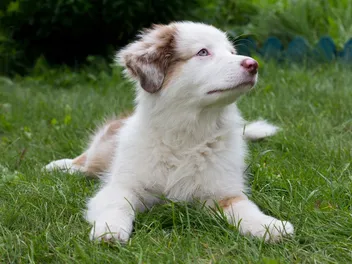
Yellow Australian Shepherds inherit their unique color from both parents. For a puppy to be yellow, each parent must carry a hidden gene for yellow, even if the parents themselves are not yellow. This hidden gene can be present in red or black-based Australian Shepherds, so two dogs that don’t look yellow can still produce yellow puppies.
Yellow Australian Shepherds usually have black noses. Because the yellow gene overrides other coat colors, it can mask what color the dog would otherwise be, such as black or red. When two yellow dogs are bred together, all of the puppies will be yellow.
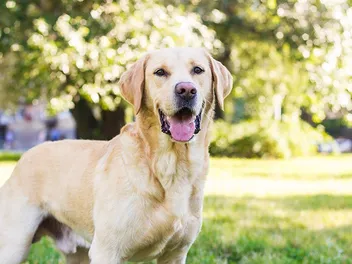
Yellow coats can range from very pale cream (similar to a yellow Labrador) to deep gold (like a Golden Retriever). Some yellow Aussies may appear darker or richer in color, but they still fall within the yellow spectrum
The yellow color comes from a recessive gene, which means a dog must inherit it from both parents for the yellow coat to show. This gene controls whether the coat shows only yellow pigment or allows darker colors to appear.
Yellow Aussies are sometimes confused with sable dogs. A sable dog has hairs that are light at the base with darker tips, while a yellow Australian Shepherd has hairs that are the same yellow color from root to tip, with no dark shading.
Are There Any Health Issues With Yellow Australian Shepherds?
Unfortunately, there are sometimes health issues with certain non-standard coat genetics. Breeding two dogs that both have merle coats can result in puppies with an increased risk of congenital hearing and vision defects.
The issue here is that the recessive yellow gene E-locus gene can sometimes mask the visual appearance of merle patterning in a dog's coat. This means a dog could genetically carry the merle gene but appear yellow rather than visibly merle. Breeding a yellow Aussie that secretly carries merle with a visibly merle dog can unintentionally result in a double-merle pairing, which raises the risk of serious sensory defects in the puppies.
Before there was genetic testing, breeders had the wrong impression that yellow Aussies could produce puppies that were deaf or blind. A genetically yellow Australian Shepherd that does not carry the merle gene can be bred successfully with any colored dog, including a merle. The breeder just needs to run a genetic test on their yellow Aussie to confirm that the yellow dog does not carry the merle gene before breeding.
How Popular Is the Yellow Australian Shepherd?
Since yellow is a non-standard color and due to the longstanding misconception that breeding yellow Aussies would produce unhealthy dogs, they’ve never been the most popular coat color. But they are certainly beautiful dogs!
The most popular coat color in Aussies is blue merle. This is unsurprising considering how eye-catching these coats are! But the color of a dog’s coat shouldn’t matter. It’s about finding a dog with the right temperament that is the perfect fit for you and your family.

The Australian Shepherd Temperament
The temperament of any dog is one of the most essential parts of choosing a dog for your household. Dogs should never be selected just because they are cute or their coat color is appealing.
Australian Shepherds are athletic and energetic dogs that do best when given a job to do. They are hard-working and will become bored and destructive if left alone for too long or not kept physically and mentally active.
But they are also devoted, intelligent, and loving dogs that make excellent family pets in the right household. They are social, and most will greet everyone they meet with enthusiasm.
They do best with active owners who have experience with dogs. While they are eager to please, their intelligence also makes it easy for them to outwit beginners.
Conclusion
Yellow Aussies do exist and are just as healthy as any other color, as long as their parents are both yellow Aussies that do not carry the merle gene.
Ensure that you find a responsible breeder if you decide that you want to bring one of these dogs home. Remember, though, the color isn’t nearly as important as the dog’s health and temperament.
If you’re looking for a high-energy dog that enjoys romping during the day and cuddling in the evenings, the Australian Shepherd may be the right breed for you.
Featured Image Credit: Ermolaeva Olga 84, Shutterstock
Expert dog care, straight to your inbox
News, insights, expert advice, and everything dog.

No spam — unsubscribe anytime.
By signing up, you agree to our Terms & Conditions and Privacy & Cookies Policy.
How useful was this post?
Click a star to rate. You can leave written feedback afterwards. (We read all feedback.)
Kathryn was a librarian in a previous lifetime and is currently a writer about all things pets. When she was a kid, she hoped to work in a zoo or with wildlife in some way, thanks to her love for animals. Unfortunately, she's not strong in the sciences, so she fills her days with researching and writing about all kinds of animals and spends time playing with her adorable but terribly naughty tabby cat, Bella. Kathryn is hoping to add to her family in the near future – maybe another cat or two and a dog.