In this article
View 2 More +Note: This article’s statistics come from third-party sources and do not represent the opinions of this website.
No one knows the exact number of homeless cats and dogs, but the rough estimate is around 70 million. Shelters aren’t required to disclose the data that would help quantify exactly how many animals live there, and still more animals live on the streets. One study suggests that the majority of dogs that are rehomed aren’t relinquished to a shelter, but given to a friend or family member.1 Cats are more likely to be surrendered to a shelter, however. Although some animals are rehomed due to their size or temperament, the vast majority become homeless due to human problems, ranging from a personal housing crisis to allergies or abuse.
ontinue reading to learn more about the homeless dog and cat statistics in the U.S.

The 10 Homeless Dog & Cat Statistics
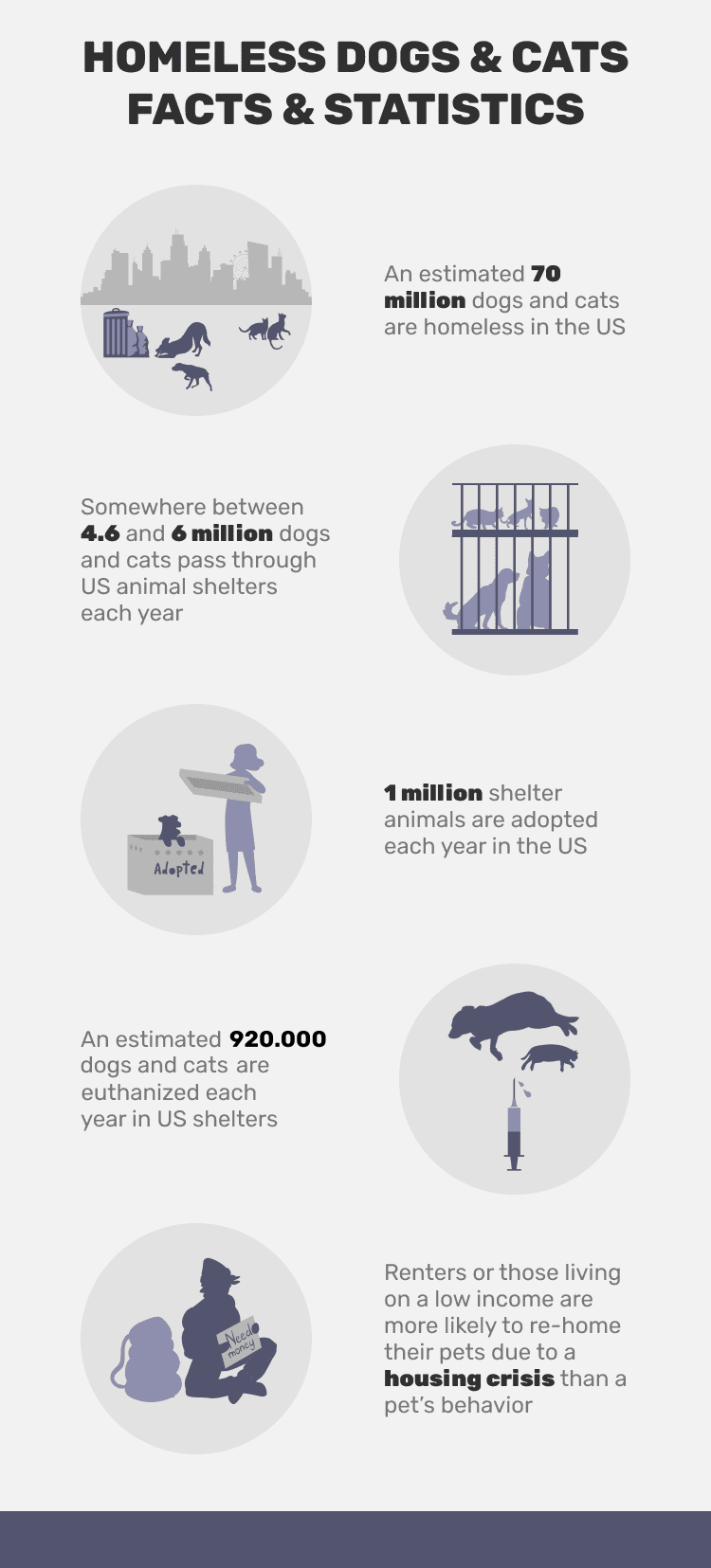
- An estimated 70 million dogs and cats are homeless.
- 41% of dogs are most likely to be rehomed to a friend or family member.
- The majority of rehomed cats are relinquished to the shelter (30%) .
- Somewhere between 4.6 and 6 million dogs and cats pass through the animal shelters each year.
- 1 million shelter animals are adopted each year.
- An estimated 920,000 dogs and cats are euthanized each year in the shelter.
- Dogs and cats are 15 times more likely to die at the hands of an abuser than euthanized at the shelter.
- Renters or people living on a low income are more likely to re-home their pets due to a housing crisis than a pet’s behavior.
- Middle to upper-class people who make $50,000 or more each year are more likely to rehome pets due to behavioral issues or allergies.
- 30% of low-income people who gave up their pets said they wouldn’t have made the decision to re-home if they had access to pet-friendly housing and free or low-cost veterinary care.
General Homeless Animal Statistics
1. An estimated 70 million dogs and cats are homeless.
(Roice-Hurst Humane Society)
The gap between strays brought to shelters from the streets and lost animals reunited with their owners suggests that more animals are abandoned than rehomed to family members or surrendered. It’s estimated that a mere 6.5 million of these 70 million pets will end up in a shelter. The remainder are rehomed in other ways, with a large number left to suffer on the streets.
2. 41% of dogs are most likely to be rehomed to a friend or family member.
(Open Journal of Animal Sciences)
Unless the dog has displayed significant behavioral issues, their owner will likely try to find a close relation to care for them before surrendering them to a shelter, which is the second most common method at 36%. Dogs with aggressive tendencies are more likely to be relinquished to a shelter, though this is still a minority of shelter dogs at large.

3. The majority of rehomed cats are relinquished to the shelter (30%).
(Open Journal of Animal Sciences)
In a rehoming survey, researchers discovered that only 30% of felines are given to family and friends. Most cats are placed in the shelter (40%). However, the large intake of strays suggests a great percentage of unwanted cats are abandoned to fend for themselves.

Animal Shelter Statistics
4. Somewhere between 4.6 million and 6 million dogs and cats pass through the animal shelters each year.
(The Zebra, Best Friends Animal Society)
These two numbers come from two different sources with different methods for finding the data. Since shelters aren’t required to report how many animals reside in their care, there are vast discrepancies in trying to figure out exactly how many dogs and cats are taken in each year.
The state of the economy and world events also have significant influence over the intake rate. For example, some U.S. shelters were wiped clean at the start of the COVID-19 pandemic, as Americans adopted a friend to stay at home with them while they stayed in place. However, these same shelters saw a sharp uptick in intakes and abandonment cases as soon as COVID protocols were lifted and Americans returned to the workplace.

5. 1 million shelter animals are adopted each year.
(The Zebra, ASPCA)
The happy news is that the majority of shelter animals find a home. Unfortunately, though, sometimes this home isn’t permanent, with up to 60% of animals finding themselves being rehomed again within 6 months of adoption.
6. An estimated 920,000 dogs and cats are euthanized each year in the shelter.
(ASPCA)
Cats are more likely to be euthanized than dogs, accounting for 530,000 of the reported deaths, compared to 390,000 dogs. Feral cats are the most at risk.

Problems Affecting Homeless Animals
7. Dogs and cats are 15 times more likely to die at the hands of an abuser than euthanized at the shelter.
(The Zebra)
Each year, an estimated 10 million animals die as the result of animal abuse. Dogs make up the largest percentage of these deaths. These animals are innocent victims of neglect and domestic violence, both of which have skyrocketed in recent years. This weighty statistic deserves our attention as a society because animal rights groups tend to focus on shelter euthanizations, which only account for a comparatively slight number of animal deaths.
8. Renters or people living on a low income are more likely to re-home their pets due to a housing crisis than a pet’s behavior.
(Open Journal of Animal Sciences)
People who make $50,000 or less each year are more likely to rent than those whose salaries rise above the bar. As renters, these low-income families are often forced to make tough financial decisions, such as renting more affordable apartments that might not allow pets (or only a certain number) or leasing a more expensive place they might not be able to afford.
Pet deposits, pet rent, and generally higher listing prices than other rentals create a financial dilemma that unfortunately sometimes results in the displacement of an entire household of pets, as opposed to higher-income families that typically only get rid of one “problem child.”

9. Middle to upper-class people who make $50,000 or more each year are more likely to rehome pets due to behavioral issues or allergies.
(Open Journal of Animal Sciences)
Since higher incomes alleviate the financial and rental stressors common in the low-income class, the middle to upper-class population tends to focus on animal behavior and amiability to others in their household. Most animals rehomed from families making $50,000 or more are given up due to conflict in their home with other family members or animals or due to allergies.
10. 30% of low-income people who gave up their pets said they wouldn’t have made the decision to re-home if they had access to pet-friendly housing and free or low-cost veterinary care.
(Open Journal of Animal Sciences)
A rehoming survey revealed that low-income pet owners often regret giving up their pets, but most chose to do so out of financial burden. An overwhelming 30% said that they wouldn’t have given their dog or cat up for adoption if they had the means to keep them. Participants also said that resources like pet-friendly housing and free spay/neuter surgery would have made all the difference.

Frequently Asked Questions
How many homeless pets are in the shelter?
Very few pets that are homeless or in the process of being rehomed ever enter through a shelter’s doors. In a recent survey of people who rehomed a dog or cat, most people said that they gave their dog away to a friend or family member. However, the participants were also more likely to surrender their cat to the shelter than to try to find them a new home.
The sheer number of shelter intakes that are never recovered suggests that a large unspoken percentage of people dump their pets into the street as opposed to trying to rehome them or surrender them.
We’ll never know how many pets are abandoned in this way because there’s no way to quantify the data. Even if more surveys were conducted, moral shame or carelessness may prevent some people from revealing that they dumped an animal or from participating in the study at all.
Since 15 times more animals die every year as a result of domestic abuse versus euthanasia in shelters, we can safely conclude that many more animals find themselves homeless due to abandonment or running away from an abuser than will ever reside in a shelter. (The Zebra)

What can we do to eliminate the pet homeless crisis?
Although overpopulation is often cited as a primary reason for the number of dogs and cats in shelters, the data suggests that the problem is more rooted in human origins. Low-income study participants reported a housing crisis as a key reason for having to rehome their pets, as pet-friendly housing is harder and more expensive to find. The most common reasons for rehoming in medium to high-income households also reveal human reasons, such as allergies or no time to spend with their pets.
Animal control methods, such as spaying/neutering, may help reduce the overall number of homeless pets, but it doesn’t touch the core of the problem. More work needs to be done on the human side to really relieve the crisis, including providing low-cost places to rent that are pet-friendly, as well as behavioral training and education to higher-income populations who are more likely to rehome a dog due to “aggressive” tendencies. A negative stigma toward Pit Bull types has also resulted in them being among the most common dogs that find themselves in a rehoming situation and among the most common residents in animal shelters. (HASS)
Conclusion
It’s estimated that 6% of U.S. households give up a pet every 5 years. With no accurate way to quantify the data, we don’t know how many of these animals end up with forever homes. Even though 1 million animals are adopted out of the shelter each year, over half will return to the shelter within 6 months. Most dogs and cats that are given up aren’t surrendered to a shelter. Some pass through the loving hands of friends and relatives, but others are dumped outside of the home with no one to care for them.
As a society, we should be concerned not only for the animals that wind up in shelters through unfortunate circumstances but also for the animals remaining in abuse or going hungry on the streets. The reasons behind rehoming most often stem from human troubles, which suggests that pet education and affordable pet-friendly housing might alleviate the homeless crisis even more than successful shelter adoption programs, since most of these adopted animals will be returned. We should focus on the former while not neglecting the latter.
- See also: 12 India Pet Industry Statistics to Know
Featured Image Credit: NPvancheng, Shutterstock