In this article
View 3 More +The Goldendoodle is one of the most popular designer breeds on the market, and for good reason. They embody all the characteristics of what most people would deem the “ideal” dog. Goldendoodles are friendly, gentle, loving, playful, and great with children. They’ll thrive in just about any home as long as their basic needs are met and they’re relatively healthy. What more could you want?
Before adopting a Goldendoodle, you must understand the difference between an F1 and an F1B Goldendoodle. The differences are minor but may be very important when choosing a puppy. 
Visual Differences

At a Glance
- Average height (adult): 15–22 inches
- Average weight (adult): 15–60 pounds
- Lifespan: 10–15 years
- Exercise: 1+ hour a day
- Grooming needs: Moderate
- Family-friendly: Yes
- Other pet-friendly: Yes
- Trainability: Easy
- Average height (adult): 15–22 inches
- Average weight (adult): 15–60 pounds
- Lifespan: 10–15 years
- Exercise: 1+ hour a day
- Grooming needs: Moderate
- Family-friendly: Yes
- Other pet-friendly: Yes
- Trainability: Easy

F1 Goldendoodle Overview
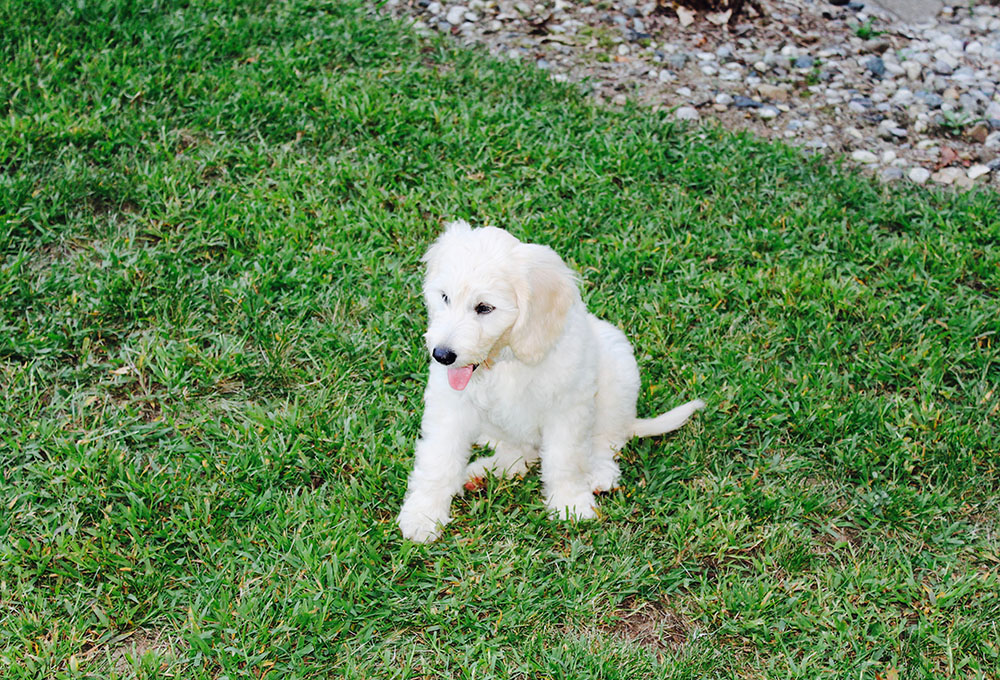
An F1 Goldendoodle is a first-generation Goldendoodle. Breeders use an “F1” to indicate that one of the parents is a Poodle and the other parent is a Golden Retriever. F1 Goldendoodles are very healthy since they’re genetically diverse, unlike their purebred parents.
Personality/Character
An F1 Goldendoodle has many of the characteristics of the Golden Retriever and Poodle—both good and bad. Golden retrievers are happy-go-lucky, intelligent dogs devoted to their families, and they’re friendly to everyone. They love other dogs and are highly adaptable.
Poodles are slightly more reserved with their emotions but are just as affectionate and intelligent as Golden Retrievers. They love their owners, including children, and are very open to strangers.
Poodles are wary of other dogs at first but warm up eventually. When you put these characteristics together, you get the Goldendoodle—a fun, loving, intelligent dog who isn’t as hyper as a Retriever but still remains open to strangers and pets. Because they are a mix of a Golden Retriever and a Poodle, F1 Goldendoodles are not guaranteed to be non-shedding pups.
They typically shed much less than a Golden Retriever, but more than a Poodle. Because an F1 Goldendoodle’s DNA is 50% of both breeds, some doodles can have more of a Golden’s personality, and some can act more Poodle-like.
Physical Characteristics
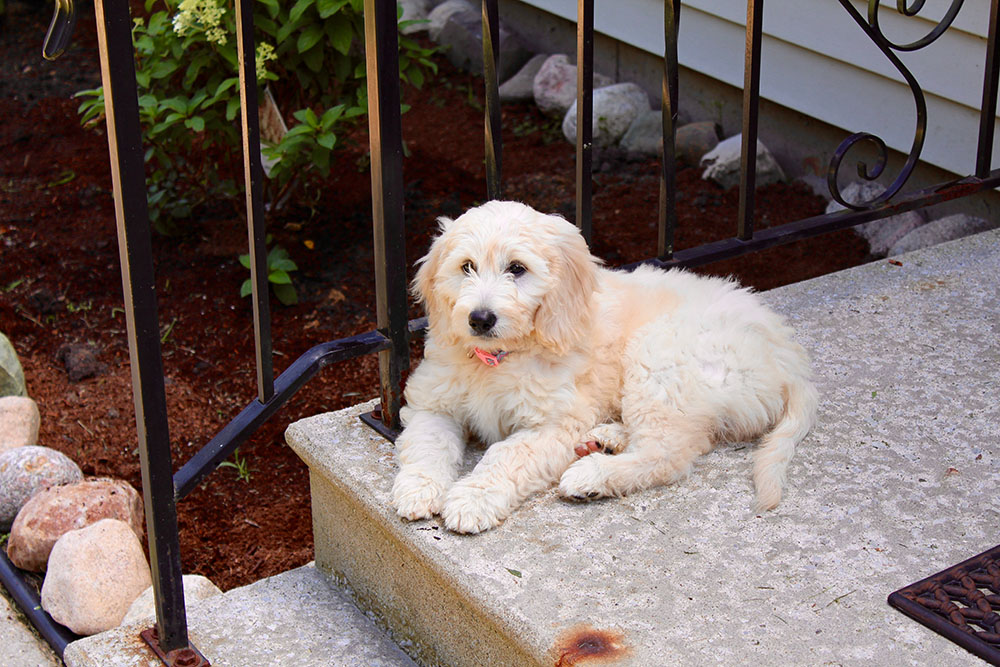
First-generation Goldendoodles can come in various sizes, depending on whether the Poodle parent is a standard or miniature Poodle. F1 Goldendoodle coats can be wavy due to the inheritance of a curly gene from the Poodle parent and a no-curl gene from the Golden Retriever parent.
One of the best things about Goldendoodles is their full spectrum of coat colors, like:
- Apricot
- Black
- Cream
- Blue
- Champagne
- Red
- Tan
- Merle
- White
- Chocolate
- Dark brown
- Silver
- Gray
- Tricolor
Suitable For:
The F1 Goldendoodle is great for families who are okay with more Golden Retriever attributes. They are not guaranteed to be non-shedding dogs and are not hypoallergenic.
- Golden Retriever x Poodle
- Shed lightly to moderately
- Personality traits can vary
- Wavy fur

F1B Goldendoodle Overview
So, what makes an F1B doodle different from an F1 doodle? The differences are minor, but they’re enough for people to have a strong preference for one or the other. Instead of having one Golden Retriever parent and one Poodle parent, an F1B Goldendoodle has one Goldendoodle parent and one Poodle or Golden Retriever parent, i.e., an F1 Goldendoodle is crossed back to one of the original breeds.
These doodles are the most popular since 50% are non-shedding dogs. If the B parent is a Golden Retriever, the puppies will be more genetically similar to the Golden Retriever and more likely to have a straight coat that sheds. This explains why it is much more common to use a Poodle as the B parent rather than a Golden Retriever.
Personality/Character
Since F1B Goldendoodles may be genetically more like the Poodle than the Golden Retriever (if the B parent is a Poodle), they may have a more reserved personality like their Poodle parent. They’re still very friendly and love people and pets.
F1B Goldendoodles are highly intelligent and are extreme people pleasers. They enjoy learning tricks and excel in training at home and work as service dogs.
Physical Characteristics
F1B Goldendoodles can have long, thick, curly, wavy, or straight fur. If you want a medium or mini Goldendoodle, you’ll probably end up with an F1B, but F1 Goldendoodles can also come in a variety of sizes.
They have the traditional furnishings of a Goldendoodle (scruffy beard, eyebrows, and mustache), but you’ll also notice a pointed nose and a more confident stance with these Doodles. Similarly, F1B Goldendoodles can have the same coat colors and patterns as the F1 Goldendoodle.
Suitable For
50% of F1B Goldendoodles (with a Poodle B parent) will be non-shedding. This doesn’t mean they are hypoallergenic, as no breed is. Even dogs that don’t shed much still produce allergens in their dander, salvia, and urine.
This Goldendoodle may be suitable for families who struggle with mild allergies, or anyone wanting more Poodle characteristics and features.
- Goldendoodle x Poodle/Golden retriever
- May be non-shedding dogs
- More consistent with temperament and looks
- Curly, straight, or wavy fur, depending on the breed of the B parent.
Which Doodle Is Right for You?
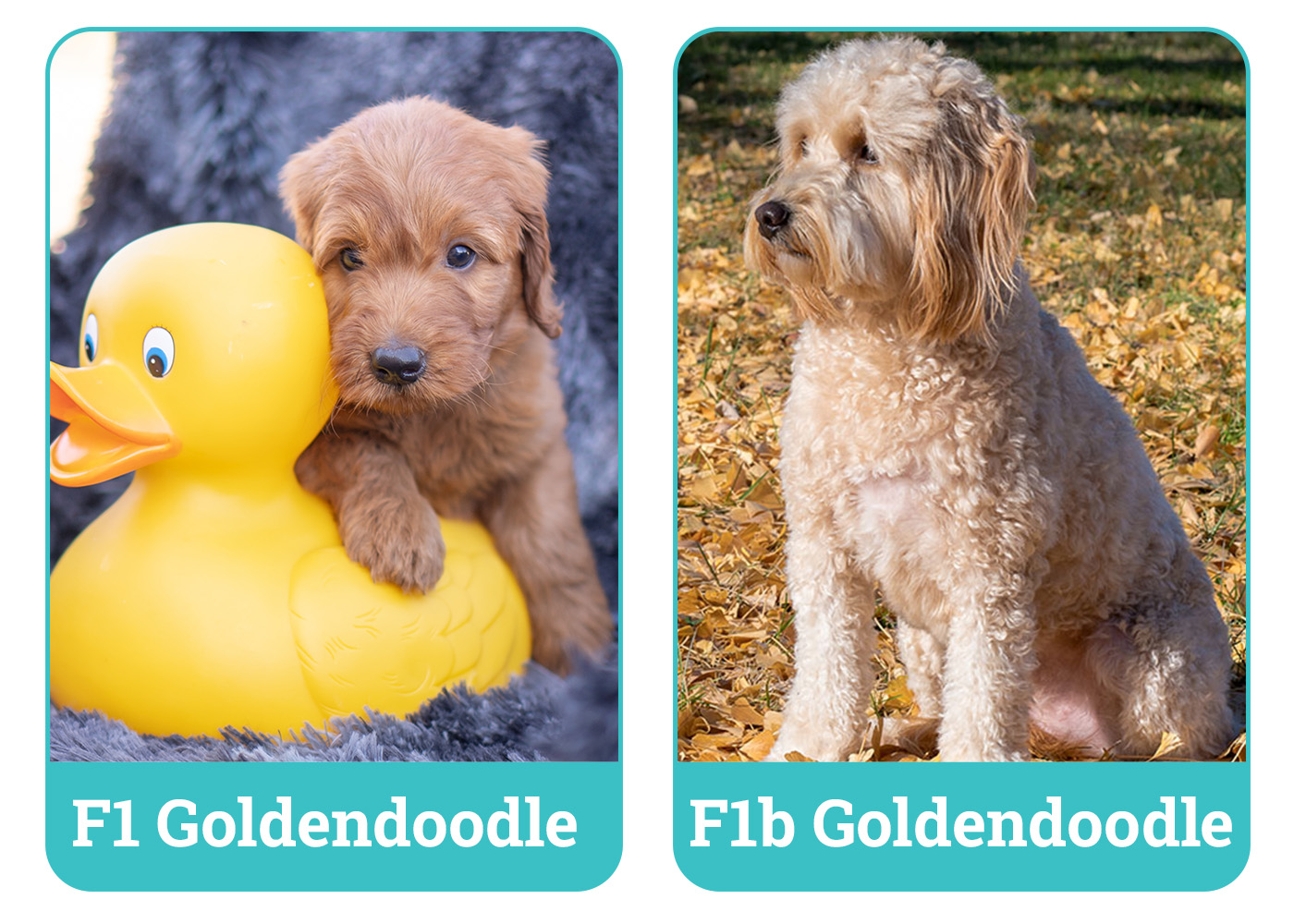
No matter which generation you choose, you will love your Goldendoodle for their gentle and playful nature. First-generation Goldendoodles and F1B Goldendoodles are so similar, and you have to squint to determine their differences. An F1B Goldendoodle may be easier to deal with than an F1 Goldendoodle if you have mild allergies, but getting a dog is not recommended if you have moderate to severe allergies.
F1B dogs contain more Poodle characteristics, and some shed far less than first-generation Goldendoodles. However, if you want a Goldendoodle with more Golden Retriever qualities, the F1 Doodle or an F1B with a Golden Retriever B parent is ideal.
Featured Image Credit: (L) Cavan-Images, Shutterstock | (R) Icarus66, Shutterstock