
In this article
Note: This article’s statistics come from third-party sources and do not represent the opinions of this website.
Ask any pet owner, and they’ll tell you just how much owning a pet has transformed their lives. Our pets give us unconditional love and add so much joy to our lives, so it’s not surprising to learn how many animal adoption agencies there are in Canada. These organizations are scattered throughout the country and house thousands of animals waiting for their forever homes.
If you’re wondering about the state of pet adoptions in Canada, we’ve put together a list of interesting statistics to quell that curiosity. Read on to learn more.

The 11 Pet Adoption Statistics in Canada
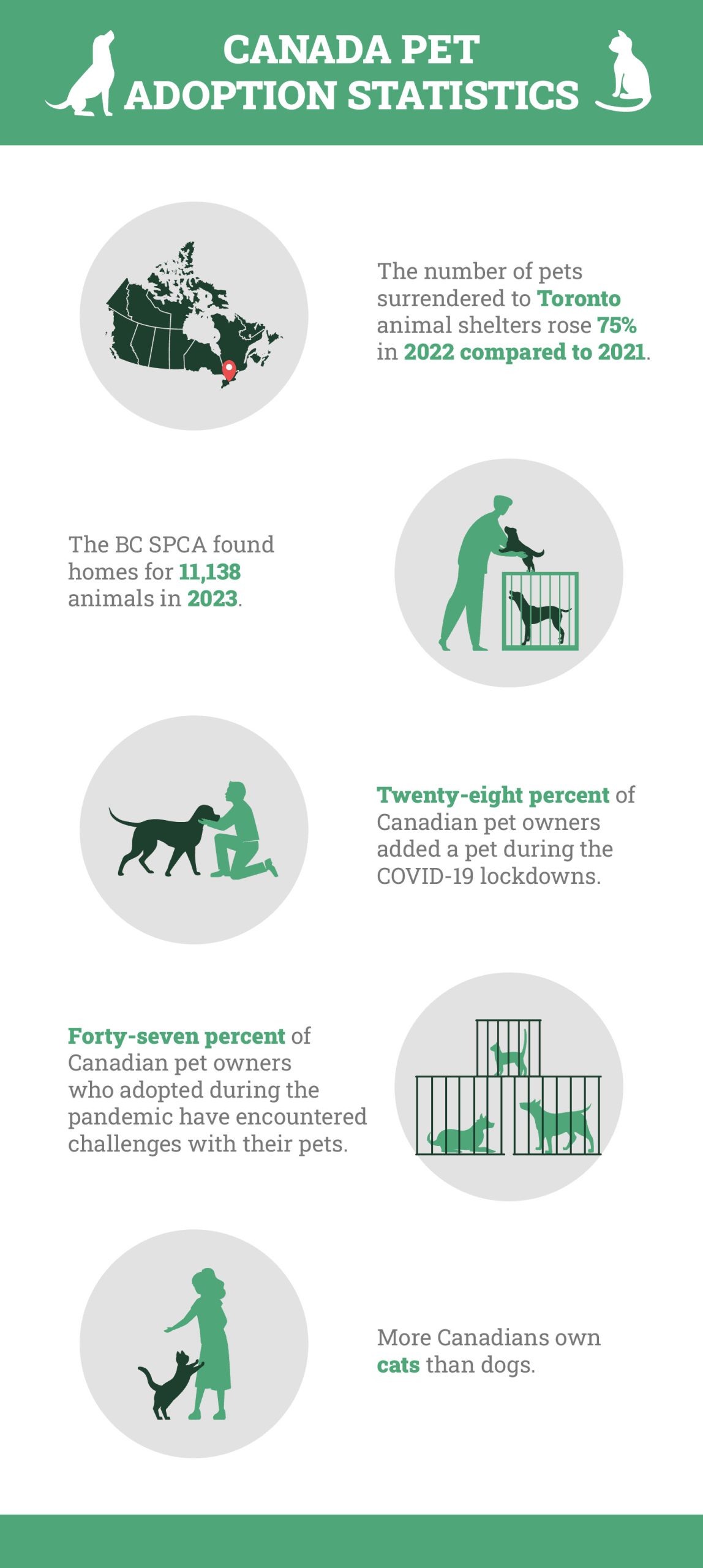
- The number of pets surrendered to Toronto animal shelters rose 75% in 2022 compared to 2021.
- The Ottawa Humane Society saw a 15% increase in animals arriving at their shelter.
- The BC SPCA found homes for 11,138 animals in 2023.
- The Regina Humane Society found homes for 2,085 animals in 2022.
- The Calgary Humane Society found homes for 2,371 animals in 2022.
- The Ontario SPCA had 3,918 animals adopted in 2022.
- The Montreal SPCA adopted out 4,018 animals in 2022.
- Twenty-eight percent of Canadian pet owners added a pet during the COVID-19 lockdowns.
- Forty-seven percent of Canadian pet owners who adopted during the pandemic have encountered challenges with their pets.
- More Canadians own cats than dogs.
- Approximately 1.4 million wild animals are kept as pets in Canada.
The State of Animal Shelters in Canada
1. The number of pets surrendered to Toronto animal shelters rose 75% in 2022 compared to 2021.
(CTV News)
The pandemic saw a huge increase in pet adoption rates throughout Canada, but the return to the office, coupled with rising pet costs in the country, meant many people had to surrender their pets. In Toronto, the number of pets surrendered to shelters rose 75% in 2022 compared to the first half of 2021. Between January 1 and June 23, 2022, 709 pets were surrendered to city shelters, compared to just 404 the year prior.

2. The Ottawa Humane Society saw a 15% increase in animals arriving at their shelter.
(Ottawa Humane Society)
In January 2024, the Ottawa Humane Society reported a 15% increase in animals arriving at their shelters compared to the previous January. This trend continued into February, with more than 100 animals being admitted in a single week alone. However, despite the increase in intakes, fewer animals are being adopted, as the organization saw a 23% decrease in adoptions compared to January 2023.

Pet Adoption Success Stories in Canada
3. The BC SPCA found homes for 11,138 animals in 2023.
(BC SPCA)
The BC SPCA had a busy year in 2023, assisting over 130,000 animals in the province. They found homes for 11,138 animals and reunited 2,165 lost animals with their families. These numbers are up from 2022, when the SPCA found homes for 9,773 animals and reunited 2,032 lost pets with their guardians.

4. The Regina Humane Society found homes for 2,085 animals in 2022.
(Regina Humane Society)
The Regina Humane Society adopted 2,085 animals in 2022. The majority of these animals were cats and kittens, accounting for 1,612 of the 2,085 adoptions. Dogs and puppies accounted for 453, while just 20 small critters were adopted. The adoption rates in 2022 were slightly higher than in 2021, when the organization found homes for 1,965 pets. Hopefully, when the 2023 report gets compiled, we will see another increase in adoptions.
5. The Calgary Humane Society found homes for 2,371 animals in 2022.
(Calgary Humane Society)
The Calgary Humane Society found homes for 2,371 animals in 2022 and returned 238 animals to their owners. The adoption rates are up slightly from the previous year when the organization adopted 2,114 animals.

6. The Ontario SPCA had 3,918 animals adopted in 2022.
(Ontario SPCA)
In 2022, the Ontario SPCA found homes for 2,693 cats, 911 dogs, 274 small animals, and 40 birds. They were also able to reunite 689 animals with their families. These numbers are up slightly from the previous year when the organization found homes for 3,381 animals and reunited 282 lost pets with their families.
7. The Montreal SPCA adopted out 4,018 animals in 2022.
(Montreal SPCA)
The SPCA found homes for 2,796 cats, 391 dogs, 384 small animals, 263 rabbits, 147 birds, and 37 farm animals. The organization also performed 2,506 sterilizations to help address the province’s animal overpopulation problem.

COVID-19 and Pet Adoptions in Canada
8. Twenty-eight percent of Canadian pet owners added a pet during the COVID-19 lockdowns.
(Angus Reid)
The initial lockdowns due to the COVID-19 pandemic inspired many Canadians to welcome a new furry family member to their lives. According to a 2022 study, 28% of Canadian pet owners said they added a new pet that they still have to their family during the lockdowns.
9. Forty-seven percent of Canadian pet owners who adopted during the pandemic have encountered challenges with their pets.
(Angus Reid)
Nearly half of all Canadians who adopted an animal during lockdowns admit to encountering challenges with their pets when their lifestyles returned to their pre-pandemic schedule. One of the most common challenges faced by pet owners is anxiety, both from the animal and the owner. Twenty-six percent of owners report feeling guilty about leaving their pets alone, and 19% report their pets exhibiting anxious behaviors when they’re left alone.

Miscellaneous Pet Adoption in Canada Statistics
10. More Canadians own cats than dogs.
(CAHI)
A nationwide survey of 4,000 Canadian pet owners found that 52% of households were cat owners, while 48% had dogs. The survey also found that the Canadian pet population grew between 2020 and 2022, from 7.7 million to 7.9 million dogs and from 8.1 million to 8.5 million cats.
11. Approximately 1.4 million wild animals are kept as pets in Canada.
(World Animal Protection)
These wild animals range from small invertebrates like stick insects and scorpions to large vertebrates like alligators. It is important to note that the above statistic does not figure in the fish population. Since fish are the third most commonly kept pet in Canada, the actual number of exotic pets in the country is likely much larger.

Frequently Asked Questions About Pet Adoption in Canada
Is it legal to adopt a wild animal in Canada?
There’s no denying the beauty of wild animals; however, many are being poached from their natural environments or bred in captivity to become non-traditional “pets.” Each province has its own laws and regulations regarding keeping wild animals as pets, so you must educate yourself about the laws in your region.
However, potential pet owners need to realize that keeping exotic animals can be a public health and personal safety risk. Zoonotic diseases can be passed from animals to people, and injuries from teeth, beaks, claws, poison, or venom can be deadly.
Additionally, animal welfare is rarely taken into consideration when adopting exotic pets. These animals have very specific care requirements and housing needs, and lack of resources, education, and specialized veterinary care can make caring for these animals properly nearly impossible.
Are any dog breeds illegal to own in Canada?
The federal government does not enforce breed-specific legislation. However, provincial and municipal governments throughout the country do have the ability to ban or restrict certain dog breeds. For example, in the city of Winnipeg, American Pit Bull Terriers, Staffordshire Bull Terriers, and American Staffordshire Terriers are prohibited, as is owning any dog that has the appearance and physical characteristics of any of these breeds. In Ontario, the aforementioned breeds, as well as the Pit Bull Terrier, are prohibited from entering or transiting through the province.

Is there a difference between humane societies, SPCAs, rescues, and satellite adoption centres?
While all these organizations and facilities are pet and animal-centered, they do have some key differences.
Humane societies and SPCAs are the most similar organizations on the list above. They typically run shelters and animal adoption programs to find loving homes for mistreated, abandoned, or surrendered animals. They also often educate the communities they serve about animal welfare.
Rescue organizations are often run by animal enthusiasts and volunteers. They accept animals that don’t belong in shelters or pounds and sometimes also take in surrenders. The animals waiting for their forever homes are most often kept at the volunteers’ homes or in foster homes.
Satellite adoption centers are typically pet stores that don’t sell animals but instead will display them for the Humane Society or SPCA. The animals you see at your local PetSmart are likely not sold by the store but by their partners. Displaying these animals in the store helps them reach more people faster so they can go to their forever homes sooner.
Do all animals in shelters find homes?
Unfortunately, no. However, according to statistics from Humane Canada’s 2021 Animal Shelter Statistics, adoption is the largest outcome category for pets in Canadian animal shelters. At the time of writing, there are no statistics available for 2022 or 2023, so we’re using somewhat outdated stats from the 2021 report.
According to the report, 44% of admitted dogs and 62% of admitted cats were placed in their forever homes during 2021. The number of stray dogs reclaimed by their owners was the highest ever recorded, at 85%. Meanwhile, 16% of stray cats were reclaimed.
In 2021, the proportion of cats and dogs taken in that had to be euthanized was historically low. The euthanasia rate for cats was just 11%, and for dogs, it was 10%.
(Humane Canada)
Did COVID-19 impact pet adoptions in Canada?
People all around the country welcomed new pets into their families during the COVID-19 pandemic. In fact, according to statistics from Global News, almost 30% of Canadians adopted a new animal during the pandemic, and 31% of those who adopted new pets during this time were actually first-time pet parents.
However, as evidenced by some of the stats we reviewed at the beginning of this article, not all of these pandemic adoptions ended happily. When people needed to go back to work after lockdowns, many pets were relinquished back to shelters. A report suggests that the most commonly cited reason for relinquishing a pet post-pandemic was financial restraints1.
(Global News)
How much does it cost to own a dog in Canada in 2024?
Though inflation rates appear to be lowering in Canada finally, the cost of pet ownership is still a tough pill for many Canadian pet owners to swallow. According to recent statistics from Rover, it can cost anywhere between $965 and $4,020 annually to care for a dog. The median monthly cost is $210, up $70 from 2023. The rising costs appear to be attributed predominantly to the increase in the price of pet food, with some brands costing up to 130% more than last year.
(Rover)
Final Thoughts
While pet ownership rates appear to be rising in Canada, there’s no knowing for sure exactly what statistics for the next few years will suggest, nor will we know what will become of all the pets adopted during the COVID-19 pandemic. Canada’s economy had one of its weakest years in 2023, and though the country is not in a recession, many people are struggling to make ends meet. It will be interesting to look at the statistics on pet adoptions and pet ownership rates in the country and how they evolve over the next few years.
Featured Image Credit: hedgehog94, Shutterstock