

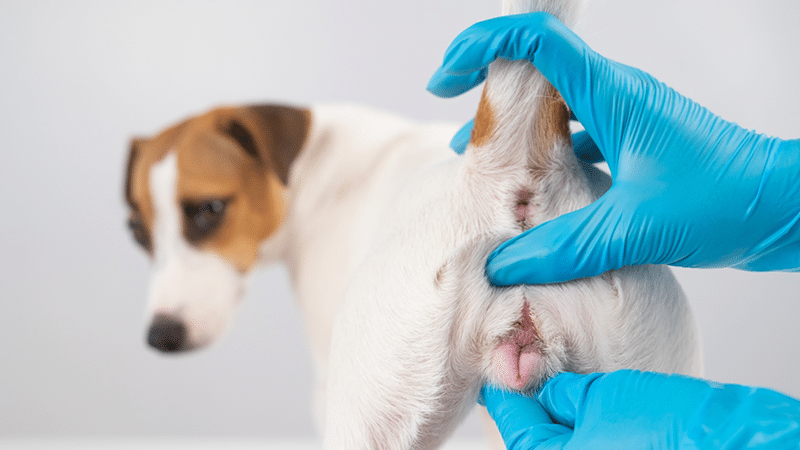
When it comes to your favorite canine companion, you probably think about various parts of their body as it relates to their health—like whether they’re limping because they have something stuck in their paw or if their ears are dirty and likely to get infected. A part of your pup you may not think about as it relates to their health is their genital area.
However, a dog’s genitals can be affected by illness or even get injured, which is why you should know a bit about them. Here’s a closer look at the anatomy of both a male and female dog’s genitals. Knowing this will allow you to have a better idea of when a medical issue may be affecting your pup’s genital area so you can seek treatment sooner rather than later.
Did you know that you can speak with a real vet online about your dog’s health?
To talk to a vet online, click on the image or button below:


Anatomy of a Male Dog’s Genitals

There are three parts of a male dog’s genital area we’ll look at: the testes, the penis, and the genital tract.
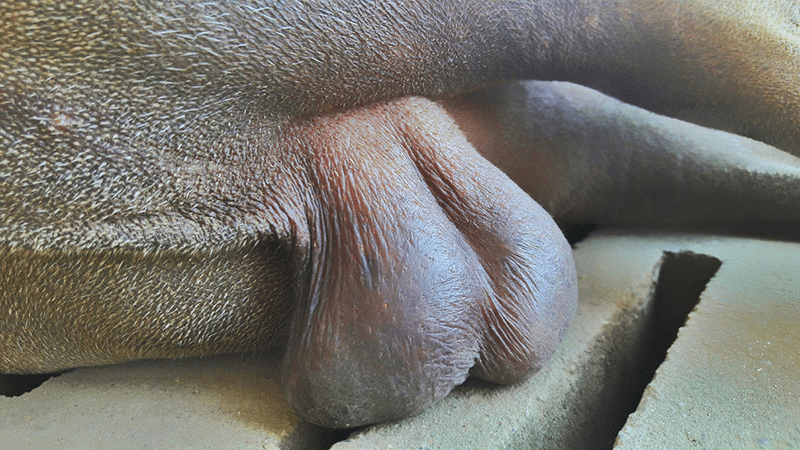
Testes
The testes, or testicles, are the parts of a dog’s genital area that produce testosterone and sperm. They are undescended when a dog is first born but typically descend into the scrotum (the part you can see on the outside of the body) once a pup reaches about 8 weeks old. Testosterone is required for the appearance of male sex characteristics, sexual glands such as the prostate, and sexual behavior. The production of testosterone (and hormones that stimulate follicles) is also responsible for stimulating sperm maturation. Dogs that have been neutered do not produce testosterone, but they are still perfectly healthy.
Penis
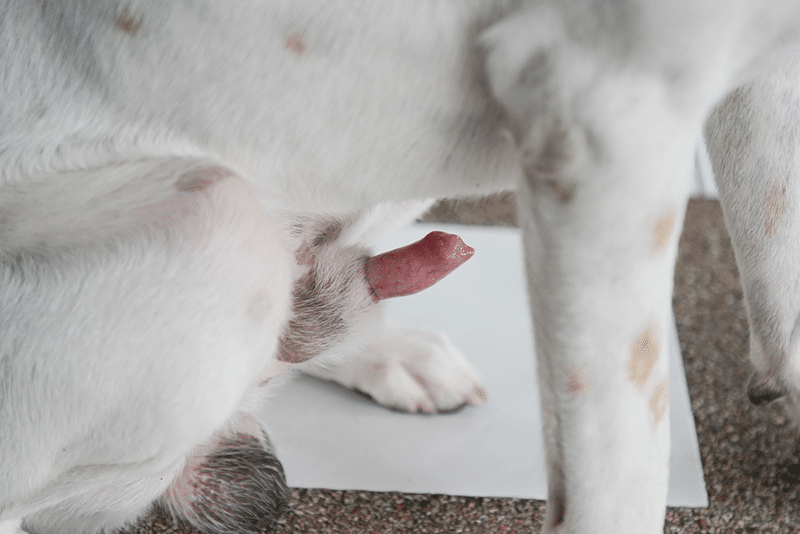
If you have a male dog, then you’ve probably seen his penis before. You might also wonder why it’s a bright pink or red color. This is actually a mucous membrane that covers the penis. The majority of the time, you won’t see the penis itself, though. Instead, you’ll see what’s known as the prepuce, which is tissue and skin that sheathes the penis when it isn’t erect. And speaking of erections, these can occur in un-neutered and neutered canines and last up to an hour.
But did you know that a dog’s penis is always rigid? Yes, even if a dog’s penis isn’t erect, the penis is still rigid because there is bone inside, known as the os bone, that keeps it that way. Another part of a dog’s penis you may not be aware of is the bulbus glandis. The bulbus glandis can be found at the base of a dog’s penis, on either side. When a canine becomes aroused, this part of the penis is filled with blood and swells, so there are two bumps under the skin that are clearly visible. It is also what forms the “tie” during the mating process.
Finally, there’s smegma. Smegma isn’t a part of a dog’s penis, but it is discharged from the prepuce. Smegma can be yellow-white in color or even just a bit green and can be found collected at the opening of the prepuce. A little smegma is perfectly normal. If you see your pup licking at their genitals a lot, they may have an excess of smegma they’re trying to get rid of.
Genital Tract
What is the genital tract? This is what provides a path for semen and sperm cells to move through when ejaculation occurs. The ductus deferens are connected to the testicles via the epididymis; the ductus deferens are what move sperm that has been ejaculated to the urethra (the path for urine and semen to exit the body). The epididymis is the area where sperm are stored and mature. Then, there’s the prostate, which is responsible for creating the part of semen that is fluid.

Anatomy of a Female Dog’s Genitals

The female dog only has two parts we’ll look at: the ovaries and the genital tract.
Ovaries
Ovaries are where female sex hormones and eggs are created. The main female sex hormones produced are progesterone and estrogen. Progesterone is needed to prepare a dog’s uterus for pregnancy, while estrogen is required for eggs to develop. When a female dog reaches the age of their first heat, the appearance of the ovaries will change in both form and size.
A heat is begun when hormones stimulate the growth of follicles (as follicles in the ovary surround each available egg), which leads to estrogen being produced and eggs maturing. The estrogen is important because it lets the brain know it’s time to release the luteinizing hormone. This hormone is what causes eggs to be released from the ovary (aka ovulation). After ovulation happens, progesterone is created and starts to prepare a dog’s uterus for pregnancy.
Genital Tract
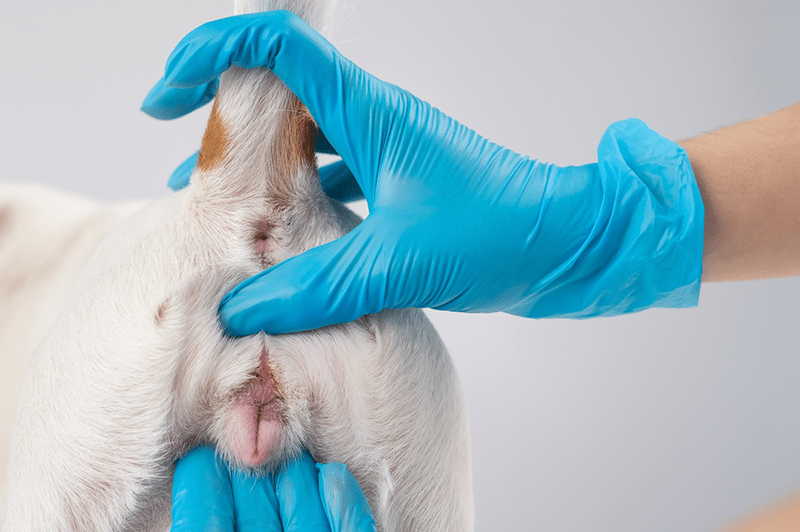
The genital tract of a female dog is a bit more involved than that of a male, as it is made up of the oviducts (or Fallopian tubes), uterus, cervix, vagina, and vulva. The ovaries and uterus are connected by the Fallopian tubes. Each ovary is connected to a Fallopian tube, as these carry eggs to the uterus after ovulation. The cervix is the end of the uterus; it works as a barrier to prevent infection and also keeps the vagina and uterus separate. The vagina of a dog runs from the cervix to the outside of the body and ends at the vulva, or external opening. The vulva consists of two labia or tissue folds and can be seen when looking at your dog.

Genital Health
Now that you have a better idea of the anatomy of a dog’s genitals, what sort of common health problems with the genitals should you be aware of?
If you are concerned about your dog’s genital health, we suggest speaking with a vet.

If you need to speak with a vet but can’t get to one, head over to PangoVet. It’s our online service where you can talk to a vet online and get the personalized advice you need for your pet — all at an affordable price!
Males
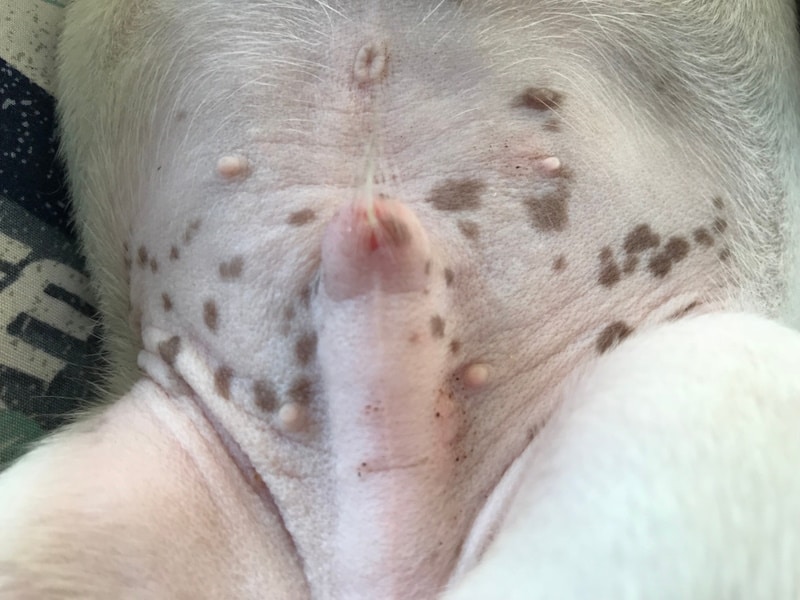
- Testicular cancer
- Testicular torsion
- Cryptorchidism (when one or both testicles are undescended)
- Benign prostatic hyperplasia (overgrowth of prostatic tissue)
- Prostatitis (infection of the prostate)
- Prostatic adenocarcinoma (cancer of the prostate)
- Paraphimosis (the penis gets stuck outside the prepuce)
- Benign and malignant skin cancers
Females
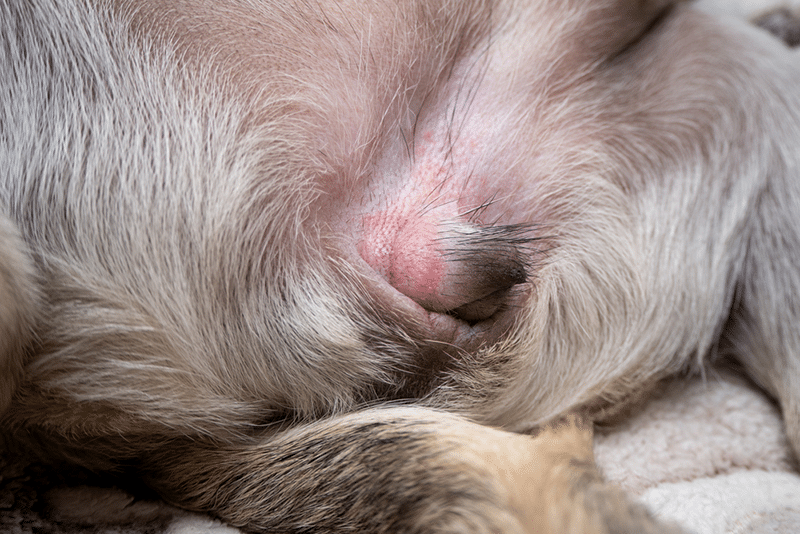
- Ovarian cancer
- Pyometra (pus filled uterus)
- Metritis (uterine infection)
- Vaginal hyperplasia (overgrowth of vaginal tissue leading to a prolapse)
- Vaginitis (sterile or infectious inflammation)
- Benign and malignant skin cancers
Conclusion
Knowing what your dog’s genitals should look like and how they work, whether they are male or female, is important as then you know what to watch out for in the way of health problems. Several health issues can occur in the genital area, so you should be aware of the signs your dog might display when suffering from one. Occasionally checking out your dog’s genitals may seem a bit weird, but it’s vital to keep them as healthy as can be!
See also:
- Labradoodle: Pictures, Care Tips, Facts & Lifespan
- What Are the Top Dog Sports & How Can I Participate?
Featured Image Credit: Reshetnikov, art_Shutterstock



























4 Responses
my maltipoo 9mos old. seemingly her vulva is located in the area like where male dogs testicle hangs. very visible. thinking this is odd?
Hi Rosemary, thank you for getting in touch. It’s completely reasonable to have questions about this. It could be a number of things, including swelling from being in heat, vaginal prolapse, or potentially an underlying abnormality. I recommend scheduling a consultation with one of our veterinarians at PangoVet, who can assess the situation thoroughly and provide answers to any questions you may have. You can schedule a video consultation with our team at https://pangovet.com. I hope this helps! 🙂
Do es the female dog have separate vaginal opening and anal openings
Hi Mike, thanks for reaching out. Yes, female dogs do indeed have separate openings for their vagina and anus. The vagina is used for urination, reproduction and in some cases birthing. While the anus serves for the elimination of waste. I hope this helps clear things up. 🙂