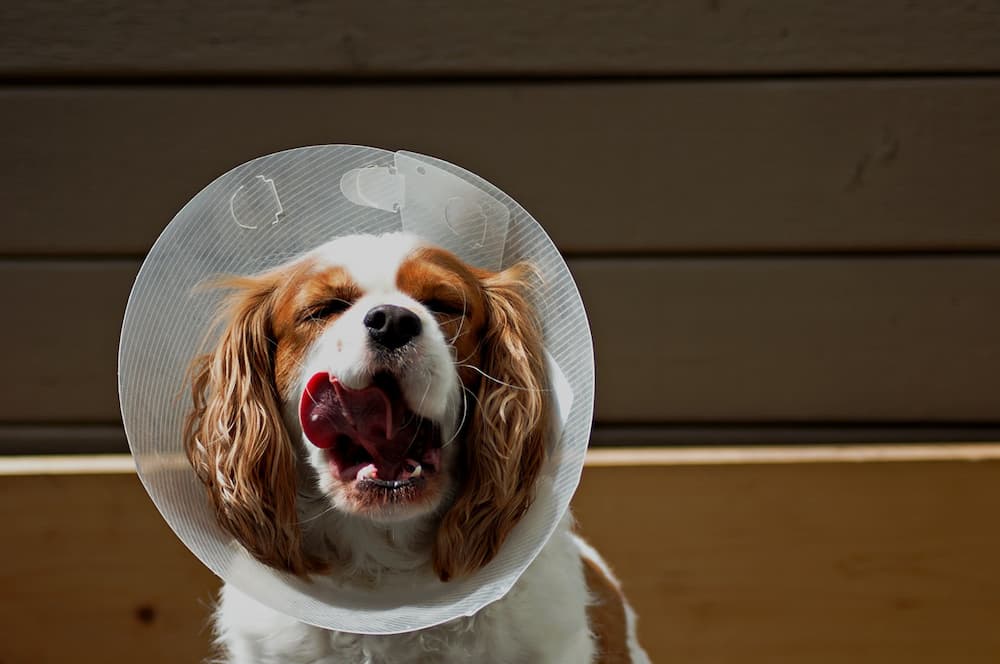
Whether it’s to protect a surgical wound or stop dogs from chewing their feet, scratching their ears, or damaging itchy skin, there are a number of reasons why your dog might need to don the proverbial “cone of shame.” Also called e-collars (short for Elizabethan collar), dog cones, or buster collars, your vet will be able to provide you with one, or you can pick one up online or at the local pet store. But if you’re after a collar that’s custom-made to fit your dog, is able to be created from materials you have at home, and costs next to nothing, you are in the right place.
Some of these designs for a DIY cone of shame are great in an emergency, while others can be used for longer than just a day. In any event, it’s important to make sure that the collar is comfortable, protects the zone of interest, and that your dog can’t get tangled up in or easily remove it.

Before You Begin
- Dogs generally don’t like wearing e-collars, so it’s important to stay strong and not give in to those sad little eyes!
- If you have duct tape, you can make an e-collar, along with just about anything else! So, if you don’t have any duct tape, get some now—immediately. It’s an essential component of all our designs.
- Pre-cut small pieces of duct tape in advance.
- Measure and cut a length of the cord of the exact circumference of the collar, allowing space for two to three fingers to fit underneath. This will be useful as a template for getting your measurements right.
The 7 DIY Dog Cones You Can Make Today
Now, let’s check out these DIY dog cone alternatives that won’t cost you a cent (unless you don’t have any duct tape, in which case, get some!).
1. The Paper Plate Collar

This DIY dog cone is ideal for small dogs. All you need is a couple of paper plates, duct tape, a cord, scissors, and a pen or pencil.
- Paper plates (2)
- Duct tape
- Cord
- Scissors
- Pen/pencil
- Measure and cut the cord to the exact circumference of the collar, allowing space for two to three fingers to fit underneath. This will be your neck template.
- Use your neck template to draw a circle in the center of both plates that is 1 inch wider than the neck circumference, then cut this out. Make a straight cut to the center hole. Overlap the two ends until the inner circumference matches the neck template, and then tape this in place.
- Measure a separate length of cord that allows extra length for tying the ends.
- Use one piece of tape to join the two plates together, then secure the cord between the plates with a small piece of tape on the inner circle edge. Leaving the two ends free, continue placing small pieces of tape around the inner and outer edges. Finally, place the collar on your dog and tie excess cord pieces in a bow so they don’t dangle.
2. The Cardboard Box Collar

There’s never a shortage of cardboard boxes around my house, and I’m sure yours is the same! The folding flaps are the best pieces to use, and with a lot of duct tape, you can put together a pretty sturdy cone of shame that’s great for small and large dogs alike.
- Tape
- Cardboard
- Cord or a dog collar
- Scissors
- Cut sections of cardboard at an angle like a propeller. The number of sections you need will depend on the size of your dog.
- Make sure the cardboard sections are long enough to reach from the neck to past the nose; otherwise, they’ll be able to reach past the collar. The longer the collar, the more protection there will be.
- Arrange the cardboard pieces around your neck circumference template and tape them into place. On each side, place tape along the length of each joint, folding it over the inside edge.
- Fit the collar to your dog’s neck and tape it in place.
- Now it’s time to make some loops to thread a collar or cord. Take 2 pieces of tape, one approximately 5 inches long and the other around 2.5 inches. Stick the pieces to each other, sticky sides facing in, and use the sticky ends to attach the loop to the inner edge of the collar. Place an extra piece of tape on each end to secure the loops in place and repeat this three more times around the circumference.
- Thread the collar or cord through the loops and get ready for some final adjustments. Check the fit and length of the collar once it’s sitting in place. If needed, cut the length of the cardboard so that it reaches past the nose. Reinforce the collar by applying tape to any exposed edges.
3. The Pool Noodle Collar

This is another DIY dog cone alternative that can work especially well for larger dogs. If you’ve got an old pool noodle at home, this one couldn’t be any easier.
- Pool noodle
- Cord
- Scissors
- Knife
- Cut a length of cord that is twice the circumference of your dog’s neck. Cut a section of noodle the length of the collar circumference (half the total length of the cord). Cut the noodle into 4- to 6-inch sections and thread them onto the cord.
- Tie this into place, ensuring that the collar is firm enough to reduce how much the neck can flex, but not so tight as to put pressure on the neck. Add a second row for dogs that are flexible or have long necks.
4. The Toilet Roll Collar

This is just the small-dog version of the pool noodle collar!
- Toilet roll centers (2–3)
- Cord
- Scissors
Cut a length of cord twice the circumference of the neck and select enough toilet rolls for the length of half the cord. Cut toilet rolls into 2-inch sections, thread them onto the cord, and tie them in place.
5. The Floppy Hat Collar

Got an old, floppy hat? Then you’ve got the makings of a soft, comfortable e-collar! These need to be large enough that your dog can’t easily push them out of the way, but not so large that they’ll end up tripping over them.
- 1 floppy hat
- Tape
- Scissors
- Cord
Make an X-shaped cut on the top of the hat. Fold each triangle of fabric over the cord and use tape to secure it in place. For a longer-lasting result, you can sew the folded fabric in place. Then, all you need to do is use the cord to secure the collar around the neck.
6. The Stuffed Tights Collar

This is a great way to make use of a pair of old tights and some trash, such as old newspapers that you need to throw out. It’s best for protecting the head and torso areas of your pooch.
- 1 pair of tights
- Some old newspaper, paper
- Scissors
Stuff one leg of the tights with paper, leaving about 1 foot at the toe end for tying the collar. Tie off the end, and then you can either cut off the other leg or make a double-layer collar by filling the second leg as well. Use the free ends to secure the collar in place.
7. The Towel Collar

This might be the simplest of all our solutions. If you have duct tape, you can make this emergency version of a “cone of shame.” All you need is a towel, tape, and scissors.
- Duct tape
- Towel
- Scissors
Fold the towel lengthwise, wrap it firmly around the neck, and use duct tape to secure it in place. This one isn’t a long-term solution, but it can stop your dog from being able to reach their feet and body and protect the head and ears from scratching until you can get to your vet. Make sure the wrap is firm enough to be effective, but not so much that it’s putting pressure on the throat.
Final Thoughts
So, there you have it! We hope you enjoyed looking through these seven different options for creating a cone of shame with items you will find around almost any home. Just make sure you’ve always got some duct tape handy, as you’ll use a lot of it!
Featured Image Credit: Micah, Pexels
 Before You Begin