How to Teach Your Dog to Sit - Our Vet’s Recommended Steps
In this article
One of the first things that you want to teach your new puppy (or older rescue) is to sit when you give them the cue to do so. Fortunately, the sit command is one of the easiest things to teach a dog, young or old. The problem is that if you don’t know how to do it, the process can be confusing and frustrating. If you’re interested in learning how to teach your dog to sit without hassle, read on!

Before You Begin
Make sure that you’re in the right frame of mind and that you have everything that you need before the training session begins, whether you’re teaching the sit command or anything else. Ensure that you’re in a positive mood and that you have the patience to go through 15 minutes of training without frustration, no matter what happens. Keep in mind that training is a learning experience for your dog and that they can’t be expected to perform with perfection.
You should also make sure you have plenty of treats in your hand or pocket—enough for one treat per repetition—as these’ll act as reinforcement and encouragement. But don't forget that treats should account for no more than 10% of your dog’s daily calorie allowance. Finally, prepare a quiet space that’s free of distractions for the upcoming training session to take place in. The fewer things that distract your dog, the more they can focus on the task at hand, which is learning how to sit and be still.

The 7 Steps for Teaching Your Dog to Sit
1. Present the Treat
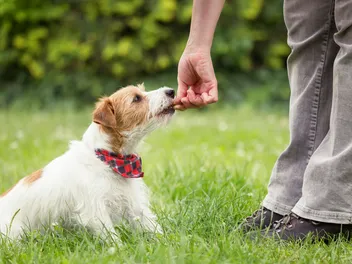
Start by standing right in front of your dog, then hold a treat in your hand, and let the pup sniff it to understand what's up for grabs. This will give them the idea that they are given the chance to get treats in some way, which helps set the stage.
2. Move Your Hand
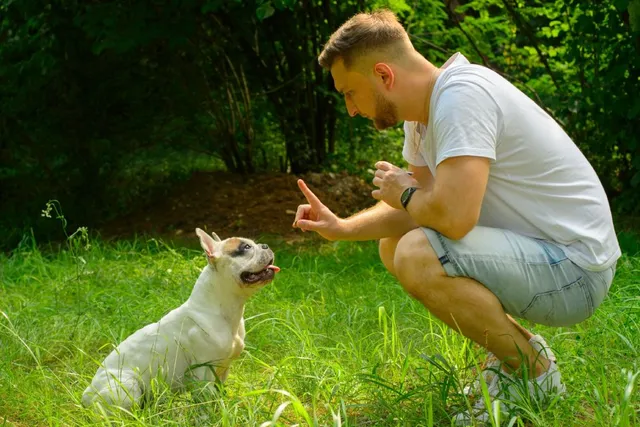
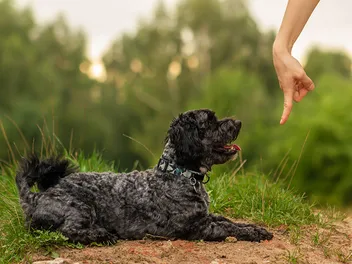
With the treat in your hand so your dog can see it, slowly raise your hand upward and over their head, then toward their back end. This should trigger them to look up and back and while doing so, to sit their bottom on the ground.
3. Consider Clicker Training
As soon as your dog sits, praise them with a clear marking word, such as “good,” and immediately reward them with that treat that’s in your hand.
You can also use a clicker as a marker instead of the word “good.” However, keep in mind that “sit” is a very basic command, and you do not need a clicker for it. Treats are a surefire way to get results without much training experience. If you wish to introduce your dog to clicker training, you can learn all about it by reading our post: How to Clicker Train Your Dog: Basics & Vet-Verified Guide, which will walk you through the process.

4. Repeat
Get your dog to stand up again by backing away from them or tossing a toy for them to fetch, then start the process of getting them to sit and marking the behavior with the word “good”(or a click), immediately followed by a treat again. Repeat this process a few times per training session. A great tip to help your dog understand is to ensure you deliver the treat while the dog is still sitting.
5. Introduce a Cue
Once your dog knows that they can get a treat while sitting, they will start offering the behavior as soon as you look at them. We need to now bring this under stimulus control by introducing a cue.
Start by using the word “sit” every time you practice the sitting movement, just like when you had a treat in your hand. Your empty-handed movement will become the visual cue to sit, while your verbal cue will be the word “sit.”
6. Practice the Verbal Command
After your dog reliably sits with your verbal and visual hand commands, you can start practicing with just the verbal command. After a while, your pup should sit anytime you tell them to without any hand signals or treats.

7. Work on Variability of Areas, Time, and Reinforcement Delivery
Once your dog reliably responds to both the visual or only verbal command and sits, you can start including variability. It is important to practice the behavior in different scenarios because this will teach your dog that being attentive to you no matter where you are gets them the opportunity to get something they desire.
You can also work on gradually extending the time they need to sit patiently, and you can also use some cuddles, an opportunity to play with their favorite toy, or even going outside for a walk as a reinforcer. You know your pup best, so you know the different things that will make them happy and keep them motivated.
Training Tips
There are a few tips that can help make the process of training your dog to sit easier and more effective overall.
Check them out:

Frequently Asked Questions (FAQ)
Can Dogs Be Taught to Sit Without Treats?
Yes, it is possible to teach a dog to sit without the help of treats or other accessories like clickers. It just might take more time, patience, and commitment. Just follow the same training techniques but without the treats. Instead, use something else that is highly reinforcing for your dog; for example, their favorite toy or some cuddles and belly rubs.
Can Older Dogs Learn to Sit?
Absolutely! Dogs of all ages can learn how to sit, as long as they can actually do so without discomfort due to problems like hip dysplasia and arthritis. It just might take extra time for adults and older dogs to learn.

What’s So Important About Teaching a Dog to Sit?
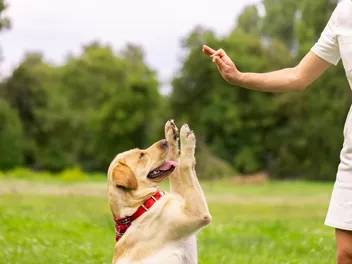
There are a few important reasons to teach your dog how to sit upon command. First, ensure that they can stay calm in social situations. If the atmosphere is loud and rambunctious, sitting is much preferred to your dog jumping around and being unmanageable. Second, sitting is a basic behavior from which other behaviors, such as “sit pretty,” “hug,” “stay,” and “lay-down,” can build on.
Conclusion
Teaching your dog to sit is easy, especially if you have a step-by-step plan so you understand exactly what to communicate to your dog and avoid confusion. Once you get started, stick with the training process, making sure to incorporate at least a short session daily until you get the results that you want.
Also Read:
Featured Image Credit: Linas T, Shutterstock
Expert dog care, straight to your inbox
Vet-reviewed advice, training tips, and the best of Dogster. Free, and you can unsubscribe anytime.
By signing up, you agree to our Terms & Conditions and Privacy & Cookies Policy.
Dr. Paola Cuevas is our Senior In-House Veterinarian at Dogster and Pangolia. She has over 19 years of experience working with an array of species and loves sharing her knowledge and experience with our readers and aims to provide assistance with any issue presented by your non-human family members. She received her degree from the University of Guadalajara, Mexico.
Her passions are animal welfare and preventive medicine, and has skills in the fields of nutrition, microscopy, clinical pathology, diagnostic imaging, and endoscopy. Paola frequently contributes pet care insight to various media outlets like PetMD, The Daily Record, Parents.com, etc.
Paola is also an animal behaviorist with extensive experience in positive reinforcement animal training.
Join the conversation
Ask a question, share your story, or send private feedback.