Dogster is reader-supported. When you buy via links on our site, we may earn a commission at no cost to you. Learn more.

Lifestyle

Why Do Dogs Have Tails? Vet-Reviewed Facts & FAQ

Elizabeth Gray
By Elizabeth Gray · Reviewed & fact-checked by Dr. Ashley DarbyVet Approved
Dr. Ashley Darby
Reviewed & Fact-Checked byDr. Ashley DarbyBVSc (Veterinarian)
Dr. Ashley has worked in mixed and small animal emergency clinics and general practice ever since 2017 after studying Sydney University. She grew up in South Africa and England before moving to Australia, and her passion for animals came from many childhood safaris in the Kruger National Park.View authorThe information is current and up-to-date in accordance with the latest veterinarian research. Learn more
Updated on June 17, 2026
Share
dog tails

For dog lovers, few actions are more likely to bring a smile to their faces than the sight of a wagging tail. Whether long, fluffy, short, or stubby, dog tails come in many forms, but have you ever wondered why they exist in the first place? Over the years, humans have developed many theories, including that dogs use their tails for balance.

However, the most current explanation for why dogs have tails is that they serve as a communication tool. Dogs use their tails to communicate with each other, with humans, and to react to inanimate objects. Keep reading as we share the facts and answer frequently asked questions about why dogs have tails.

Dogster divider_v1_NEW_MAY_24_

How Did Dogs Start Wagging Their Tails?

Image Credit: Stanimir G.Stoev, Shutterstock

Although tail wagging is observed in wild canines like wolves, dogs are by far the most likely of their scientific family to perform this behavior. Dogs were domesticated from wolves, so when did dogs start wagging their tails?

Scientists believe that dogs began to be domesticated over 30,000 years ago. During this process, wild canines experienced physical and behavioral changes. Humans shaped the development of dogs by selecting desirable traits.

It is thought that tail wagging was one of the traits that became more prevalent as dogs were domesticated. One theory is that dogs adapted their behavior, wagging more, because it produced a desired effect on humans. In other words, the humans responded positively when the dogs wagged, so they kept doing it.

Another theory is that humans caused dogs to wag more simply as a side effect of selecting the friendliest and most social wild canines to interact with and breed. Although we don’t know precisely how and why dogs started wagging their tails, it certainly occurred during the domestication process.

dogster paw divider

Frequently Asked Questions

Does It Mean Something If a Dog Wags to the Right or the Left?

Surprisingly, the answer is yes! A study from 2013 found that dogs react differently to others, depending on which side they are wagging their tail.1  Wagging to the left versus the right is associated with different emotions in dogs. When dogs wag their tail to the right, they feel more positive. Wagging the tail to the left indicates possible wariness.
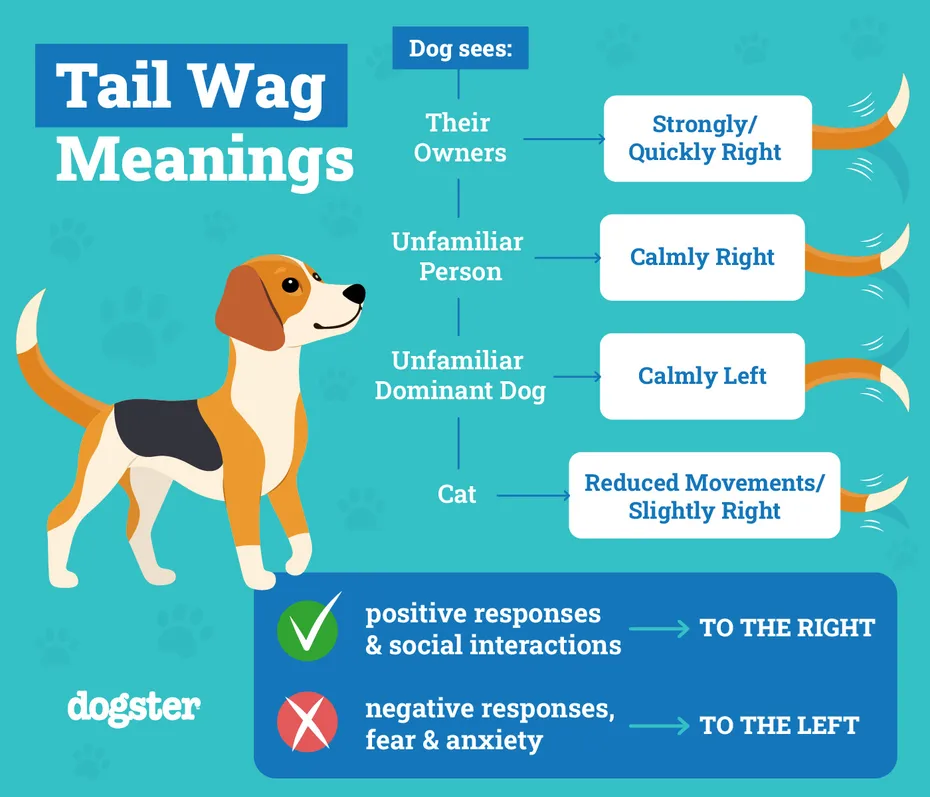
You are free to use this image but we do require you to link back to Dogster.com for credit

What Can My Dog’s Tail Tell Me About Their Feelings?

How your dog carries and wags their tail can be an important indicator of their current state of mind. For example, a dog holding their tail high and wagging it hard and fast is projecting confidence and a willingness to engage with another dog, possibly in an aggressive manner.

Dogs who hold their tails low and wag just the tip usually feel insecure or submissive. Tucking the tail hard between the legs is a common sign of fear in dogs.

Isn’t a Wagging Tail a Sign of a Friendly Dog?

This is a commonly held but not always accurate interpretation of a tail wag. A dog who is wagging their tail is simply indicating that they are prepared to interact with a person or another dog.

However, it doesn’t automatically mean the interaction will be friendly. You’ll need to rely on interpreting other body language from the dog to figure out if they’re friendly. For example, are the dog’s ears relaxed or pinned back? Are their muscles tense? Are their pupils dilated or small?
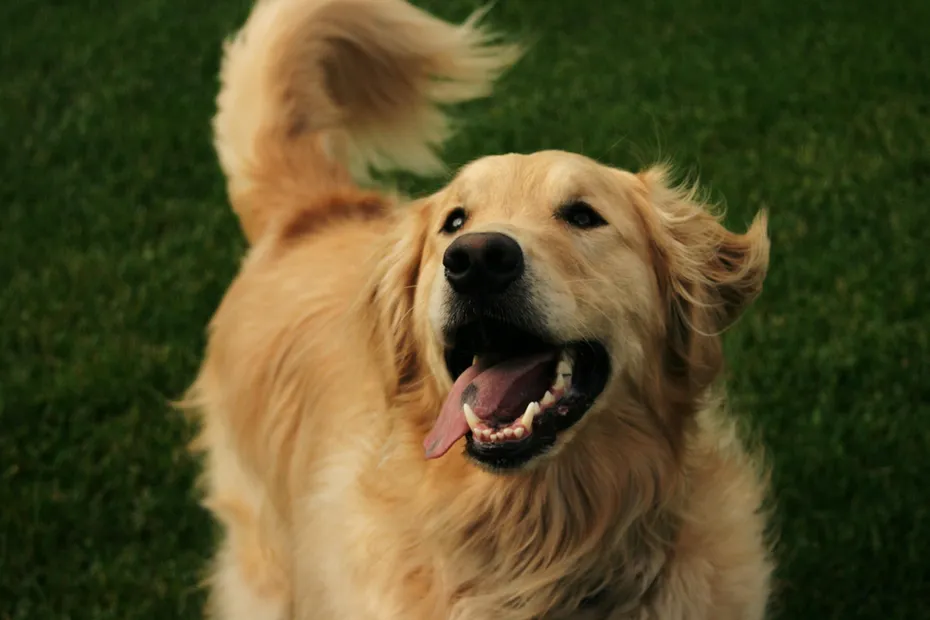
Image Credit: Aaron Pletta, Shutterstock
dogster paw divider

Conclusion

Dogs rely heavily on body language to communicate with each other, and tail wagging is just one of their tools. Scientists have learned that dogs can communicate by wagging their tails.

Learning to interpret the meaning of how and why dogs wag their tails in specific ways allows humans to interact safely with unfamiliar animals. It’s a helpful technique to prevent unnecessary bites or other injuries.

Sources

Featured Image Credit: ayorch, Shutterstock

The Dogster Newsletter

Expert dog care, straight to your inbox

News, insights, expert advice, and everything dog.

No spam — unsubscribe anytime.

By signing up, you agree to our Terms & Conditions and Privacy & Cookies Policy.

Click a star to rate. You can leave written feedback afterwards. (We read all feedback.)

Elizabeth Gray
Authored by

Elizabeth Gray

Leave a Reply

You're very welcome to leave a comment or question. Please know that all comments must meet our community guidelines, and your email address will NOT be published. Let's have a positive and constructive conversation.

What Does It Mean When a Dog Wags Its Tail? Vet-Reviewed Explanation

What Does It Mean When a Dog Wags Its Tail? Vet-Reviewed Explanation

When your precious pup wags their tail when you come home, it just means they’re incredibly happy to see you, right? But is this really the case? We often beli…

Genevieve Dugal
By Genevieve Dugal · 1 month ago
10 Fascinating Dog Tail Facts: Communication, Behavior & More

10 Fascinating Dog Tail Facts: Communication, Behavior & More

One of the main things people look at when engaging with a dog is the tail. It may be wagging vigorously, tucked between its legs, or resting still in the air.…

Nicole Cosgrove
By Nicole Cosgrove · 1 month ago
Why Do Dogs Wag Their Tails? 6 Vet Reviewed Reasons

Why Do Dogs Wag Their Tails? 6 Vet Reviewed Reasons

Most people assume that dogs will wag their tails when they’re feeling happy. However, dogs actually use their tails to communicate and express an even wider r…

Jessica Kim
By Jessica Kim · 1 month ago
Do Dogs Have Bones in Their Tails? Vet-Verified Facts & Info

Do Dogs Have Bones in Their Tails? Vet-Verified Facts & Info

A dog’s tail is a powerful communication tool, but it is also used to help keep insects away, spread their scent, and balance. So do dogs tails have bones? The…

Matt Jackson
By Matt Jackson · 1 month ago

Dog Communication & Body Language: 50+ Vet-Verified Signs to Understand

There’s not a pet owner among us who hasn’t wished their dog or cat could talk. We can communicate easily using complex verbal language, but dogs are limited t…

Oliver Jones
By Oliver Jones · June 29, 2026
Dog Communication & Body Language: 50+ Vet-Verified Signs to Understand

Do Corgis Have Tails? Vet-Verified Facts & Characteristics

Hold onto your hats because we're about to dive deep into the world of Corgi tails. Most people know and love these short-legged, poofy pups, but have you ever…

Nicole Cosgrove
By Nicole Cosgrove · June 17, 2026
Do Corgis Have Tails? Vet-Verified Facts & Characteristics

Understanding Your Dog's Ancestral Instincts: Vet-Verified Facts & FAQ

Dogs might be the most domesticated animals on Earth, but they are still deeply connected to their ancestral roots. It might not seem like it on the surface, b…

Oliver Jones
By Oliver Jones · June 17, 2026
Understanding Your Dog's Ancestral Instincts: Vet-Verified Facts & FAQ

Why Do Dogs Like Butt Scratches? 3 Vet-Reviewed Common Reasons

Who wouldn't like getting scratched in their favorite spot? When you are scratching a dog's hindquarters, it probably just feels so good to them! If you wonder…

Nicole Cosgrove
By Nicole Cosgrove · June 16, 2026
Why Do Dogs Like Butt Scratches? 3 Vet-Reviewed Common Reasons

How Is Being Cute for a Dog an Evolutionary Advantage? Vet-Verified Behavior Explanation

While beauty is in the eye of the beholder, most people agree that puppies are adorable. Something about their cuteness draws our attention, and you just can’t…

Jessica Kim
By Jessica Kim · June 16, 2026
How Is Being Cute for a Dog an Evolutionary Advantage? Vet-Verified Behavior Explanation

Does a Boston Terrier Have a Tail? Vet-Verified Breed Facts

Hailing from Boston, Massachusetts, the Boston Terrier is a small, cute dog breed that is known for its intelligence and loyalty. Strutting around with a tuxed…

Nicole Cosgrove
By Nicole Cosgrove · June 17, 2026
Does a Boston Terrier Have a Tail? Vet-Verified Breed Facts

Puppy Dog Eyes: What Do They Mean & What They Do to Us (Vet-Reviewed)

Any dog parent will tell you their pup is the cutest animal alive. However, the cuteness factor of a dog increases exponentially when they break out the puppy…

Misty Layne
By Misty Layne · June 17, 2026
Puppy Dog Eyes: What Do They Mean & What They Do to Us (Vet-Reviewed)

What Do Dogs Think About All Day? Vet-Verified Insights, Emotions & Body Language

Dogs communicate via their body language and various vocalizations. As a dog parent, you should become familiar with your dog’s body language, as it can tell y…

Kathryn Copeland
By Kathryn Copeland · June 17, 2026
What Do Dogs Think About All Day? Vet-Verified Insights, Emotions & Body Language

Love Dogs? So Do We! Join the Dogster Community

Stay informed with expert pet care insights delivered straight to your inbox! Discover professional guidance on animal behavior, feeding tips, trusted product picks, and much more.

You may opt-out at any time. View our Privacy Policy for more information.

The Dogster app on a phone